Kategorie-Archiv: diary

diary entries of Franz Ferdinand

At Sea to the Solomon islands, 5 and 6 June 1893

During the night from the 4 to the 5 June „Elisabeth“ had reached her Eastern-most point of the journey near the Loyalty islands — 167° 36′ longitude East of Greenwich — and at that time the course was set towards San Cristoval of the Solomon group. The wind remained fairly constant during the 5th so that there was still a heavy pitch but then relented on the 6th. The temperature on deck but especially in the cabins announced the approaching tropical region and the weather similarly changed in character on the 6th. The sky was often cloudy and rain storms came down with increasing intensity towards the evening.

During intense rain a large flock of terns (Hydrochelidon fuliginosa) was flying around the ship, some of which sat on the yardarm of the main mast and attracted everybody’s attention by their cries. When a sailor climbed up and caught one of these gliders of the air with his bare hands despite the great darkness, the terns startled by this circled again in the air and crashed into the foresail light as well as the two position lights. Two of the birds apparently much exhausted landed on the deck and were captured without effort.

We used the two days, as well as we could in this wind and weather, to package and store our acquisitions from New Caledonia as well as completing our diary entries.

Links

  • Location: At Sea to the Solomon islands
  • ANNO – on 05.06.1893 in Austria’s newspapers.
  • The k.u.k. Hof-Burgtheater is playing „Das Heiratsnest“. The k.u.k. Hof-Operntheater is closed from 1 June to 19 July.

At Sea to the Solomon Islands, 4 June 1893

Despite the program of hoisting the anchor already at 7 o’clock in the morning we had to delay the hour of departure for some time as, besides the collection gifted to me, a number of objects had to be loaded on board which the governor and his adjutant had sent like multiple logs of precious wood which the dispatch boat „Loyalty“ had brought back from a day trip as well as a collection of partly alive partly stuffed specimens of bird species present on New Caledonia etc.

Among the birds, a special mention is deserved for the broad-billed parrot as well as the kagu (Rhinochetus jubatus) that is restricted to New Caledonia.

During the billeting of the animals in cages three of the wonderful roseate cockatoos we had taken on board in Sydney unfortunately escaped. The fugitives flew, happy about their regained freedom, towards the land. As much as we felt sorry about this loss we had the satisfaction of maybe having introduced a delightful bird species to New Caledonia as the cockatoos should find a favorable environment here to multiply given the comparable climatic circumstances.

After the church service — it was Sunday — we steamed out of the harbor of Numea, while we were saluted by the French ships with the flag, with board salute shots and with triple shouts of Hurrah to which we replied also with the flag, salute and sideway shots. On the island of Nu a music band had taken up position and played our anthem which meant we had to reply out of international courtesy with  the Marseillaise — a drastic exchange: the noble sounds of „God save“ and as its echo the revolutionary song!

We set course along the South-west coast and the small offshore islands to the South-east so that the coral reefs remained to starboard and passed rapidly through the Woodin Passage between the island of Ouen and the mainland. In this small sea strait which is in some places barely a sea mile wide reveals a number of picturesque views  in front of the mariner’s eye. On starboard rises the island of Ouen in jagged contours, long red stripes betraying its wealth in iron rocks; on port the coast of New Caledonia rises covered in rich mostly tropical vegetation. In a dense tangle as a characteristic of this special plant region of this part of Melanesia grow the slender and soaring araucariae; also some huts and a small house become visible and bring a refreshing sign of life into the scenery.

The journey continues through Prony Bay, around the Southern point of New Caledonia past the sharply protruding Cape Ndua, then a turn to the Northeast through the Havannah canal and finally out of its numerous coral reefs and currents into the open sea, steering North in the direction of the Loyalty islands. In the evening navigating through these islands was quite difficult as the sky had turned cloudy, a heavy rain storm was coming down so that we could not see further than a few meters and thus had to reduce our speed even more as now precise soundings of the Loyalty islands existed and the sea maps were of little reliability.  Finally the moon appeared again and then we could pass the islands without problems. The wind came during the whole day from North and North-east and made the ship pitch mightily.

Links

  • Location: Next to the Loyalty islands
  • ANNO – on   04.06.1893 in Austria’s newspapers. The Wiener Salonblatt of 4 June informs its readers belatedly about Franz Ferdinand’s departure from Australia.
  • The k.u.k. Hof-Burgtheater is playing „König Ottokars Glück und Ende“. The k.u.k. Hof-Operntheater is closed from 1 June to 19 July.

Numea, 3 June 1893

For today there was a full program planned. In the morning at 8 o’clock the governor fetched me in his boat to visit the prison which was to be constructed on the island of Nu on the spot where the first penal depot had been built in 1864. Here the hard criminals as well as those who committed crimes during their time of detention which results in harder conditions or a prolongation of the sentence were to be kept. Furthermore the prisoners coming newly from France or from the colonies are to stay there until they can be distributed to the various places on the island.

After half an hour we landed at a garden which is assigned to the director of the establishment. It consists of a large number of large widely dispersed locations which we visited guided by the director. We started at a small barracks where a detachment of about 100 men of marine infantry under the command of a captain was staying. Then we had a look at various workshops where the prisoners performed various crafts such as a bakery, locksmithery, carpentry etc. In this prison too the prisoners are housed during the night in long rows of houses side by side like in Montravel. Only here the houses are surrounded by high walls. The middle of the housing complex was a place of execution where on occasion the guillotine is set up; all prisoners have to attend the executions on their knees while behind them the soldiers take up position with loaded rifles.

Above the prisoner houses rises a mighty building without windows in which small cells intended for the hardest criminals and namely the recidivists. These contain wooden beds with a blanket each to which the prisoner can be shackled with iron bars. To my surprise I found books in some of the prisoner’s cells. The director of the prison intends to house the hardest criminals in other locations without beds where the prisoner has to sleep on the naked ground and has no benefits at all.

The first cell whose iron door was opened for me held a six-times murderer whose fate rested on the outstanding decision of the president of the republic. When the governor directed a few questions to the prisoner condemned to death, he showed his bad behavior and answered quite impertinently. The criminal was shackled on one foot. The other leg which had been wounded by a revolver shot when he had attacked one of the guards was bandaged. A still young man of a strong almost Herculean build, the deported had started his criminal career by murdering his lover.

I had almost all the cells in the building opened and made the impression that the inmates showed without exception impertinent behavior which was evident in their answers. True criminal physiognomies that indicated crime and vice and made us realize that we faced the scum of the earth.

A part of the inhabitants of these houses  is awaiting their turn at the guillotine which was shown next. I had this earnest instrument of justice never seen before and could not resist an awkward feeling, due not in the least to the the cruelties of the large revolution which passed through my mind. The executioner, a former prisoner, a truly vile guy demonstrated how a criminal is tied to the horrible board and explained the mechanism of the machine. Finally he let the blade crash down on a reed bundle which was cut through by the impact of the falling executioner’s sword. This was accompanied by the vile man’s cynical jokes and smiling, he finally presented me with his photograph which had his name and the following words: „Executeur des hautes oeuvres“.

We visited also the magazine with all supplies and tools for road construction and then walked some kilometers to the hospital which was under the care of merciful sisters and held about 150 sick persons and is situated in a beautiful, healthy location at the edge of the sea. It was exemplary well run, especially concerning cleanliness and order.

Next to the hospital was an institution for the mentally ill with a large garden where these unfortunate humans seemed to be as well cared for as was possible. During my visit there were scenes similar to those in other mental homes. As all the poor ill persons approached us and gave speeches, presented themselves as kings of Spain and other countries, declared to be kept here illegally as mentally ill persons and uttered many words of sad mental state. One man who suffered from rage attacks of such an intensity that he could break iron bars that were as thick as a thumb showed me a nice blanket he had woven.

Leaving this dark place we drove in the barge and then with the wagon to the country retreat of the governor which was half an hour outside of Numea to attend here a Pilu-Pilu, that is a music and choreographic and warlike performance of the natives, in the honor of M. Gallet, the official in charge of native affairs. Under a tent that is usually set up on a place for lawn tennis games we enjoyed this strange but exciting spectacle.

Two groups of about fifty natives each from Montfaue and Huailu performed a funeral dance together accompanied by song. These groups alternated in the performance of a number of dances and then made room for the natives from Bai who also excelled in dance and song. The natives of Montfaue then sang a song that told about episodes and memories of the uprising of 1878, the year of uprising and war. In these fights the tribe of Unua fought on the French side. One of that tribe, a chief called Dui won fame by his audacity in the fight against the rebellious natives.

The members of each tribe distinguish themselves by their appearance from other tribes only in details. Their dances and songs are also similar. All actors, tall beautifully grown men, wore full war costumes with long spears and heavy clubs while the chiefs wearing many centimeters more of clothing than during the hunt yesterday were also armed with axes made out of serpentine stones. White cock feathers as well as combs stuck into the thick curly hair served as headdress.

The dances which were executed with a precision that would make any well drilled corps de ballet proud were accompanied by wild but at least rhythmic songs which included the singers convincingly imitating animal voices and sounds of nature. The choreographic productions — every single movement was executed by all dancers in sync — were partly funeral dances, that is religious ceremonial, partly war dances partly the illustration of emotions, actions, customs, machines etc. Thus one could see in an audacious step and movement: fruit bats, cattle, love, war canoes, a taro harvest feast, hunting, fishing, a free horse, the turning of a ship screw, a European threatening with his finger, a man with crippled arms, even the signals of a semaphore and surveying the land — for a ballet master a true treasure chest of surprising new effects.

In their songs these wild artists express partly harmless views and exhortations partly energetic inimical and bellicose thoughts and even examples of anthropophagous poetry. The latter was namely also the case in the sung episodes about the year 1878 of the Montfaue. Whatever the individual truth behind the content of these tales they were taken in their whole originality from the points of view of a primitive people and formed in a most naive way: „Prepare for the dance (Nipagüeü-nipagüeü)! — You are numerous, all begin! Dance the Nequipin! — Put a canoe in the river! — Have persons thin due to the inundation and his ship be carried away! — Prepare for battle! — Shout the war cry! — We want to kill chief Dui! — I will cut his brother Meino in two pieces! —“ etc.

The spectacle received great interest not only because it permitted insight into the importance of dance and song for these primitive humans as a means to express their desires, moods and feelings but also because these spectacles showed an excellent powers of observation and real talent to perform the noticed. They thus confirm the above average intelligence of the wild artists. Most remarkable was the endurance and the effort with which they danced and sang as well the rage that flashed in the physiognomies of the dancers.

The following spear throwing of the natives offered nothing exceptional as they were probably exhausted and excited from the dance so that many spears missed their target. The slinging of stones however was very original. The islanders put hard stones that they had sharpened at both ends into conical points into a twisted slip knot made out of fibers which they swung around in circles so that the stone escapes with speed and flies toward the distant target with force. The projectile flies hurling through the sky and penetrates even fairly think planks. These slings were once used as dangerous weapons in the never-ending fights between the different tribes.

This production was followed by a Pilu-Pilu native from Lifu, the largest of the Loyalty islands. The facial characteristics of these islanders who also have Polynesian blood mixed in are more beautiful than those of the natives of New Caledonia. They are also said to be more intelligent and more open to trade with Europeans than the latter. In contrast to the New Caledonians the  Lifuese were painted in the most flashy colors mostly vermilion and sky-blue. Even their faces had been fully covered and individual artists wore grotesque face masks. The Lifu islanders acted in two groups one of which performed a dance of the warriors accompanied by song. The other produced an episode of the family history of an old demon again with song and dance. The latter production starting with monotonous singing suddenly turned into wild pantomimic movements that however were executed only by a few artists while the others crouched or clapped hands and shouted.

This performance had an erotic character as it treated the kidnapping of the wife of an old demon by multiple young devils. These appear and try to lure the wife away from the old demon with all kinds of inciting tales. The old demon’s warning voice dies away in vain. „Come with us, our land is beautiful, and the paths that led there fine“ sing the young demons. After the fearful old demon’s „Don’t listen to them“ the flighty wife sings „I will follow you“, so that the old demon left alone can only ask the empty question „Where is my wife?“ and sadly answer in resignation „I have lost her..!“ The show would not have been suitable for ladies as the wild artists enjoyed their exuberant even unrestrained fantasies and many alternating songs especially that between the wife and the young devils left out nothing of comic and drastic matter.

Thus the program of the morning was complete. I then returned on board while my gentlemen ambled through the town and there made a number of purchases of ethnographic objects for me.

In the government building illuminated brightly as daylight by lampions and gas flames and whose entrance was a glittering triumphal arch, the governor hosted a gala dinner attended by about thirty dignitaries of Numea among them the bishop, the president of the council, the ship commander, the colonel of the infantry regiment, various councillers and other officials. In full concordance with the long duration of the hunting breakfast, the dinner lasted considerable time too so that after two hours no end was in sight. When the champaign was opened, the governor rose to offer a long but good and well received toast to His Majesty and me to which I replied with a few words. The dinner music was provided by a band composed of prisoners. As waiters too deported persons were used who probably had only been sentenced for small crimes and who wore immaculate livery appropriate to the occasion instead of prisoner clothing.

After the dinner which we left only at a late night hour, M. Picquie led me into a side room where he presented me a displayed collection of Kanak weapons and fetishes and to my pleasant surprise, to offer it, a kind act for which I am all the more thankful to the governor as this collection contains some pieces that are valuable due to their rarity and thus are a valuable enrichment to my prior acquisitions.

In the brightly illuminated garden a dance number by the Loyalty islanders was seen by a large audience as the governor had invited also the staff of Elisabeth“ and those of the French warships. The show resembled those in the morning only the wild men accompanied  their dances with sounds of somewhat primitive musical instruments, a kind of drum made out of leaves and plant fibers.

Then we said good-bye to the governor, assured him our vivid thanks for the most obliging and even cordial reception he gave us as well for his successful efforts to make our short stay on New Caledonia as agreeable and as educating as possible and repeated our large interest for this island.

Links

  • Location: Numea, New Caledonia
  • ANNO – on  03.06.1893 in Austria’s newspapers.
  • The k.u.k. Hof-Burgtheater is playing „Der letzte Brief“. The k.u.k. Hof-Operntheater is closed from 1 June to 19 July.

Numea, 2 June 1893

Today a deer hunt was to be organized. Everybody assured me that the territory was rich in game and thus the hunt promised excellent results. Even though I always am somewhat sceptic about such tales and promises in foreign countries, I was still full of hope to catch at least one specimen of the deer species introduced and acclimatized here. At dawn we set off from the board and met the adjutant of the governor at the landing as well as one of the highest civil servants who formerly had been resident in Tonkin and been assigned by the governor as his representative.

M. Picquie himself could not participate in the hunt as he had slipped and dislocated a leg while playing „catch“ with the young ladies during a garden party he had organized. Apparently the cause of his injury seemed to the governor not dignified enough to tell me and had instead communicated that he had fallen off a horse during a business trip and thus injured himself.

The company of the former resident of Tonkin by the way was very welcome as he could tell me during the drive many strange things about this country which had become important for the European Oriental politics and where he had lived for many years. We only had to cover 21 km but spent three hours as the horses were notable for their special slowness and the road went up and down the mountain.

The weather was agreeable, the temperature pleasantly fresh. We were now already in June, that is close to the coolest period in this part of hemisphere in which — in July and August — the average temperature drops from the annual average of 22 to 23° C during the day by 5 to 7° C, while it drops in cool nights down to about + 9° C.

The region we were driving through has a mostly monotonous character in scenery as the road goes almost always through the monotonous looking Niauli forests. Still there are changing and interesting impressions. Close to a saddle of a mountain which we had to cross there was an oasis amidst the Niauli forest with splendid almost tropical vegetation. We passed numerous settlements with large vegetable gardens and furthermore also hotels or more precisely road-side inns with proud names such as „Au rendez-vous des chasseurs“, „Hotel beau site“ etc. that offer the Libérés the prized opportunity to waste their small savings on drink.

The orange tree is growing splendidly here. Unfortunately, the golden fruits are fouling on the trees as it is not profitable to harvest them due to the impossibility of exporting oranges.

During the drive we saw few birds which was all the more remarkable as 45 species of birds were natives only of New Caledonia. I managed to observe only a small predator, then a kingfisher as well as a Myna and a few singing birds. Poorer still the country seemed to be as far as mammals were concerned. Apart from deer there seems to be only a species of fruit-eating  bat, large megabats (Pteropididae). This lack of large animals and the periodically recurring need for more substantial food than fish, megabats, rats, worms and snails is used by ethnographers to explain the native predilection for human meat suppressed not long ago.

The last part of the journey turned out to be very difficult as a large water pipeline was under construction for Numea and the iron pipes was just then being transported there.

Next to a small settlement we were expected by two gentlemen who led us on foot through a wide valley to the hunting ground. Here I had the first chance of seeing a large number of Kanaks who had been called out of the interior of the island to serve as drivers — beautifully built muscular men of a dark coffee-brown color with dense fully curly hair of a true Papuan character which they wore combed upwards. Their faces are not beautiful and raw, but show a certain intelligence in their expression. Clothing is limited to small waist belts. In contrast the Kanaks are all the more equipped with all kinds of ornaments which they carry as necklaces and bracelets made out of shells and footrings made by twisting megabat hair. As weapons they carry long lances with very original points as well as clubs made out of heavy ironwood that is found on the island.

The endurance of the natives at swimming and their skill in fishing are reportedly excellent. My informants claimed to have personally observed how these islanders had swum out two to three miles out into the sea and there threw out a fishing rod while „treading water“, then keep their catch under their arm and continue to fish until they had caught a sufficient number of fishes to return to land. The Kanaks are said to be highly proficient in guiding canoes and using them for fishing, a method much preferred to the just described fishing rod technique. It might well be possible that my informants had seen more than actually happened and that the fishermen stood on reefs and cliffs — not visible to the observer — below sea level and so on a firm setting could go after catching fish.

In total there are about 40.000 natives on New Caledonia whose race however is on the way to extinction as the numerous endemic and many newly introduced illnesses as well as the numeric gender imbalance causes their number to decrease year by year. The killing of new born girls is said to be widely practised. Women are also treated everywhere much worse and have to perform all the hard work. In earlier times, the population was reduced by the continued feuds between the different tribes where the prisoners and the killed were always eaten. Today the natives are more peaceful but withdraw from contact with the whites.

The civil servant in charge of the natives had set out with the drivers and posted us for the hunt at the foot of a hill covered only with grass behind which was a densely forested mountain slope. The islanders with their dogs were tasked to drive through these woods to force the deer to cross over the hills. This battle plan did not please me in the slightest and in fact neither were the drivers as well as almost all the natives that had before taken part in our hunting. They walked without order or plan during the drive, took up position on small hills or at the edge of gorges where they started shouting for extended periods while only a few drivers with dogs actually entered into the woods. The dogs still barked a few times but the hunt took another direction turned away from our position what was to be expected right from the start as the game in New Caledonia too shows no preference to cross into an open valley. All the more so as there was much noise behind us caused by the construction of the water pipeline.

Thus I sat there for a full three hours when suddenly but at great distance a spike was fleeing in front of me. I shot it, apparently a hit to the lungs but the deer stood up again and draw itself forward for a few steps to collapse in the high grass. As soon as one of the drivers had seen this, they all ran in the true sense of the word like wild men with great shouting to the deer that naturally again stood up and fled into the very dense wood pursued by the wild men and the dogs where one could hear their sounds for some time until the deer disappeared forever. From a true follow-up search one could naturally not speak and also a heartfelt request directed to the wild men to find the wounded animal in their own manner and kill it was in vain.

Thus the first drive was a complete failure even though the game was said to be plentiful which had been assured at the start of the hunt that the game was more like a plague on the land by their quantity in the woods and the fields. As usual in such cases the hunting masters were certain that the failure of the hunt would have been successful at an earlier hour or if executed as a chase — an insight that came too late. As I would have put up no resistance to start the hunt earlier, I would even have started our journey after midnight if necessary.

Unfortunately a straight continuation of the hunt was impossible as the governor who had followed us was awaiting us in a settler’s house close by for an opulent breakfast which consumed a full two hours as the majordomo and liveried servants presented a never-ending series of dishes and wines. As well meant this feast had been I still considered it a waste of time — sitting on pins and needles — and would have preferred to use the time for hunting or  collecting beetles and butterflies, with one word more purposeful as I had only a few days to visit the interesting island in the midst of the South Sea which I would never see again in my lifetime. I had not come to spend hours eating at a table! After the end of the breakfast I hoped to be released  —  but not at all. A Hiob’s message arrived that the dogs of the drivers had been lost and the hunt could only be continued after the dogs had been caught again. With the exception of my gentlemen all participants of the hunt seemed to e relieved and continued to eat until they finally managed to recall the dogs to duty late in the afternoon.

Finally a new drive started from a hill that was densely covered in ferns. The local islanders may be really honorable people and have all kinds of good qualities but driving and hunting they completely fail to understand. The dogs soon barked and one could see soon thereafter some great game run through the bushes. Unfortunately the unlucky drivers had noticed the deer too and now all ran in the direction of the game with cries. The deer naturally broke in the opposite direction which made the drivers happy and shouting and gesticulating in front of my position  perform some kind of war dance.

As I lacked the possibility to express my opinion with some native strong or swear words I slung my rifle on my back in my helpless anger and turned away from this „wild, daring hunt“ to the wagon where I received the message from the fast following hunting master that just now four deer had crossed at the position I just had vacated. I did not doubt the truth of the appearance of the deer which might also only have shown up to restore the honor of the hunting master but did not change my direction to return to the position and started calmly my homeward journey.

This partly compensated for the failed hunt. Driving between the high mountains surrounding the valley, we enjoyed the vivid color effects produced by the rays of the setting sun on the mountain slopes; The Niauli trees glittered in a blueish color next to the clefts and bare areas which glittered metallic and were glowing red due to the rich iron content in its rocks.

At a late hour we were back on board of „Elisabeth“ which its commander followed by my gentlemen and a number of officers soon after left to attend a dinner given by the officers of the French armored ship „Thetis“ on its board while I stayed home.

Links

  • Location: Numea, New Caledonia
  • ANNO – on  02.06.1893 in Austria’s newspapers.
  • The k.u.k. Hof-Burgtheater is playing „Der Meister von Palmyra“. The k.u.k. Hof-Operntheater is closed from 1 June to 19 July.
Numea, 1 June 1893

Above the island of New Caledonia lay heavy clouds which blocked the lighthouse from our view during the night and made navigation more difficult for „Elisabeth“. Taking the bearing of Mount Mu showed that the ship had moved far to the South during the night. The position had to be corrected and course set for the lighthouse of the small island of Amédée which we sighted towards 8 o’clock in the morning. The wind and the motion of the sea had much diminished and in time the sun broke through victoriously so that the contours of New Caledonia with its high mountains became clearer and clearer appearing out of the calm waves of the ocean. Towards 9 o’clock in the morning „Elisabeth“ was in front of the Bulari passage where we took the pilot called from Amédée on board and then we drove between the reefs which accompany New Caledonia along the Northeast and Southwest coast with only a few breaks in between and reach out far in the North and South as well as through the small green islands of Brun and Dubouzet.

After we had celebrated the feast of Corpus Christi with service in the battery, the ship was moored at half past 10 o’clock in the morning in the inner harbor of Numea at the Messageries maritimes buoy offered by the harbor captain.

New Caledonia generally comprises the whole archipelago. This includes the main island discovered in 1774 by Cook and named in the honor of North Scotland New Caledonia, the  Loyalty islands Mare, Lifu, Uea and Beaupre islands to the east discovered in 1795 as well as L’Île-des-Pins, Southeast of the main island, and finally the Chesterfield islands to the West. New Caledonia and the Loyalty islands together include an area of 19.823 km2 and 62.752  inhabitants according to the census of 1890.

First colonized by English merchants and missionaries, New Caledonia and the Lifu group of islands were declared French territory by admiral Fevrier-Despointes in 1853. The actual permanent French governance over the long resisting natives only happened after the subduing the insurrection of 1875 to 1878.

Earlier ruled by the governor of the islands of Tahiti and the Marquesas, the colony called „New Caledonia and dependencies“ has its own special governor since 1860 with his seat in Numea, while the main French settlement used to be Balade in the Northeast of the island from 1853 to 1854. New Caledonia is darkly notorious for its penal colony. Even though there had been prisoner transports to here earlier, only the internment of multiple thousands of criminals in the year 1871 made the island notable for a wider audience.

The island of New Caledonia lies to the East of Australia between 20 degrees latitude and the tropic of capricorn. Its width is relatively small compared to its length of 440 km. The coasts are accompanied by mountain ranges consisting in the South-east of Mont Humboldt, 1634 m. These mountain ranges drop off sharply in the North-east to the sea, while in the South-west coast there are plains between the foot of the mountain and the beach.

The entrance to the harbor offers beautiful sights even though the scenery of the landscape we were seeing can not match those of Port Jackson. The harbor of Numea is formed toward the West by a tongue protruding into the sea on which sits the town of Numea. Towards the East the harbor is closed off by a number of small islands. Here too the view passes over picturesque bays that reach deeply into the land up to the foot of the mountains like Bulari Bay in the East and Dombea Bay to the Northwest of Numea. The Mont des Sources at 1025 m and Mont Dore at 775 m are the most notable mountains.

In the harbor anchored the armored ship „Thetis“, the transport dispatch boats „Durance“ and „Scorff“, as well as the dispatch boat „Loyalty“ and the English cruiser „Tauranga“. Our territorial salute was answered by a land battery at a very slow pace — the individual shots happened after long intervals. While mooring the ship at the buoy, a small incident took place. A steam barge bringing baggage to „Elisabeth“ collided with the ship due to its clumsy maneuvering throwing one man out of the barge into the sea. But he was soon thereafter fished out of the water with a hook.

The town of Numea, even though it is situated in picturesque surroundings, presents naturally not improved by the fact that one can see from the ship the purpose of the town as the capital of a penal colony. Along the bay are groups of small houses and prisons with high walls. Whole columns of prisoners clad in denim and protected effectively against the sun with large straw hats are working on the construction of a quay.

When we were moored, the commander of the dispatch boat „Loyalty“, ship of the line lieutenant Louis Lucas, appeared first to offer his services, then came governor M. Albert Picquie to welcome me in the name of the colony, accompanied by the commander of the land and naval forces as well as the commander of the warships, and to discuss the program of the coming days. The governor seemed to be not very pleased himself about the country that he had to govern as he repeatedly said that I would be disappointed in all aspects.

An hour later I returned the visit of the governor in his small government building which lies about in the middle of the town on a hill and is surrounded by a garden where a statue of liberty causes an artistically not really beautiful impression that stands in a rather stark contrast to the purpose of the colony. The parlors of the building are large and paneled with local wood. The governor must be an animal lover as an important number of large cages with parrots and pigeons was in the garden of the residence. Deer too could be seen whose species seemed to me to be different from those on Java.

Accepting the invitation of the governor to visit the surrounding of the town I drove in his company in a four horse carriage whose horses alternatingly became lame first to Montravel, where a prison is located for housing prisoners working in the town and the surrounding areas during the night. 50 men each occupy one house where each man is assigned a hammock. On a plank above them the prisoners could store their possessions. Between the houses of which there are I think twelve small patches of vegetable gardens are set up as well as guard houses and a kitchen.

I was very astonished about the great quantity of food the prisoners received daily. They get coffee in the morning, meat with vegetables at noon and in the evening again vegetables. It seems to me to go too far to provide these jailbirds as far as food and board is concerned as well if not better than the soldiers. My astonishment increased when suddenly a music band appeared that was constituted by 40 prisoners and welcomed me with a fast played waltz by Strauß. This musical assignment not compatible with the idea of punishment I can not approve. Apart from everything because these musicians by performing their musical activities are spared from having to do any hard labor.

In total there are about 8000 prisoners on the island who are mostly building roads but also assist in mining the large nickel mines. Regarding the local distribution and occupation one distinguishes more or less three kinds of prisoners:  Those coming directly from France or the colonies who are immediately put to work at the different places of the island. Then there are those deported who commit new crimes on the island and were sent as die-hards to the actual main depot on the island of Dubouzet or Nu. Finally the so called Libérés who had already completed their sentence but were not allowed to return to France. The latter enjoy almost a state of liberty but are still under political surveillance and had to report to the government on certain days. Prisoners who were sentenced for eight years are not allowed to return to their own soil. Those sentenced to less than eight years may return home after the double number of years. The largest contingent of the deported are naturally made up by the French, but there are also among the prisoners  numerous Arabs from Algeria as well as prisoners from Tongking. Discharged NCOs of the French army serve as guards.

The governor made many surprising remarks to me about the state of the penal colony. He is only in office for half a year and seemed to be a very energetic man who shares my opinion that humanity towards criminals individuals among the categories of the deported gone too far has bad consequences and at the same time seems to be unjust towards the decent elements of society. The predecessor of M. Picquies seemed to have acted with extreme mildness and established the principle that prisoners should not be forced to work which had the result that most refused to work. Naturally under such a forgiving rule there were a number of abuses. The patriarchal state that came to be is shown by the fact that the criminals erected triumphal arches to the former governor when he made inspections with the letters „A notre père“. The life of the prisoners were quite nice.

When these conditions were finally noticed and the newly installed governor had reined in these practices, he was met with much resistance. The prisoners were no longer used to work. It even happened that some prisoners gouged out their own eyes in order to not having to work. The governor countered by sending those who had gouged out their eyes into the mountains to have these immolators cut stones for ten hours per day — a drastic proceeding that taught the other prisoners a most healthy lesson.

When he came into office M. Picquie had two of the worst criminals and gang leaders decapitated what however made the colonial council advising the governor anxious with concerns. It thus vetoed the death penalty when the governor again wanted to condemn a criminal to death who had already murdered six persons and finally tried to kill a guard so that the governor was required to appeal the decision to the president of the republic. No decision had been made during our stay here.

Our drive now turned to the interior of the island along a beautiful road that crossed a swamp thickly covered with mangrove bushes and then along the foot of the mountains in an Eastern direction towards blue-green Niauli forests in which we found individual araucariae and coconut palms. The Niauli tree (Melaleuca viridiflora), a Myrtaceae species with a crippled trunk, covers nearly the full island and gives it a character that is reminiscent of Australia. Out of the Niauli tree oil is collected which is similar to the cajuput oil produced by Melaleuca leucodendron in chemical composition.

Along the road one finds everywhere small gendarmerie barracks and posts whose garrison keeps up the order among the working prisoners as well as the policmen’s houses or more exactly huts who are recruited from the native Melanesisan population which is mixed with Polynesian elements. If a prisoner escapes to the endless forests of the colony, something which happens fairly often, then it is these native policemen who track down the fugitive with their fine senses and return them — actually only as a dead body. Fleeing prisoners either die of hunger or are murdered by the hand of the natives as the government pays out a prime of 25 Francs for each escapee dead or alive. As the natives find it much more convenient to return but the cut-off head than the live prisoner, this is the consequence. As incredible as it seems given the about 1600 sea miles of distance between the colony and the closest point on the mainland — Brisbane, there are a few but mostly just a few cases where prisoners managed to escape successfully from New Caledonia.

We also passed the nice settlements of the Libérés. But the settlements of free European colonists are rather scarce on the islands despite all the efforts of the French government to support such settlements, as any respectable man understandably is reluctant to permanently settle on this island dedicated to criminals or stay as soon as he knows about the actual state here.

The governor deplored that this beautiful island with its good and healthy climate, its productive soil and the rich mineral wealth — gold, copper, antimony, cobalt and especially nickel — is in fact renounced from being settled by free colonists and thus lies bare in such a large part. Even though the conditions are met both for the growth of tropical plants — the cultivation of cotton, maize and coffee is growing— and the growth of temperate plants, agriculture is not at a higher state than negligently managed  cattle breeding so that the island is still today dependent in many relations on imports from Australia. Great care is given by the natives who prefer to eat plant matter to the cultivation of taro (Colocasia antiquorum), yams roots, sugar cane etc. By the way the development of the island lets as far as the roads and other public works are concerned much to be desired according to the opinion of neutral observers. In France the reasons are said to be well known that currently hinder the full development of New Caledonia and there exists an intent to send the deported in the future to Cayenne so that respectable members of society can be added to the population of New Caledonia.

In a small valley we passed a Catholic mission not far away from Numea which was led by French nuns who made it their task to educate the native children. The mission does much, like the twelve other ones on the island to raise the moral and material level of the native tribes that not long ago practised cannibalism. Instituting missions seems to be very common in this French colony and show beneficial effects. As all natives on New Caledonia who adhere to Christianity are of the Catholic faith, while the number of Protestants surpasses the Catholics on the Loyalty islands where evangelical missionaries had been at work since 1840.

Turning towards the city we ascended a steep path that offered a beautiful view upon the distant coast,  Mont Dore and the small islands of the Bulari Bay.

The artillery horses of the battery of Numea drawing our wagon did not seem to be used to this task. Soon after the departure, they already showed signs of exhaustion and had reached the end of their strength when we wanted to ascend the mountain. They could not be moved by any means and we had to leave the wagon and continue our drive in another vehicle.

The regularly organized streets of the town intersect at a right angle. The houses are small, ugly and visibly built in a haste. The general view of the town is overall a melancholic one. Everywhere one meets the long columns of prisoners marching in pairs to an from work, many of whom are in chains for having attempted to flee or disciplinary offenses etc. There is not much life in the streets only a few Europeans and now and then a few natives become visible. Numea has besides the governor’s mansion also a large military hospital, two barracks, one of which is occupied by a marine infantry regiment the other with artillery, as well as multiple schools and depots. A beautiful church is being constructed and is nearing completion.

Returned on board I enjoyed a splendid evening with a gorgeous full moon glitteringly mirrored in the calm sea. Agreeable cool air fanned the brow. Now and then the calls of the guards on the warships could be heard by us. From the Place des Cocotiers, however, where our music band was giving a concert the noble sounds of our anthem rang out which was repeated no less than three times due to the roaring demands of the numerous audience.  For a long time I remained on deck, lost in my thoughts.

Links

  • Location: Numea, New Caledonia
  • ANNO – on  01.06.1893 in Austria’s newspapers.
  • The k.u.k. Hof-Burgtheater is playing „Der Meister von Palmyra“. The k.u.k. Hof-Operntheater is closed from 1 June to 19 July.
At Sea to Numea, 29 to 31 May 1893

On the high sea, direction New Caledonia. The wind blew continuously from North or North-east, piling up long mighty waves of the Pacific Ocean that hurled our brave „Elisabeth“ up and down like a toy. Especially uncomfortable were the heavy blows of the high sea against the protruding bays of the fore barbettes and on the gun batteries. These impact sent shock waves through the whole ship so that everything not fixed in place had to be tied down.  The living sea sometimes extended itself up to the forward tower and the iron deck was often completely under water.

All that breathed in the rosy light was more or less sea sick, even I who had up to now always shown resistance was affected. Even the menagerie whose numbers had been much increased in Sydney was suffering greatly under the effects of the bad weather. The two monkeys, namely especially Fips, became totally melancholic. The billy goat pressed its body sadly against one of the guns. The wild boar, the wildcat and the squirrel from Singapore refused to eat.

The least concerned seemed to be the mood of the birds if the endless spectacle they caused in the lower deck which robbed our poor commissary officer of sleep of  of sleep is not interpreted as an energetic protest against the persistent storms. The cockatoos, parrots and laughing jackasses were the lead voices in the choir in this savage concert.

During the whole trip the Pacific Ocean felt no compunction to honor its name and show us mercy. The moods were depressed by a dark melancholy which was only lifted by talking about the beautiful stay in Sydney and lamenting about being forced to leave the splendid calm harbor only to drive out into the stormy waves of the great ocean.

Numerous albatrosses, those huge storm birds, were flying  now and then close to the ship as if they wanted to jeer us by their show of beings that enjoyed it when the heavy winds were sweeping the sea. I let them be and did not shoot at them as the heavy sea would in any case not have allowed to send out a boat to bag the catch.

Links

  • Location: at sea to New Caledonia
  • ANNO – on  29.05.1893 in Austria’s newspapers.
  • The k.u.k. Hof-Burgtheater is playing „Der Richter von Balamea“. The k.u.k. Hof-Operntheater is performing Mozart’s opera “Don Juan”.

At Sea to New Caledonia, 28 May 1893

The sky was overcast with low hanging clouds out of which was drizzling gentle rain — „just the right weather to say good-bye“. Our mood was just as sad. We all were in a depressed mood — what is called at home a „moral hangover“ — faced with the necessity of leaving Sydney that has been such a kind host and its inhabitants who had been so nice and have received us so cordially. After the muggy heat of the tropical regions we had found here a climate that resembled the one at home. We were favored with splendid weather in all aspects as well as during the hunting expeditions into the interior of the country. Admired for its size and delightful because of its lovely surroundings, Sydney has made an indelible impression on us. All Australians, first amongst them the inhabitants of Sydney, whom we have come into contact knew how to capture our heart by their gentle affectionate way so that we have declared them as our special favorites — no wonder we had such difficulties leaving this Benjamin of continents!

It is an eternal pity that Australia has been felt in old Europe only by its increasing influence in many economic activities as a already notable competitor while its intimate advantages are so little-known and appreciated what however hardly can be different given the brutal distance. Thus I might compare Australia to a human who is not easy to approach and only shows its rough side who however reveals to those who are able of coming closer its felicitous amiable character.

Even though we had hoisted the anchors early — at 7 o’clock in the morning — the windows of all houses and villas were densely packed with our friends waving handkerchiefs and sending good-bye greetings. While passing the flagship „Orlando“ its band played our anthem while the music band of „Elisabeth“ replied with „God save the Queen“; the Spanish sailing corvette „Nautilus“ signaled „Happy voyage“.

We had hardly left Port Jackson and lost sight of Sydney, when a hard North wind blew against us and made the sea choppy, so that „Elisabeth“ soon started pitching heavily. At first we drove alongside the coast but then took a North-eastern course and soon the last part of the Australian continent disappeared into the ocean.

Links

  • Location: at sea near Australia
  • ANNO – on  28.05.1893 in Austria’s newspapers.
  • The k.u.k. Hof-Burgtheater is playing „Das Heiratsnest“. The k.u.k. Hof-Operntheater is performing Verdi’s opera “Aida”.

Sydney, 27 May 1893

All Sydney today was talking only about the ball of the „Austrians“. In the streets, photographies of „Elisabeth“ were sold; the newspapers devoted multiple columns to reporting about our party and our cabin was overflowing with flowers which ladies had sent on board. Some ladies were said to have planned to send a delegation on board — led by a particularly beautiful spokeswoman — in order to effect a delay of departure for „Elisabeth“. Unfortunately this flattering request could not be granted due to the strictness of the travel itinerary from which we had already departed by extending the stay in Sydney harbor. I believe that nobody on board the ship would not have heartily welcomed to extend the stay in gorgeous New South Wales and namely in happy Sydney. Everywhere there was hope said as a joke that machine damage would force a prolonged stay which was not possible according to the official program. Various ladies were under suspicion — if the gossip were right — to have tempted our engineer to cause such machine damage.

I used the last day of our stay in Sydney for visits and shopping. I also went again to the museum to look more closely at the in fact interesting collection of ethnographic objects of the native territories of Australia and the South Sea. Apart from numerous weapons made only out of wood and cut stones as in those territories iron is partly unknown I also found as original as horrible dance and war masks. Many of these had been made out of human scalps and in many territories it was common to use parts of the slain enemies to produce various objects such as jewelry, hollow ware, weapons etc.  Martial decorations, products of a very primitive local industry and a whole collection of canoes with carved and painted oars offer a good image of the cultural level of their creators. I also browsed through the bird collection to determine more precisely various species of which I had bagged individual representatives during the hunting expedition in the country.

I managed to buy a large part of the ethnographic objects of a private collector whose objects exclusively were made by the original inhabitants of Australia called „Aborigines“ who are at the lowest cultural level and are in the way of dying out. In 1891 there were in total 8280 „Aborigines“ in New South Wales — 4559 men, 3721 women — who stood under the protection of a special association called „Aborigines Protection Society“, that was tasked to civilize as far as possible the former masters of the land and to atone for many of the atrocities inflicted upon them.

During the dinner we took again in the excellent Australian Hotel a funny scene happened which was typical of the naivety and also confidingness and, I might say, cosiness here and thus merits to be remembered. While I sat at a table with Clam and Sanchez, two well dressed gentlemen approached, introduced themselves as owners of a Sydney company and asked pointing at me whether I were the prince. When this was answered in the affirmative, they requested to shake my hand and when Clam indicated that this was not proper, they requested that I at least take a drink to their health — an impertinence that I however still complied with due their entertaining originality after which the satisfied gentlemen calmly went away.

The evening we spent in a circus that had arrived in Sydney two days before. It offered, filled to the last densely packed seat, performances that one had to appreciate even though one could naturally not expect anything new in this much practiced art. A special mention deserves an Aboriginal boy captured in the interior of the land who had accepted his new fate and showed feats of astonishing skill. The condition and quality of the horses however left much to be desired. During a break the director came to me to invite me to visit the stables where he proudly presented me two horses with special consideration as these animals the director valued so much had been ridden by Sarah Bernhardt. It seemed that the circus master qualified this as a special sign of the horses‘ talents for their current occupation. That actress was doubtless more familiar with tragedies than with horseflesh. Her former chargers were quite nasty and rich in flaws.

In his tent the director presented me — what turned out to be no less comical — one after another all his male and female artists whose colorful but quite used costumes ornamented with all kinds of glitter were a strange enough contrast to the artistic self-esteem expressed in the faces and stature of this masters and mistresses of their trades. Among the ladies the snake girl was especially notable for her pretty face. A fast steeple chase ridden through the whole circus which included a few good jumps concluded the show.

Links

  • Location: Sydney, Australia
  • ANNO – on  27.05.1893 in Austria’s newspapers.
  • The k.u.k. Hof-Burgtheater is playing „Faust“. The k.u.k. Hof-Operntheater is performing the ballet “Die goldene Märchenwelt”.

Sydney, 26 May 1893

At 2 o’clock in the morning we steamed out of Moss Vale and towards Sydney. Despite the severe cold and the bad bed I slept splendidly. We had made good use of the day before being on foot without interruption from 6 o’clock in the morning to midnight.

I found everybody on board very busy with decorating our ship most brightly for the ball in the afternoon, the officers and the men competing in the effort. Tents had been set up on deck, electric lighting effects prepared, flowers, plants, flags and carpets lay ready to be used for decorative purposes. As much as the noise caused by these preparations permitted, I tried to sleep a little bit longer, and then drove towards 10 o’clock on land where the kind minister of education was waiting for me to watch a demonstration of a machine shearing a sheep. Even though it was not the season for such a procedure, one of the big wool companies had set up one of their machines to show me the procedure — a sign of the friendly reception we enjoyed everywhere in New South Wales.

The sheep shearing machine was similarly constructed as our horse shearing machines and are powered by steam and work exceedingly fast without harming the animal in the slightest. Something that happens very often during a manual shearing. Furthermore the resulting wool is very smooth and it shears off everything to the last atom. A man is capable to shear 120 to 150 animals per day. The highest performance that a very skillful and worker is capable of achieving is shearing 200 sheep. I tried personally to shear a ram and thus was able to personally witness how simple it was to handle the machine and how splendidly it worked. My example found many imitators among my gentlemen and other spectators so that the elegantly dressed group of gentlemen engaged in shearing sheep provided quite a comical sight. In the large magazines of many floors we passed through are stored many thousands stapled wool bales awaiting to be shipped out, representing an enormous capital value.

From here the minister accompanied me to a large meadow in a public garden where the natives were to demonstrate throwing boomerangs and spears. A black man from Western Australia, a truly hideous sight, demonstrated this art of his people in throwing the boomerangs made out of iron and wood and shaped like a scythe in different manners so that they always returned to him. Soon these projectiles rose straight up into the air, rotating constantly, soon they formed a circle or an ellipse and fell down at the feet of the thrower. Then they flew for an extended distance swooshing a meter above the ground only to suddenly rise high up etc.

Finally the Australian discus thrower threw two boomerangs at the same time in opposite directions, so that their paths crossed before they returned to him. A correctly thrown boomerang kills a human due to its enormous flying speed. The long distance spear throwing was as interesting. Even at a distance of 200 paces the thrower was very accurate in his throws.

An object of great pride for Sydney is its art gallery whose collection has only started a few years ago, and I gladly followed the desire of the city to pay it a visit. As neither effort nor cost have been spared for the acquisition of art works, the gallery already contains a great number of sometimes very remarkable pictures.

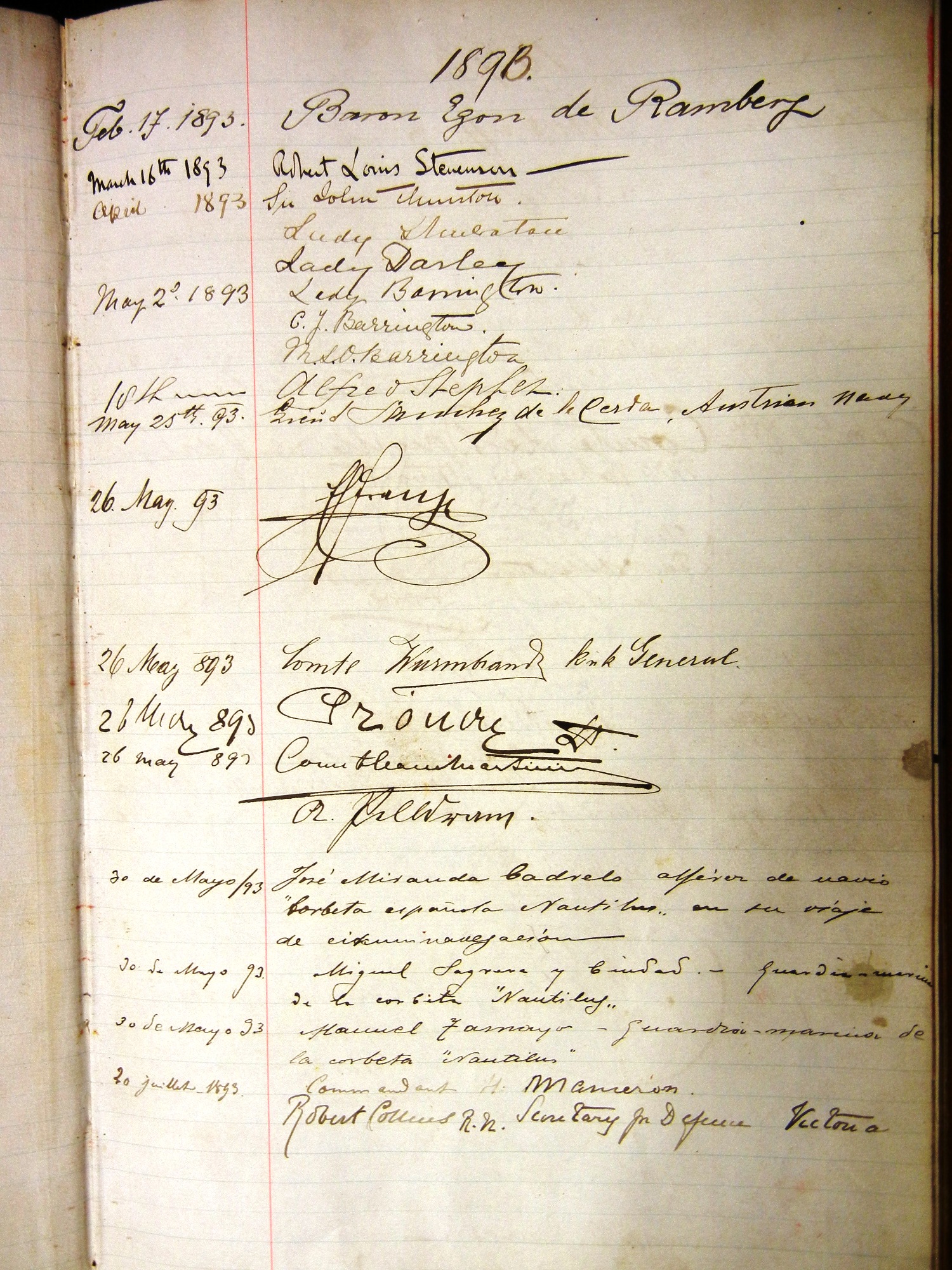
The signatures of Franz Ferdinand and his gentlemen Wurmbrand, Pronay, Clam-Martinic in the visitor's book of the Art Gallery of New South Wales in Sydney, Australia. Courtesy of the museum.

The signatures of Franz Ferdinand and his gentlemen Wurmbrand, Pronay, Clam-Martinic in the visitor’s book of the Art Gallery of New South Wales in Sydney, Australia. Courtesy of the museum.

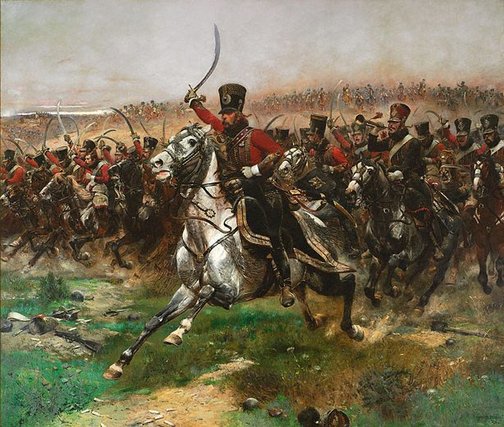
I found here many works I already knew from the exhibitions in the Viennese Künstlerhaus. Especially an impressive battle painting by Detaille caught my eye, a cavalry attack of French hussars in the year 1809 [actually 1807] which has recently come into possession of the city.

Edouard Detaille (France 05 Oct 1848 – 23 Dec 1912): Vive L'Empereur - Charge of the 4th Hussars at the battle of Friedland, 14 June 1807, 1891.

Edouard Detaille (France 05 Oct 1848 – 23 Dec 1912): Vive L’Empereur – Charge of the 4th Hussars at the battle of Friedland, 14 June 1807, 1891. Art Gallery of New South Wales

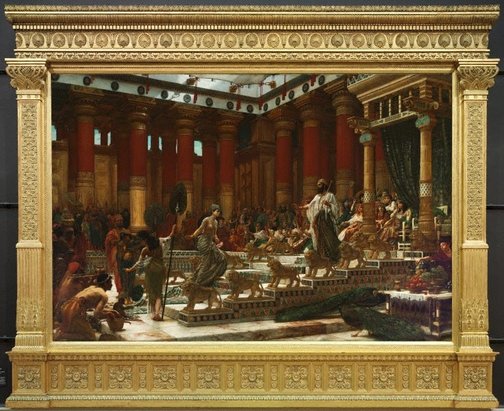
Then a much admired picture of the Queen of Sheba’s visit to Solomon, in which the figurative part is well done, namely the queen whose dress the artist has seemingly interpreted quite freely. Otherwise the picture makes, for my taste, a too colorful, given the richness of the colors an almost screaming impression.

Edward John Poynter (England 20 Mar 1836 – 26 Jul 1919): The visit of the Queen of Sheba to King Solomon, 1890

Edward John Poynter (England 20 Mar 1836 – 26 Jul 1919): The visit of the Queen of Sheba to King Solomon, 1890, Art Gallery of New South Wales

The most modern aberration, open-air painting is represented by audacious master works, while among the pastels there are only few of them but those of a very good standard. It is worth mentioning especially a study, the head of a young girl. In the comprehensive and quite solid water colors department, landscapes are given prominence.

The visit to the gallery demonstrated to me that in Sydney there is much interest and understanding for art so that the city will soon own a very comprehensive collection of high artistic value if it continues to follow its current path.

Breakfast was eaten in the formidable Australian Hotel whose director, a Saxon, asked us after the lunch to go up to the tower of the hotel to enjoy a truly splendid view of Sydney and its suburbs. From a bird’s perspective Sydney impressed me by its large extended area. The city lay in front of us like in a large scale painting surrounded by a ring of hills, gardens and bays, coming alive by the stream of humans and vehicles. Unfortunately we could not enjoy this view for long as it was time to return on board where the last preparations for the ball had to be made.

After 2 o’clock the ship was in full gala. Everything was ready and we could calmly await the arrival of our guests  as the artists on board had exceeded even our audacious expectations and the ship indeed looked most splendidly. The middle deck had been transformed into a richly decorated ball room by the erection of a tent in which were placed flags, palm trees and other plants. The interior was ornamented with blue-white linen, while the outside ship parts on deck were covered with black and yellow canvas. This produced a very friendly and cheerful impression. For the music band a high stand had been erected above the stairs and the bridge from which both our, the English and the Australian coat of arms were displayed while the companion deck was surrounded by small tables as it was intended as a buffet for the dancers. All kinds of objects had been transformed into elegant seating furniture. Even the large carpet covered containers in which the corals collected on Thursday Island were stored in water had to serve as canapés.

In a lovely way the iron deck had been turned into a saloon. Heavy carpets lay on the floor and a dense wall of palm trees and flowers closed off the room towards the exterior. in each corner were spots that invited tired dancers to rest there while in the middle of the saloon a happy spring fountain splashed water out of a tuff basin. Strange in the midst of this room dedicated to a happy conviviality stood out the large 24 cm gun — an earnest contrast to the cheerful event that was soon to happen here.

In the battery was a buffet for the older gentlemen and the non-dancing members of society. The prepared large buffet in the officer carré however was only to be opened after the cotillion to provide ample refreshment to the hungry and thirsty on small tables. My saloon was serving as a wardrobe. The cabin of the captain as the ladies‘ wardrobe. Here only we had the assistance of a woman, a marchande de modes who was in charge of arranging the dresses and assist the ladies. Everything else, even the binding of the flowers and the most delicate decorative embellishments had been prepared by the rough sailors‘ hands. Our cook Bussatto was in charge of all buffets and displayed all his art — this time in good mood which was not always the case with him — most brightly exploring all his culinary fantasies. A legion of bowls of cold dishes that he had given the most varied perfectly executed were standing on the tables: rigged ships whose full sails were imminent for departure, palaces, basins with fishes, crowns, all kinds of imaginative land and sea monsters stood in a colorful row, so that the buffets almost resembled a toy store. Our Mahmood was at the head of a group of sailors acting as cupbearers and waiters. In his gold laced gala uniform he was an object of interest for all guests and he appreciated the curiosity especially of the ladies with a dismissive grin.

With uncommon punctuality the arrival of the guests started at 3 o’clock partly in our barges and boats that we had sent out to land, partly in their own vehicles. To send out the invitations we had asked an English admiral who knew Sydney’s society more closely than we and only limited the number of invited guests to 300. Soon, however, there were 500 guests on board as many of the invited had taken relatives along.

We however were not displeased as the ship had the capacity to easily host all those who had come on board and had considerably augmented the ring of beautiful dancers. Apart from the most honorable dignitaries of the city almost only ladies and gentlemen eager to dance had come and I have to admit that I had never before seen so many beautiful girls and ladies assembled on a ball. The ladies of Sydney combined the beauty of the motherland’s country with the Southern graceful moves and the perfect elegance in appearance.

While the music band played some numbers, the ship was closely inspected by the guests. Then the dance started to the sound of the „Blue Danube„. For the dance besides our officers and cadets were also invited all the officers and cadets of all the ships of the Sydney squadron and the Spanish corvette which had arrived two days before in Sydney. As the foreign sailors were nearly inseparable from the buffets and the smoking rooms during the whole ball, only our own gentlemen gave the honor of dancing without being able to fully satisfy the dancing desire of the numerous ladies who had arrived from Sydney despite the eager support by the local gentlemen. The dancing was enthusiastic. Even our captain and Wurmbrand joined in. Thanks to the attractive ladies, some of which were able to speak German or French so that I was able to engage in lively conversation with them, it was a pleasure to dance.

We encountered a courtesy among the gentlemen and ladies of Sydney which did not fail to make its effect. The open unaffected character is combined with a natural kindness — qualities which ease the exchange all the more as despite the honoring the ruling social norms a more open concept of conventional forms was practiced than it is common at home. Thus ladies addressed the word to gentlemen who had not been introduced to them beforehand without inhibition — which could happen all too frequently due to the number of arriving people — and greeted both in meeting and leaving everybody with a handshake.

Shortly before our arrival a banking crisis that had been looming for a long time had hit Sydney caused by overtrading and other reasons which deeply shocked the markets in all areas and was not only reported in the European newspapers but was also felt by the London stock exchange by wide fluctuations. All tiers of the population were negatively affected and had had to bear important losses. Even during our stay, the economic calamity was still going on. Even though our guests seemed not to be affected in their good mood and  cheerfulness, so that one could even hear some witty remarks about the crisis but no laments or complaints.

The cotillion arranged by Ramberg — a new choreographic spectacle for Sydney — pleased our guests immensely. The oldest figures of home such as the tunnel, the eight, columns etc, attracted the most vivid applause and with the final rounds with bouquets and the black and yellow bands the excited mood reached its high point.

Accounting for the cool weather at the moment and having no gifts of meteorological divination to know that the evening would be so mild we had announced the ball to take place in the afternoon and set the time of the event from „3 to 7 o’clock“. In Sydney they seem to respect punctuality both in the time the guests arrive as well as when it is time to leave in order not to create a hint of appearing immodest in staying too long.  Towards 7 o’clock began a general movement of departure. Our insistent pleas and words were in vain. The girls and young ladies were on our side; Mothers, fathers and husbands showed no mercy. Only a tiny group of faithful stayed behind with us, enjoying the dance for a long time and only leave „Elisabeth“ at an advanced hour after happy hours spent cosily on the iron deck.

We can rest well on the honestly and eagerly won laurels and be proud about the unanimous praise of the guests that no warship that entered Sydney had given such a party that was as beautiful and as successful as that on board of our „Elisabeth“.

Links

  • Location: Sydney, Australia
  • ANNO – on  26.05.1893 in Austria’s newspapers.
  • The k.u.k. Hof-Burgtheater is playing „Torquato Tasso“. The k.u.k. Hof-Operntheater is performing the opera “Freund Fritz”.

Badgery Station, 25 May 1893

As the early morning hours promise as much success as the evening ones for the platypus hunt as the animals leave their lair also in the morning emerging out of the water to eat, I asked our hunting master to let me have another go at trying my luck in hunting platypus. At 6 o’clock sharp I was ready. Unfortunately, I took nearly one valuable hour until our horses had been caught in the meadow. Even though we covered the considerable distance to a suitable spot riding hard we only arrived at the river at an advanced hour. At least the situation was eased by the dense fog over the river area.

During this ride I learned about a method unknown to me of curing devious horses. The brave fox I was foundering but still had to gallop in order to transport me in time to the hunting ground.Rittes. When the malady understandably did not get better Mr. Badgery had me switch horses with him, so that the slim fox had to carry Mr. Badgery with all his weight which must have been twice that of mine at full gallop over rough and smooth. Incredible but still true — after half an hour the animal was cured!

The location where we were to hunt for platypus was similar to the one the day before in a steeply descending gorge shaded by trees, in the valley bed a stream was flowing calmly. Mr. Badgery remained behind with the horses while I and the hunter descended to the shore of the stream. Hardly arrived I already saw a platypus emerge and swim away in the water. A happy shot killed the animal on the spot but now it was hard to know what to do as the animal was floating downriver in the deep water and nobody was eager to swim in the ice-cold water of the river in the cool morning. Finally my practical Australian had a good idea to solve the problem by throwing rocks in the water behind the platypus. The waves thus triggered pushed the platypus towards the shore. This procedure took quite some time but finally resulted in us bagging the animal which was found to be an old male. A few hundred meters downriver I saw another platypus but I only could see the animal dive and was unable to fire a shot.

Now the hunter explained that there was another good spot about 2 km further away but we had to hurry to reach it in time. We quickly jumped into the saddle and rode along the valley ridge on a rather bad stony path which would have been only suitable for goats but which the horses followed with strange skill. We climbed down the slope to the river and soon I could see a platypus emerge and swim in circles according to the visible black back on the opposite shore, still out of range. The hunter also announced with signs that he had spotted a second animal further downriver. I decided to wait behind the tree cover until one of the animals was close to this shore which would have happened soon if not fate in the form of Mr. Badgery had intervened. He could no longer contain his curiosity and had advanced with the horse to the ledge where he could survey the water and unfortunately also discovered the two platypus. In the best intention he called without interruption to point out the presence of the two animals. The hunter who was with me could not abstain to shout back despite my pleading gestures not to respond so that a loud long distance conversation developed which naturally made the timid animals quickly disappear from sight. Even though they are at a lower level of development, they hear and view extremely good so that the most distant suspicion of a danger perceived by their senses made them dive and return to their lair from which they would only emerge again in the evening.

In a not very rosy mood I climbed up the slope and sacrificed a blameless rock wallaby that crossed my path to my bad mood and could criticize Mr. Badgery’s ardor — due to my limited knowledge of the English language — only by repeating in an accusing voice „not well, not well“. Mr. Badgery replied to my words in the beginning only with a stoic smile. Then he tried to give me a longer explanation. As he was repeatedly saying the word „breakfast“ and pointed in the direction of the farm, I had to conclude that his curiosity was based on a very prosaic motive, namely a huge hunger, and that he wanted to now allay it why a continuation of the hunt was no longer possible. I made a timid attempt to repeatedly and pleadingly say „platypus“  accompanied by gestures. „Piatypus“ being the English word for „Schnabeltier“ and pointing down to the river. My hunting master remained adamant, mounted his horse, waved at me to follow him and rode towards his breakfast. On the way back I had quite some hunter’s luck and bagged two bears and a  buzzard.

After Mr. Badgery had revitalised himself with a hearty breakfast we ventured out for a rock wallaby hunt as the sun had in the mean time conquered the fog. In the same location where we had achieved favorable results the day before. Already during the first drive an astonishing number of wallabies fled but this time were evading my position and escaped on the side where Wurmbrand and Clam stood, so that one bagged 18, the other 19 pieces. As the day before a few pieces had escaped on my left, the hunting master tried to stop that this time by positioning some people to defend the critical spot. But they had failed to understand their mission and defended not up from my position but in front of my position so that the game almost always retreated before I was able to shoot. Thus my result was only six rock wallabies. A second drive ended without any result while an improvised drive at a valley crossing delivered ten wallabies for me within only a few minutes even though the drive had begun before I had taken up my position.

Now we said good-bye to the beautiful rock valley where we have spent many a good hour yesterday and today and rushed past the farm to a distant hill where we tried to do a last hunt prior to our departure. Unfortunately the attempt failed as the game escaped on the flanks so that only Wurmbrand and Prónay bagged a  wallaby each while I made do with a hare.

This was the end of a eminently successful and interesting hunting expedition in New South Wales. We had to rush back to Sydney where social engagements awaited as an afternoon party was to be hosted by me and the gentlemen of the staff on board of „Elisabeth“ to which invitations had been sent out even before my departure to Arthur’s Leigh Badgery station.

In order to prevent any loss of time due to the wagons getting stuck, they had already crossed Wollondilly River earlier and we thus found the vehicles already in good order on the other shore when we crossed it on horseback. Here we said good-bye to the kind farmers and the hunting companions and started our return journey to Moss Vale. Our mounting the wagon was greeted with three „Hurrahs“. After a drive of four and a half hours we arrived in Moss Vale.

As the train would only depart at 2 o’clock in the morning to Sydney, we arranged quickly an improvised night hunt. We found a hunter who owned three well trained dogs that could track possums and quolls (Dasyurus viverrinus), chase them up the tree and then bark.

At the spot outside the village where the hunter was already waiting for us with the dogs, they started their chase on the command of „Go on“ only to bark loudly only a few minutes later. I rushed there and saw the dogs barking and jumping at an eucalyptus tree. The moon was favorable so that my first shot already gained me a quoll that I had discovered on a branch after some search. It is also part of the predator marsupials and resembles in build our marten. Its body is slight and elongated. The neck rather long, the head is elongated and the point of the muzzle is of a fleshy red color. The tail is long and uniformly bushy. The toes at the rear legs are armed with strong pointed claws. The fur is on the back a livid brown speckled with white spots, the belly is white. A bit smaller than a possum, Dasyurus viverrinus has a body length of 40 cm and its tail length is about 30 cm. In its way of life this marsupial resembles completely that of a possum. It spends the day in holes and ventures out during the night to feed checking in also in the chicken coops and there murdering everything without mercy.

Urged on by their owner the dogs rushed on and soon afterwards barking was heard again. But this time there was a novelty, namely a possum of a still unknown possum called ring tailed possum. Hunting with the three dogs was a great joy as they found new tracks quickly and pursued it until they had found and stopped the game. Only then did they start barking and waited for the hunters to arrive and kill the piece. The brave pack also retrieved a quoll who probably had not run up the tree quickly enough. The hunter’s son, about ten years old, distinguished himself by his excellent eyes. He was always the first to spot the game among the branches and pointed it out to me triumphantly. When a shot was fired, the boy quickly ran forward to protect the kill from the dogs. Until midnight we had bagged six quolls and six possums — certainly a rare result achieved under original circumstances at night in moonshine.

When we approached the home of the hunter during our march across the woods, the dogs suddenly disappeared and all whistling and calls were in vain. Their owner assumed that they had returned home to rest as they were tired from the long hunt. We followed their example and returned to Moss Vale.

Links

  • Location: Moss Vale, Australia
  • ANNO – on  25.05.1893 in Austria’s newspapers.
  • The k.u.k. Hof-Burgtheater is playing „Faust“. The k.u.k. Hof-Operntheater is performing “Der Freischütz”.