Kategorie-Archiv: diary

diary entries of Franz Ferdinand

Garut, 14 April 1893

Travelling in the typical volcano country of Java I could not resist to ascend a still active volcano, all the more so as the known Papandayan, one of the peaks of the South-eastern mountain range of Preang, is easily accessible from Garut. So we started very early in the morning and reached the foot of Papandayan after a drive of about three hours.The route is very difficult. It is very steep and the road goes continuously up and down which is the case of all roads in Java. The roads are generally very good, have a firm base, good water drain systems, firm bridges and other installations. The layout, however, is quite primitive as usually a straight line is chosen over hills and valleys and serpentines and similar technical solutions to ascend heights seemed unknown to the builders of Java’s roads or at least are not used by them.

Our carriage was drawn by four Javanese ponies that marched at a fast pace. They were driven by the coachman as well as additionally two boys with whips who stood on the rear axle of the carriage and jumped from time to time from the carriage, ran in front and urged the ponies on. All inclines were surpassed at full speed. The three persons beat the four ponies in unison and the peak was quickly reached. If the inclines proved too much or would have taken too long to surpass, two strong bulls were yoked to the carriage too so that we were driving with a six animal team. As carriage brakes or wheel spikes were unknown here, the Javanese use a primitive method to prevent the rapid descent of a carriage in hilly terrain. In such a case the carriage is fastened with rope which is held by about twenty coolies who are charged with the task of slowing down the speed of the descending carriage by the counterweight of their bodies.

On the whole tour to the Papandayan we were protected by escorts in which Wedanas or Demangs (district chiefs) and Djaros (Dessa chiefs or village chairmen) besides an number of the village elders and other local dignitaries rode along. These escorts offered, if this was possible, an even more comical look that the riders in Bandung and Garut. The fast speed of our drive seemed to be unfamiliar to the gentlemen and certainly too fast as many times a dignitary was separated from his horse or was carried nolens volens by the animal during the ride through of a village into the next barn.

We passed numerous Kampongs or Dessas, as the native villages are called. The leave their dwellings and assemble along the road to greet us. The civilized settled Javanese are characterized by their gentleness, calm and sense of order. Their main occupation was agriculture to which they tend much more industriously than the inhabitants of continental India. As the most numerous tribe of the Malay race, the Javanese generally are slim, well proportioned, of small stature with a light brown, bronze skin. Beard growth is very meager.  The long hair is carried in an intertwined knot at the back of the head. The women, much smaller than their men are also of well proportioned stature.

The clothing is very simple: the men usually wear a calico jacket (Badju) that reaches the hip and some kind of female skirt called Bebed. On the head they carry a turban-like wrapped cloth whose ends West Javanese let hang out  from the head; the women wear a sarong (Kain), slung around the waist as well as a breast cloth which covers the upper body knotted in the manner of a Scottish plaid. Above this the wear a calico jacket (Kabaya). The coolies often wear but a loin cloth while the children are most of the times completely nude.

Of jewelry there is little to be seen among the people. Instead in every man’s belt is his favorite weapon, the kris or duwong, a dagger-like sharply honed knife whose  sheath is ornamented more or less richly according to the wealth of the owner.

The poor Javanese lives together with but one wife; the rich one, however, arranges his household, according to the rules of Islam, as a polygamy. In all cases, the women who carry the burden of most of the work are completely subordinate to the men. The way the Javanese mothers carry their babies is strange. The baby, wrapped in a cloth, is carried above the waist.

The general impression of the Javanese I received is very favorable. This judgment is based on two special moments: the agreeable cleanliness of the Javanese dwellings and the respectful and at the same time friendly manner towards foreigners.

At the foot of the volcano, riding ponies were awaiting us next to a house of a government official. The ponies were to carry us up the steep path after a short break.

On the open space in front of the government building multiple Gamelangs were posted whose combined play made an ear-shattering noise. Here I could closely examine the different instruments that the Javanese musicians use. Especially the Rebab with its two metal strings, a sort of slim violin with a crooked bow; then the Gendeer, a combination of upright bamboo tubes that are beaten with small hammers and produce different sounds according to their size. Furthermore the Gambang kaju, an instrument similar to our xylophone that consists of a box in which are wood and metal plates which are beat with wooden sticks.The different Bonongs, metal bowls that are hung between bamboo poles as well as large gongs, kettledrums and  drum-like instruments that complete the Gamelang.

Finally we had seen everything; we mounted the ponies and now we advanced at a trot towards the peak of the Papandayan. The path led through gardens, coffee and cinchona plantations; then came open areas covered with alang and finally virgin jungle that accompanied us nearly up to the crater. The ride in the middle of this tropical luxurious forest with its countless clear streams and sources was gorgeous. The path ascended at a more and more steep grade and was so smooth in the darkness of the forest that our small ponies could climb up only with great effort.

At a distance of 1 km from the crater, the character of the landscape changes. The tall trees, the tree ferns and palms recede and bush-like myrtle takes their place. Along the path one already finds lava and pieces of sulphur; the sources emerging out of the ground are hot and contain much iron and sulphur. The atmosphere lets one expect the presence of a crater. At the turn of the path, suddenly all vegetation ceases. We are in the midst of a sea of stones. White stones crossed by sulphurous veins are surrounding us. Large naked rocks lay around in wild disorder; Naked, the stones of both mountain sides limiting this desert are shimmering. No bird, no butterfly, no insect. Everything is dead and monotonous. In some distance one can already see the fog-like vapors of the crater rise. We are at the spot where the last eruption has created an eternally bare debris field and thus has left indelible marks.

Once the volcano Papandayan had a height of up to 3000 m; but about 50 years ago there was such an extraordinary eruption that a vast stone mass sent destruction down the mountain to the valleys, so that the actual crater now is at an altitude of only 2634 m above sea level.

There was still a very steep stretch to cover; our horses climbed like goats over the stones, then we stood at the edge of the crater. Papandayan is one of the few volcanoes whose crater one can climb and thus permits to examine the subterranean forces at work really closely.

The crater has the shape of a cone that is covered all over with burnt pumice stone as well as yellow glittering sulphurous crystals and sulphur pieces of the strangest shape. These sulphur products are created out of the slowly cooling vapors that escaping out of numerous small openings with a hissing sound fill the atmosphere with foul-smelling suffocating air. The volcano also throws out boiling water and out of many openings and cuts hot springs emerge. We pushed poles that we had taken along into these opening and threw stones into them which were thrown out again in a hot state. We also tried to open the ground at multiple spots. We had barely pierced a few centimeters when boiling water was gushing out or whizzing pieces of stone were sent flying into the air, driven by sulphur gas. The cone of the crater is totally hollow. Everywhere it resounded and echoed. In many spots it is even dangerous to walk as the fragile crust will split all to easily and crumble. Only recently a Malay had disappeared in such a crack and was never seen again. The booming, hissing and whizzing, the pungent and burning vapors nearly intoxicated us so that we could only breathe freely many hundred paces from the crater. Unfortunately we noticed that all golden objects we were carrying had turned black.

Still within the range of the crater, the government had built a bamboo hut for my visit in which a rich breakfast was served. But I must admit that other meals tasted better as in this atmosphere all dishes seemed to be spiked with the ingredients of this witch’s kitchen. There was music here too at this altitude. Without interruption, the monotonous sounds of the bamboo instruments were played while we were at the top of the volcano.

After I had collected some stone samples I left the strange volcano after a too short stay which sent after us a thundering last salute of departure.

At the location where our carriages were ready, the natives arranged a ram fight which the animals executed with grim determination. This spectacle differed from similar ones seen which we had seen in India by the fact that the people here let the rams fight to the end until one of the two combatants gave up and beaten, fled the field.

The regent who had heard about my passion of collecting was so kind to arrange an ethnographic exhibition after our return to the place in front of his palace. I could then select the suitable objects for my collection. There were all kinds of instruments that the natives used to cultivate the ground as well as use in their homes. Furthermore tools for artisans as smiths, potters etc. Some music instruments  and complete Gamelangs; weapons, mostly arrows, bows and kris.

In the evening we again enjoyed a performance of a Wajang, namely this time a Wajang Kulit, in which colorfully painted leather puppets were moved behind a white paper screen as shadow figures. As in the other Wajangs music was played and out of the background a nasal voice narrated the story which had a tiring effect.

At the conclusion of the performance the comely pair, the regent and his court lady, again amused us with a dance. This one was performed, apparently due to the success of the dancers the evening before, with even much more vigor and ended with the enhanced detail that not only a Ganymede appeared but three Wedanas who offered champaign.

Links

  • Location: Garut, Indonesia
  • ANNO – on 14.04.1893 in Austria’s newspapers.
  • The k.u.k. Hof-Burgtheater is playing „Das Heiratsnest“, while the k.u.k. Hof-Operntheater is performing the opera „Gringoire“.

Buitenzorg to Garut, 13 April 1893

As the special train which was to take us to some interesting points in the interior of the country was set to depart at half past 6 o’clock, I made a very early morning tour of Buitenzorg. It only had begun to dawn; many of the winged singers were awake and sang their songs in the tree tops of the botanical garden. In the Chinese quarter its industrious inhabitants started their daily work. Across a splendid forest in which were many Malay villages and on across many rice paddies we entered a deep valley to arrive at the bathing place Soekaradja which was populated by a great number of bathing men and women who performed their ritual washings.

The European houses in this valley form their own quarter that like the European quarter in  Batavia is characterized by its niceness, cosiness and the splendor of its numerous gardens. From the barracks and the obelisk honoring a governor runs an alley of slim very tall trees — I guess they might be at least 14 m to 18 m — to the train station of Buitenzorg. To my great surprise I learned that these trees had reached this height within four years. This must be the fastest growing trees in the world!

Soon our train departed for Garoet. The railway leads from Buitenzorg in a southern direction and enters at Tjitjoeroeg station into the Preang residence where it turns east. The drive to the destination Garoet was very attractive. The landscape is lovely. The traveler imagines himself to be in a park with tropical vegetation with attractive views upon hills and mountain ranges but especially upon the spiky cones of many volcanoes of which there are so many in Java. In deeply cut valleys and gorges flow rivers and streams with almost vertically descending shores. We only detected them when we arrived at the edge of the shore. The railway director who accompanied me  as a polite Cicerone answered all my questions and was not a little proud about his mountain railway which extends trough the country in frequent turns and crosses over valleys and gorges with their watercourses on audacious bridges the highest of which leads over Tji Taroem.

Just beyond Buitenzorg the land in the valleys and on the mountainsides along the railway line is intensively cultivated. Here, sugar cane, coffee, tea, cinchona bark and especially rice is grown which is the main staple of the native population. The rice paddies are not adding to the beauty and variety of the landscape due to their monotonous impression upon the spectator. It merits to observe how skilfully the Javanese manage to transform the ground into terraces necessary for the irrigation of the fields. The land seems to be built up in stacked layers like upon a relief map.

Where too large distances from the villages or the composition of the soil have prevented the creation of fields, the train is driving through completely tropical jungle or over large areas that are covered with no other plant than the reed-like blady grass which displaces any other plant and stands so densely that it it nearly impenetrable for humans.

Who else than a specialist researching the flora of Java might describe the luxuriousness and beauty, the variety and strangeness of the plants adequately which this island favored by a constant stream of warm ocean air and rainfall to its low-lying tropical plain, its subtropical virgin mountain land in which the higher regions of the volcanic mountain ranges are covered with numerous European plants!

Tropical evergreen forests, palm trees — among them, the nipa palm (Nipa fructicans), whose leaves are used for the production of cigarettes (Rokos), while the juice provides brown sugar and palm wine — bamboo, pandanus ornament the plains covered by the alang savannah; yew-like pinewoods, oak and teak trees, flower rich Zingiberaceae, broad leaved Musaceae, furthermore tall fern trees covered in orchids and Lycopodia, overgrown by moss and ferns, fill  the jungles and gorges at medium altitude. Horsetails, blackberries,  pinewoods reminding of cypresses, bushes and herbs of a temperate zone rise just up to the green slopes of the craters on whose edges a strange flora is prospering.

Thus even the autochthonous plants of Java are numbered in the thousands of families of which only around 7000 have been cataloged botanically, a range of plants which can be used as food, condiments, woods, weaving material, medicine, all kinds of fruits, juices and resins supply the natives with all they need and which seems to be sufficient for the planters and merchants. And still the never resting long-term oriented and innovation seeking business sense of the Europeans has covered the Javanese areas with plant commodities for trade which make up now, despite being immigrants, justly the first rank of the agricultural products of Java. Africa sent coffee trees, South Asia sugar cane, tea, cinnamon, cotton, China rice, America cacao, cinchona, vanilla, tobacco — plants which are the most important export goods of Java.

At the station of the small town Tjiandjoer the seat of the native regent, I was received by him and the Dutch resident of Preang who was to accompany me on the coming tour. A native musical band squatting on the ground in the local manner played our anthem on the Gamelang which sounded quite nice in the soft accords of the tuned cymbals and the kettle-like instruments. As it had become well known that I collected ornithological objects, the natives brought a large number of living birds of which I selected some.

After a stop of ten minutes the train continued and only stopped again in Bandoeng. Here in the residency of Preang I was offered breakfast by the resident in his palace, an invitation I accepted gladly. A large crowd consisting mostly of natives but also of Europeans had assembled at the station. A four horse team, almost antediluvian wagon took us to the government building which was built in the Javanese style, of one story and was located in a very well tended clean garden.

Very funny did the Javanese escort look that was rushing around in front and behind the wagon. Local mayors and city councilors, they were our honor guard, wearing a mixtum compositum of Dutch and local clothing on very small Javanese ponies. The riders had yellow lacquered broad hats, Dutch blue coats with golden or yellow laces — of the kind our court band singers are wearing and probably in the possession of the gentlemen for quite some years,  a short sarong a police scimitar en bandoulière and white pants. The riders were barefoot and desperately held the stirrups together with their big toes. The horse-gear of many consisted solely of strings. As the small ponies often balked, many of the city fathers found themselves in critical situations which vividly exercised my laugh muscles but this did not irritate or offend the members of this motley crew at all as they themselves laughed out loud in such cases in a Homeric smile so that the drive ended in a common merry mood.

In the streets stood the densely packed natives, not all from the city but also from the surrounding areas and showed their respect by squatting and looking down upon the approach of the carriage. The natives never look at the face of the person they are greeting in this strange but very common way of greeting. Sometimes they even turn away from the person greeted and higher class Javanese, especially regents and officials complement the salute by clapping their hands above their front. I often observed that Javanese regents and even native princes, if they are spoken to by the governor general or by one of the residents,  will approach them only in a crouching manner and remain squatting or kneeling with their eyes cast down in front of the dignitary. As it was known in the areas that we were passing through that I used the special train and the locomotive was decorated with flags, the country-side population was squatting on command in the fields or villages when our trains was flying past which made a very strange impression.

Between Bandoeng and Garoet, the latter one we were now getting close to, the railway journey offered a special view upon the valley of Garoet. The train had now climbed still higher up the mountain, having passed over some high bridges and viaducts, until we could suddenly see, the luxurious, water rich valley of Garoet enclosed by mighty mountain peaks and volcanic cones. Everywhere there were rivers and stream meandering like silver threads in the gorgeous green in the evening sunshine. This valley offered an enchanting view with its rich water veins, common in all of Java.

In Garoet the reception was organized similarly as in Bandung: the antediluvian wagon with a dark colored coachman in a laced red coat with a lacquered top-hat who reminded me involuntarily about an actor in a monkey comedy; the wild riders (Banderium), the crowds and — even here a fast photographer!

I put up at a very clean and comfortable hotel consisting of multiple pavilions which was located in the middle of a garden in whose bushes and trees numerous singing birds were giving a funny concert every morning and evening.

After I had walked up and down the streets of the small city for a while and observed a couple of megabats that were all flying in the same direction to their resting places, it was time to eat. Then again a Wajang was performed in the house of the regent.

The regents are natives, most are descendants of earlier princes and thus of noble birth which carry the titles of Raden Adipatti (lieutenant colonel) or Raden (Mas) Tomenggung (major). These regents who command a whole army of officials are responsible for the political administration and the collection of taxes in their territory, the regency. They are subordinate to the Dutch resident whose wishes and orders they normally execute with utmost compliance. The office of regent can not be inherited; rather the regents are appointed on a case by case basis by the government. A practice that has proven its worth as a regent deemed not fully suitable by the government can simply be stripped of his office and the appointment given to another native nobleman. Of the 22 residencies into which all of Java is divided, 19 are regencies, in turn split into districts etc. Two of the residencies are the vassal states of Surakarta (Solo empire) und Djokjakarta (sultanate) that are independent in appearance only. These and the residency of Batavia are not organized as regencies.

As an exterior sign of dignity every regent carries a richly laced Dutch coat, a golden kris with the name of the ruler of the Netherlands an finally a richly gilt sun screen called Pajung that is carried by a servant behind the dignitary everywhere. In all of Java this sun screen fastened to a long staff serves as a sign of the most noble grandeur. Such a screen was following both the governor general as well as each resident and higher official and even I was not spared this honor. At every occasion as if it were my own shadow this golden roof was held behind and over my head. The grade of a rank is distinguished by larger or smaller amounts of gold as well as differences in colors on the screen.

The Wajang performance that the regent of Garoet had organized to honor us resembled the performance seen the day before in Buitenzorg completely with the only difference being that the pas and gestures of the dancers were even more grotesque and the performance took much longer so that the unhappy daughter of the king only acquired a groom after two hours.

Completely new was the dance which the regent performed personally at the end of the feast and which made me pull together my whole moral force in order not to burst out laughing. The regent, a rather old man, had wrapped a sky-blue band around his government uniform whose ends he was carrying with grace in his hands. He appeared in the company of a young Malay woman which was part of this court but whose actual social position I could not be determine. This lady of the court was wearing an airy dress suitable to the hot climate and started the dance by first singing the verses of a song in daring soprano and then started turning  rhythmically around her own axis. Now the regent developed his choreographic activities with his eyes chastely cast down by turning funnily around his partner and performing a grotesque dance which was a mix between a  pas of a prima ballerina and the comportment of a blackcock in full mating season. As soon as the dancer approached the lady with delicate jumps, she answered these with flight-like escape so that the dance turned into a danced game of catch which was not lacking in comic and original behavior.

When finally the power of the old man started to be exhausted, a lower civil servant approached by solemn bounces and poured the tired artist sparkling champaign. The regent continued to dance around the sparkling goblet for a while and then grasped and emptied with visible delight while the lady of the court who had received nothing dried her sweat upon her front with a corner of her scanty costume.

After this exquisite feast I returned to my hotel. Between the palm trees in the garden hundreds of fireflies were whirring through the mild tropical night.

Links

  • Location: Garut, Indonesia
  • ANNO – on 13.04.1893 in Austria’s newspapers.
  • The k.u.k. Hof-Burgtheater is playing „Das Heiratsnest“, while the k.u.k. Hof-Operntheater is performing the opera „Der Freischütz“.

Batavia to Buitenzorg, 12 April 1893

The desire to visit the museum of Batavia as well a the other sights of the city made me delay the drive to Buitenzorg, which was intended according to the program for the evening of the day before, to the afternoon of this day in order to make a tour of Batavia and its suburbs to which we departed early in the morning.

The foundation of Batavia can be traced back to 1614. At that time the Dutch governor general Pieter Both erected a fortified factory on a small parcel on the eastern shore of the Tji Liwung, which he had bought in the year 1611 for 3000 Dutch guilders from the chief of Dja-Karta, a vassal of the kingdom of Bantam. This factory was called „Nassau“ and owned by the Dutch East India company, that both commercially and politically powerful trading company,  founded in  1602 and terminated at the end of the former century after many glorious decades. It formed the point of origin of Batavia.

Protected by the Kasteel and inhabited by as hard-working as smart citizens, within a few decades a promising urban community developed under the guidance of a long-term oriented government. Since 1619 officially carrying the name of Batavia, the capital city of Dutch India developed so rapidly that it became without a doubt the most important harbor in South East Asia at the beginning of the 19th century. Since the rise of Singapore, Batavia has experienced a major setback in its commercial activities but it remains even today thanks to the reforms and care of the Dutch government undeniably a very important center of trade for all colonial products. Besides the already mentioned 27.279 Chinese, Batavia counts 8613 Europeans, 2622 Arabs, 104 other Orientals and 76.246 natives.

The harbor Tandjong Priok certainly contains only a much smaller number of trading ships than the other centers of world trade; only the dense population of Java, the intensive cultivation of the very fertile ground that provides valuable products, the developments of the transportation system and especially the financial acumen of the Dutch assure this blooming agricultural colony, the most beautiful of the Malaysian islands, a continued prosperous future.

The traffic and urban life in Batavia are strange. In the European quarters there is a certain somnolence on the exterior. Below the slumbering surface  the goal-oriented, determined and active national character of the Dutch is active. The Europeans live in the southern suburbs Noordwijk and Rijswijk, as well as in Weltevreden to the South-east of those; the higher southern parts of the city are the most healthy, the business districts closest to the sea have to suffer the most from the humid climate of Batavia. The homes of the Europeans are all characterised by their niceness, cleanliness and cosiness. Between the well tended gardens with rich flower decorations rise one story buildings that due to their quasi transparent construction style permit the free circulation of air. On the veranda, without which a house here would be almost unimaginable, almost all the domestic life takes place; here, between the walls ornamented with images and blooming orchids, the family members who are not shackled by their profession to the old town hold their refreshing siesta on chaises longues and fauteuils during the hot hours of the day caused by the climate The men, however, drive early in the morning to the old town, the center of the business world to pursue their affairs up to 4 or 5 o’clock in the afternoon. At that time they return after their well performed work to their villas fanned by fresh air and spend the evening most of the time with their families as the Dutch appreciate cosy domestic life very much. Then one sees all these cosy verandas clearly illuminated and the many lights are joyfully mirrored in the small canals of the city.

The main squares of Weltevreden are „Waterloo-Plein“ and „Konings-Plein“. On the first one is the government palace, a mighty two story building, the military casino Concordia and the statue of the governor general Jan Pieterszoon Koen. who is wrongly identified as the founder of Batavia.

Konings-Plein is an extended green square of 4 hectares deliminated by Tamarind alleys. On the exterior side of these alleys we could see the new governor general’s palace, then the one of the resident, churches, the museum, the railway station Konings-Plein and other public buildings. As beautiful are the surroundings of the place, the place itself without any trees and poor grass offers little. In the agreeable shadow of the alleys, the whole society of Batavia is mingling towards evening, breathing in the fresh air in the most varied vehicles. There are also large numbers of pedestrians and even individual riders venture around.

During my drive to Weltevreden I met Dutch soldiers on the move, namely an infantry battalion and a squadron of cavalry, the latter one all on very small Javanese ponies. The riders wear a not very fashionable blue-yellow uniform and sit in the saddle with very short set stirrups and carry their carbines in such a way that it has been fastened to the saddle above the right leg — a method I do not deem practical.

While the European quarter is characterised by their relative calm, there is much more activity in the Chinese quarter. There they are continuously negotiating and working. No garden interrupts the long row of houses. There, as everything is set out to be practical and everything is based on profit, a decorative garden would only be a superfluous luxury. The queue carrying people sit in front of their workshops, develop an almost febrile activity and transfer, as soon as they have gained something, part of their profits to the opium dens and gambling houses. My tour led me from the living to the dead Chinese. Their cemeteries lies in the east of the city, mostly in the quarters called Pagansan and Sentiong; there, under palm and banana trees, also rest the sons of the Heavenly Kingdom who became victims of the population’s hate during the earlier century. The graves draw the eye by their strange construction. Very many of them have already decayed and fully covered by climbing plants or have been converted into fields and palm groves.

Close to these cemeteries one can find beside the old church of the old town the house of Pieter Erberveld, the traitor of Batavia, who has been executed in the year 1722; a stone plate above which rises a stone skull pierced by a lance which carries the inscription with the description of the events and the order that in this location nothing may be built in all eternity.

The quarter inhabited by the natives of Java covers a large area and has the character of villages that seem to be fully hidden under palm and banana trees. These villages too, called Kampongs or Dessas, are noticeable by their cleanliness and niceness, a welcome difference between the homes of the Javanese and the foul smelling, neglected houses of the Hindus in British India. The individual huts are mostly made out of bamboo. The roof and the side walls consist either out of bamboo or blady grass trellis work or simply out of dried palm leaves which by their size and great resistance provide good and cheap building material. Very often the huts are built on piles. The roof provides shade for small galleries or verandas and often extends both to the front and the back.

The interior design of these huts is very simple as the whole family is living in one large room. Long bamboo banks covered with straw mats serve as beds. Other furniture are a crude table and at best some bamboo stools. But the natives mostly sit squatting on the floor with their legs crossed under their body. The cooking equipment is equally simple and mostly made out of bamboo. Even though the houses are densely occupied given that the natives are very blessed with children,  they display the highest cleanliness and order.

The Javanese possess a special love for animals; therefore in nearly every house hang woven bird cages on walls, usually pigeons. The domestic animals are well kept, the cows and bulls are well nourished and diligently cared for. Out of every hut jump most lovely bleating dwarf goats and outside the doors large chicken are scratching.

Around most houses are small kitchen gardens surrounded by delicately woven bamboo fences in which are planted pisang, pepper, vegetables and fruit. Everywhere one sees coconut palm trees which are providing an important benefit especially close to Batavia as a strong tree will produced an annual revenue of about 10 fl. in Austrian currency. As the resident assured me, the people use specially trained monkeys to collect the coconuts. They climb up the smooth tall trees and throw down the ripe fruits. If the monkey tries to harvest a still unripe fruit, it is jerked by a string which makes it cease that activity and select a ripe fruit. A well trained monkey can be an important source of revenue for its owner as such an animal is often hired out to the owner of coconut tree plantations.

Besides the cleanliness another aspect is appreciated by a traveller coming from British India to Java — the great calm with which the Malays perform everything so that one can often walk past a Kampong hidden by trees and not notice its existence if the eye would not discover the huts between the trees. The ear, especially if it has lost some of its sensitivity for noises by the ear-splitting overpowering noise, the peculiar crying and howls in the land of the Hindus, is unable to perceive anything exceptional even close to the Kampong.

From the Malay quarter where the natural state of affairs is still active in an unclouded way, we figuratively made a big jump, to visit the place where in the fall of 1893 a miniature world exhibition was bound to display its treasures. Thus exhibition fever has even taken hold among the calm inhabitants of Java! Not without pride the resident presented the preparations which were still in an early stage; some scaffolding, however, did not forebode much of the intended future splendor. At least the vast contrast can be be felt. There in the Kampong, the life of the people that expresses itself by a continuity of a thousand years; here the preparations to complete one of those ideas where the cultural life of the peoples are demonstrated in their most modern way!

I then had the opportunity to observe the Javanese ponies, small animals, at the most 12 hands high, that draw the ugly local carriages through the streets at a fast trot. These ponies come mostly from the Sunda islands of Sumbawa and Sumba (Sandelhout). Apart from the products of the local horse breeding among which especially those of the residences of Kedu and Preang are considered excellent, one uses on Java also horses from the Sunda islands too as well as Australian carriage horses.

The then visited museum is owned by a private society  — the society of arts and science — which receives subsidies from the government. Also the government is continuously at work to complete the ethnographic collections of the museums with objects  from the Sunda islands.

A bronze elephant, a present of the king of Siam who visited Java in the year 1870 stands in front of the large building. In the entrance hall lie ancient stone figures as well as multiple cannons and carved wall screens from the time of the East India company. To the left is the e numismatic collection which contains rich material from all the countries of the world, among them also a collection of Austrian paper money and coins; the most valuable Austrian coin must be a Sigismund ducat dating from the year 1388.

The archaeological collection that follows has been developed only in recent times as there was not much interest earlier in Java for the ancient times. Some researchers have earned much merit by researching the old monuments of the island which revealed that the style of the Javanese temples, despite some deviations, resembles vividly those of continental India. This revelation can be explained naturally by the fact that in ancient times Brahminism was very common in the Malasian archipelago until it was almost completely displaced in the 13th century by the expansion of Islam. Some exceptions apart, all Javanese are of the Muslim faith while the religion of the mountain peoples continues to culminate in their ancestral gods and ghost rites.

The correctness of this dating which leads to the conclusion to speak of a Java-Hindu style is made apparent by a number of photographies of temples from middle Java. These temples surpass in terms of richness of the architectural and ornamental motives and especially in the artistic execution of the statues and the reliefs the continental Indian buildings. Among the statues and the reliefs we found many illustrations that were well known to us from India such as Shiva, the trinity of Brahma, Vishnu and Shiva, the holy bull Nandi, those of the goddesses Lakshmi and Käli as well as the elephant god Ganesha in all possible positions. Furthermore there were to be seen multiple Ungams, urns in various sizes,  pedestals of pillars etc.

A collection of found or excavated metal objects is very remarkable. Here too one meets the various gods of the Brahmin theogony, designed in bronze, silver or gold — some of these representations are artistic master works — furthermore there are various temple instruments, especially bells, gongs, sacrificial cauldrons, as well as small lamps and jewellery.

The main attraction and at the same time the most valuable part of the museum are the ethnographic collections presented in long large halls, which represents not only Java, but also the complete islands of the Asiatic and Australian archipelago and is characterised by it uncommon richness. The close examination of all objects which the different cultural levels of the Malay peoples, from the cannibals up to the rather highly developed Javanese would take days even weeks.

Thus one can see first models of different dwellings, cave-like bamboo huts from Borneo and beautiful woven houses from Java, furthermore all instruments used by different tribes for hunting and fishing. Countless strange weapons are installed on the walls. Not for all tribes whose creations here speak for or against them have replaced the stone age for the iron age. Thus there are various spear and lance heads as well as axes made out of very hard stone or wood. Some of the weapons have been impregnated with fast.-acting poison. From the lands of the Dajaks on Borneo come blow pipes with poison darts.

With great perseverance all kinds of clothes have been assembled that are used by the island peoples. The presentation of the wardrobe of some of these tribes did not offer much effort or difficulties. The costume is sometimes rather scanty and has been most exactly handed down from that of our original ancestors in paradise. On the other hand one finds from Java dancing costumes, bridal gowns and samples of Kains, woven clothes that represent a considerable value. At their side stand Pajungs (screen of distinction) and masks in large numbers for the Topeng dance, as well as Wajang figures and musical instruments in adventurous forms for the  Gamelang, the Javanese orchestra, among them huge gongs, cymbal-like instruments and a very strangely designed instrument called Anklont, consisting of tuned bamboo tubes which are made to sound by shaking them.

The most original part of the treasures assembled here is the large number of fetishes and idols as well as the cannibal’s jewellery of the Papuas, the Dajaks and the Battas. These fetishes and idols represent themselves as very realistically imagined hideous faces. Some are painted and decorated with hair or covered with shells.

The jewellery is in fantastic way constructed out of bird feathers, shells and animal bones or teeth. sometimes even out of the remains of human bodies. Thus one could see here skulls, some bones or bushels of hair similar to the Indian scalps and as a neck ornament  colliers made of human teeth on a string. This material, if I may be permitted to call it so,  was supplied for the production of the jewellery by the bodies of the slain enemies of the cannibals. On Borneo, Sumatra etc. there exists the horrible custom that a young man is only declared a grown man by the elders of the tribe after he has been able to present a certain number of skulls of slain humans — a requirement which is demanded from the youth in choosing a bride, at certain feasts or the death of a chief. The crudeness with which this custom deeply violates our sentiments may hint at the fact that those head hunts were collected not only in fights but also by assassination.

A special room, the gold chamber which is protected against theft by armor plates contains the most valuable objects, so weapons and jewellery inlaid with gold and silver, the imperial regalia of the inheritance of sultan Bandjermasing and valuable objects from the Netherlands that date back to the era of the East India company.

Many hours I spent visiting the museum and then I gave some orders and did some shopping until the departure to Buitenzorg, set for 4 o’clock in the afternoon.

The way from Batavia to Buitenzorg, which we covered in a one and a half hour drive, leads through mostly cultivated land, especially rice paddies. It offers many scenic attractions as it presents without interruption a beautiful view of the Northern slope of the mountains in the distance of this city and of the tropical nature of the outland.

In Buitenzorg, which is at a much higher altitude than Batavia, an agreeable air cooled down by one of the daily storms was waving. The Sanssouci of Batavia — Buitenzorg means „without trouble“ — is the healthcare resort of the Javanese capital and the favorite spot for the villas of the richer classes of Batavia. The first impression of it that we received was very agreeable and we soon understood how attractive a longer stay in this lovely resort at the foot of a mountain and surrounded by an evergreen luxurious vegetation must be.

Like in Batavia we find here too a European quarter of villas as well as Malay and Chinese Kampongs,  with the only difference that the Europeans are even more predominant here than there. Also one experiences here the same cleanliness and niceness, the same jovial air, the same customs and habits. I arrived towards the evening when the inhabitants of Buitenzorg were strolling around under the large trees of the main road to the sound of a military band and had the opportunity to admire the many especially pretty Dutch women. Eurasians who are a mixed breed of Europeans and natives who dress like Europeans but whose face color and type still have predominant Malay features were present in large numbers.

The life and activity in the streets of Buitenzorg is very colorful from the morning to the evening as the city lies on the main road to Preang. Besides heavy carts drawn by oxen, there are lighter carriages drawn by small fast ponies that constitute the wagon traffic. Whole caravans of half-naked coolies who carry local products on their shoulders march along. There one sees coolies that are burdened heavily with rice stalks, with packets of palm sugar, with other  food products or with fresh grass for the livestock. All this is very skilfully and cleanly packaged. The package may be in the form of staffs, fibers or baskets, all made out of bamboo, because this plant plays in Java the role of a universal material that the natives simply use for everything. Even water is carried in hollowed out bamboo sticks.

The largest and most impressive building is the residence of the governor general which is located in a large park that is notable for its beautiful tree groves, its ponds and meadows. Here stands a whole herd of semi-tamed chitals that does not shy away at all from the driving carriage or even pedestrians. The soldiers guarding the park kill their long monotonous time in attracting and feeding these animals with bread.

At Mr. and Mrs. Pynacker’s the dinner lasted for quite some time in the evening. After this there was a very interesting production, a Wajang. The Wajang may be called as the true Javanese theater. Four kinds of Wajang exist: Wajang Wong, in which masked actors appear; Wajang Kulit (Koelit), in which leather puppets are used. Wajang Karutjil (Karoetjil),  in which the puppets performing the action carry costumes and finally Wajang Beber, in which the role of the puppets is replaced by long painted paper scrolls with various pictorial scenes which are unscrolled and scrolled up to present the flow of the theatrical action by the appropriate scene.  The musical part of the Wajang Beber is accompanied by a violin, while in the other Wajangs the Javanese orchestra called Gamelang is used; all these performances are of a choreographic-dramatic nature. The actors in a Wajang Wong do not talk but only perform the prescribed gestures of their roles. The words that explain the pantomimes, mostly presented in verses, are spoken by a master actor called Dalang hidden from the audience. Both actor and puppet walk in timed or dancing steps called Tandak, as this augments the festive aspect of the action for the Javanese audience. The content of these around 200 plays called „Lelakon“ for the Wajangs are taken partly out of Indian poems from the Mahabharata and the Ramayana, of which the Javanese literature possesses a few highly cut translations, partly out of old Javanese romantic stories.

The story of these Lelakons uses almost always the same themes adapted from various cases: a king wants to offer the hand of his daughter under the condition to a prince that he will undertake an especially difficult and audacious deed; the prince fails to do; now an audacious and fortunate prince of a hostile dynasty appears. In the mean time, the princess is kidnapped by a giant but immediately rescued by the rival. The first candidate then challenges the rival to a duel but is defeated and the fortunate hero marries the princess with the father’s blessing.  This romantic plot is varied according to the demands of the case and elaborated. The performances take up more than half an evening. At the court of Wajang Wong in Soerakarta they may often go on for multiple days.

The Lelakon performed in our honor and written about five years ago for Wajang Wong apparently is a modernised product that only resembles in its Indian name to the old tales. The actors wear colorful fantastic costumes with masks. The kings were followed by dancing slaves. The presentation deemed us, especially as we could not understand the words, quite comical but still captivating by its strangeness. In the movements and namely the steps of the actors one could not mistake a certain grace; especially the female dancers made up the missing physical attractiveness by their graceful movements.

Links

  • Location: Buitezorg (Bogor), Indonesia
  • ANNO – on 12.04.1893 in Austria’s newspapers.
  • The k.u.k. Hof-Burgtheater is playing „Gönnerschaften“, while the k.u.k. Hof-Operntheater is performing the ballet „Die goldene Märchenwelt“.
Batavia, 11 April 1893

After 6 o’clock in the morning I had myself woken up and immediately went to the bridge as we were expected to land in Batavia in half an hour. The sky was very cloudy and the temperature on deck very agreeable. As earlier I was here too pleased to be disappointed that my fear of having to endure much heat in the tropical but especially in the equatorial regions did not manifest itself. After all, it was quite tolerable, except for the lead chambers, that is the cabins, where the temperature namely during the night were almost unbearable.

The first we saw of Java were the two extinct volcanoes Salak (2215 m) and Gede (2962 m) that are located just above Batavia or, better said, south from a spot above Buitenzorg. More and more one could distinguish the green coast and the beautiful harbor Tandjong Priok where the masts of many ships became visible. The pilot came on board and guided us into the inner harbor. At that moment the merchant ships anchored there hoisted their grand flag dressing.

Having anchored we offered the territorial salute which was answered by  a land battery. Close to us lay three Dutch warships, that is the habor guard ship „Gede“, the cruiser „Aceh“ and the armor deck corvette „Sumatra“, all officers and the crews stood on deck to watch our arrival and out of many gunports, female heads were peeking, armed with glasses and opera glasses.

First arrived our consul Dirk Fock on board and soon thereafter, sent by the governor general, lieutenant colonel Nepveu to welcome me and present the program for the stay in Java.  The discussion of that program presented the range of sights of this beautiful island and the large number of excursions one can undertake there.  As my voyage around the world had so many other locations to cover, I was forced to constrain my program in Java for the short duration  of 14 days. After long negotiations we succeeded to determine what could be managed to see during such a time span which repeatedly meant to rank the most interesting spots behind the spots most worth seeing and at the same time easily accessible.

Now it was important to be ready within an hour, having packed all baggage and given all orders as the special train to Batavia was set to depart already at 10 o’clock in the morning. Strangely, this was achieved. At a quarter to 10 o’clock we steamed to the railway station Priok where a large crowd had gathered, mostly Chinese and Malays, as well as a few Europeans. A police guard whose duty it was to guard Batavia and its surroundings lined the road.  It was a really comical company, mostly elderly Malays wearing some sort of circus uniform and a head cloth and were armed with hacking knives and lances. As a form of salute the held the lances high in front of the face and made hideous faces.

The Javanese railways fortunately have open view carriages; in one such carriage we sat down and arrived in Batavia half an hour later after a drive through a friendly land, past many canals. At the station we were received by the governor general of Dutch East India, Dr. C. Pynacker Hordijk, as well as the resident of Batavia province, Jonkheer van Schmidt auf Altenstadt, and the gentlemen assigned to me, artillery colonel De Moulin and captain Fabius.

For the drive into the city I used the four horse team of the governor in which I sat down beside him. The driver of this strange carriage, a coffee-brown Malay was wearing a white-red uniform with golden laces. The headdress of the driver made him look quite funny as he wore a very large lacquered top-hat under whose brim the stiff tails of the cloth wrapped around the head in the local manner loosely peeked out. Behind us stood two servants in a similar uniform on the rear foot board, holding a golden sunscreen on a long staff over our heads.

While my first impression of Batavia was very pleasing as we were driving in the middle of gardens and palm groves where almost everywhere there were clean settlements inhabited by Malays, I liked the city even more. Seen from the station, there were nice single story buildings enclosed by gardens on the right and left of the road. These houses are inhabited by Europeans and are built airily in conformity to the climate and had a cosy character.

Our arrival was attended by a large crow of Chinese, Malays, Javanese and Europeans in front of the houses and in the street. Colorfully intermingled they vividly showed their interest in u. I had for the first time the opportunity to see the airy outfit used, it is said, by the European women here in the whole of Java. As a dress they use the Sarong, a large piece of cloth, tied picturesquely around the waist that falls down like a gown, The upper body is veiled in a cut linen jacket. This very simple outfit fits the temperature and climatic conditions well. Especially the younger wearer of this dress look great in it and all female members of the European families use it and also the upper class society is wearing it during the day until the hour when the dress is changed for dinner. Until the 12th and 13th year, the girls make do with a baby-like camisole. As the body of a child develops faster in a tropical climate than in countries with a temperate climate, the new arrival is faced with the strange view of girls in this dress who seem to look almost like adults.

In front of the house which the government had rented for my accommodation there was a large triumphal arch made out of bamboo and blooming palm branches, decorated in our colors and those of the Dutch tricolore.

The one story house, as almost all buildings on Java as this island is prone to earthquakes, lies in a small garden on one of the most active roads in Batavia. Noisy and grinding the steam tramway rushes past from the morning to the evening, on the canal nearby small bamboo rafts are rocking melancholically. The interior of the house is also influenced by the Javanese style. Behind the large covered veranda is an extended room which serves both as a dining room and parlor and contains the entrances to the different individual chambers. The windows and doors seem not to be ever closed even during the night. Instead there are folding screens. The rooms are all high and airy. The floors are covered with straw mats, the canopy beds that provide rest are spacious, long and wide but are so hard that they recall the beds in our mountain huts. Apparently, the experience with the local hygiene forces the Dutch for whom in general nothing tops domestic comfort to spend the night only on hard beds.

The sky was cloudy, the temperature was muggy even tropical. An hour after our arrival, a storm started with a flood like rain, though without cooling the air. It only increased the air’s humidity so that the disagreeableness of humid heat was experienced even more.

We discussed the program for the next days with the resident as well as the two gentlemen assigned to me and ate breakfast which was conspicuous for its long duration. Even though we were served by no fewer than 16 old Malayan servants who were decorated with the local long-eared head cloths, the dinner seemed to go on without an end due to the slowness of the service.

Then  appeared Mr. E. J. Kerkhoven, the owner of large tee plantations in Singapore in the residence of Preang and an excellent hunter about whom I had already been informed at home and with whom we would undertake a hunting expedition of multiple days into the interior of Java.But at the start of our conversation with Mr. Kerkhoven it seemed as we had to cut this plan from our program as Mr. Kerkhoven, despite being a passionate hunter, and the governor general highlighted the difficulties of such an expedition and offered many reasons against it: bad communication. important physical exertions, cholera, malaria as well as other endemic mountain diseases etc. Our desire to visit the hunting grounds rich in game of Preang was clashing with the program that the governor general had planned for me in advance. I could not fully trace the different causes in favor and against which were mentioned during the discussion but it was nevertheless clear that each of the gentlemen had a different motive to paint the risks of this hunting expedition in the blackest of colors.

Finally I succeeded to allay all concerns, assisted by the clever and effective secretary general Sweerts de Landas, after I managed to particularly explain to the gentlemen that I was willing to abstain from all comfort in matters of hunting. Thus, an expedition of ten days to the southern parts of Preang was finally agreed upon. So Mr. Kerkhoven asked for a delay of five days to make all necessary arrangement, appoint hunters and carriers etc. This delay was granted and it was decided to use the time to visit Buitenzorg and other interesting spots in Java.

But I could already on this day pay homage to the joy of hunting  as the kind resident of Batavia had organized a crocodile hunt for the afternoon to which we started out as soon as the rain had mostly stopped. In the suburb of Weltevreden we crossed a long road which is inhabited only by Chinese. Here too in Batavia the „Yellow Flood“ is very noticeable. Among the 114.864 inhabitants are 27.279 Chinese.  Fixated on earning money like almost no other people and equipped with a subtle merchant spirit and a surprising frugality, these true Mongols have established a foothold not only in Batavia but in all other trading places on Java so that among a total population of 22,754.749 souls on Java — except for the army and the crews of the fleet — besides 46.631 Europeans, 13.995 Arabs, 2843 other Orientals and 22,449.553 natives 241.727 Chinese were counted.

The mistrustful and deceitful character of the Chinese,  their pure egoistical nature and their other traits make me abhor this even physically unsympathetic people even though I can not deny that they have their positive sides. Incredibly active and inventive in commercial affairs, very skilful in technical competences,  intelligent farmers and gardeners and where the primary extraction demands it and where it is advantageous to not shy away from heavy labor, the Chinese strive primarily to profit by any means from the competition in the exchange of goods and in financial business. Most are merchants and traders, partly as peddlers (Klontongs), shopkeepers, agents, partly as commission agents, retail merchants, government lessees, money racketeers, bankers. The remaining Chinese sustain themselves as handymen, domestic servants, clerks, coachmen, cooks until they too can, starting small first with goods bought on credit, become merchants as well and exploit their mercantile skills.

Scorned in the country and seen as enemies, as the persecutions in the prior centuries demonstrated — on a single day, 9th October 1740,  under the government of the governor general Valkenier, the agitated population had butchered over 10.000 Chinese — the Chinese have managed nevertheless in their strange tenacity to  hold their ground on Java and expand once more. The government shows them no favor but hits them with a special contribution, the queue tax, Bea Kondeh, forces them to live in segregated city districts and uses other rulings to restrict the fast growth of the Chinese on Java. Still and in spite of all this, the sons of the Heavenly Kingdom are partly as immigrants partly as natives – the latter are called Feranakan Chinese — have developed roots especially in the north of the island and even in the interior of the country.

Continuing on through the small alley we finally stood in front of the Kasteel (Fort), which today, preserved by the government in its old form, only is of historical value. It has been built by the East India company at the start of the 17th century and later been equipped with bastions, outworks, earth walls and fortification ditches that now have been levelled or filled in.

An important protection of the Kasteel during the time when it had been the citadel of Batavia was formed by the canals of the fortification system. As the Dutch had,  following the example of their homeland, in Batavia which is cut in two by the river Tji Liwung (Liwoeng) arranged a system of water canals partly to drain the city of water, partly to set up a dense network of shipping paths. Thus Batavia offers with its navigable canals and ditches, its shore constructions and the vessels which swim in the canals lined by tree alleys a view of a city where water canals are of great importance.

On one of the canals that led from the fort to the sea was a small flotilla of boats ready to take us, drawn by a steam barge, to the crocodile hunt. We sat down in the vehicle which was beautifully decorated with flowers and flags. The barge which was directed by a high government official in person started moving and we glided forward on the canal, swinging agreeably, refreshed by a glass of cooled champaign served by an uniformed servant and animated by the sights of the shore landscape that we were passing by.

A colorful packed crowd on both shores watched our journey with curiosity. Still appeared small settlements, now and then a Malay village, then fields of arrowroot (Maranta arundinacea), which provides the known nutritive flour, became visible. Swimming between these fields and low bushes we finally stopped at the mouth of a small natural side ditch which led into the midst of Tamarind and myrtle bushes and was in some way grown together with the jungle.

It looked to me as if there had been too much preparation to ease hunting crocodiles in this ditch. The bushes had been cut back, so that it did not limit our sight. Alongside the canal, barricades had been built in order to prevent crocodiles from escaping and upstream and downstream guards had been posted.

Right at the arrival at the canal I had noticed tiny points emerging out of the water, the eyes and nose ridges of some crocodiles but they quickly submerged and only some time later an especially strong specimen appeared again. I bagged the animal with a head shot. During its final convulsions it kicked out violently, sending water and dirt widely into the air until it finally turned a wheel for some minutes only to sink down dead. Now the native hunters threw a rope around its neck and drew it on land.

Then I marched up and down along the shore and soon discovered a second crocodile which had buried itself so deeply into the soft mud after my first shot had frightened it that I could only notice how the earth was moving alternating up and down. I fired by chance at the spot where I thought the animal’s head and soon a blood trail as well as the kicking around of the jagged tail in the mud showed that I had hit the crocodile. Then everything was quiet as the reptiles refrained from appearing again. They had hidden themselves under water in the deep mud and only after many people started hitting the water with long bamboo staffs and pierced the mud at the bottom of the canal, life returned to the canal.  The crocodiles were very much resented these operations and attacked the staffs snatching and biting. As soon as a head became visible I fired on the eyes and the cervical vertebra, the only vulnerable places of a crocodile, and thus managed to bag another six strong specimens, so that my total number came to eight crocodiles, each of which was longer than 2 m.

The coloring of the individual specimens was very different. It varied between black or greenish-gray and a clear yellow with black edges. What a thick and impenetrable skin and what hard skull a crocodile possesses, I could observe on a specimen that appeared at a distance of about 25 paces, while only its head was visible. I fired with my Express rifle, caliber 500, three times one shot after another upon the skull of the animal between the eyes. After each shot the crocodile dove without displaying any kind of wound, only to reappear on the surface again. The fourth shot finally hit close above the eye which made the animal turn and killed it.

After the animal had been drawn on land, I found upon close examination that the three bullets had not pierced but had bounced off the skull between the eyes like from armored plate without leaving more than a barely noticeable spot where I had hit it.

The killed crocodiles were stored in a boat that was towed by our flotilla and now we returned on the same path which we had used before driving through in the midst of the now brightly illuminated and therefore very picturesque Chinese quarter. Returned home we had to change clothes for the dinner at the governor general’s.

The governor general Dr. C. Pynacker Hordijk, whose residence is in Buitenzorg, owns in Batavia, the seat of the government, a beautiful one story palace, in which he and his wife were expecting me. In the large dining room decorated with coats of arms and the emblems of the homeland, there was unfortunately a muggy heat during the dinner that followed. I sat between the lady of the house and vice admiral Jonkheer J. A. Roell. This charming person told me all kinds of interesting things about the martial expedition of 1873 of the Dutch against the resisting and still independent kingdom of Aceh on Sumatra. At the dinner during which a military band was playing its melodies were also the commander of the Dutch East Indian army, lieutenant general A. R.W. Gey van Pittius, the secretary general Sweerts de Landas and other dignitaries among them many members of the council of India (Raad van Indie).

The dinner which was notable for its absence of toasting and circles was soon declared to be ended and so I could discuss the continuation of our voyage with the ship captain in my apartment.

Links

  • Location: Jakarta, Indonesia
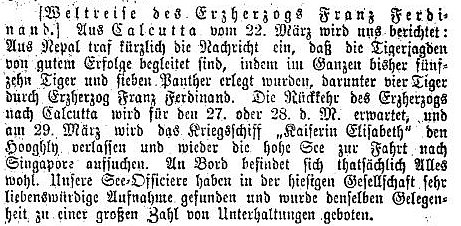
  • ANNO – on 11.04.1893 in Austria’s newspapers. Neue Freie Presse reports that FF bagged 15 tigers and 7 panthers in India.
  • The k.u.k. Hof-Burgtheater is playing „Goldfische“, while the k.u.k. Hof-Operntheater is performing the opera „Die Rantzau“.
Franz Ferdinands Jagderfolge in Indien, Die Presse 11.4.1893

Franz Ferdinand bagged 15 tigers and 7 panthers in India, Die Presse 11.4.1893

At Sea to Java, 10 April 1893

In the morning at a quarter hour past 2 o’clock we entered the strait of Banka. Heavy clouds in the South-west let us fear wind with heavy rain. But the storm passed us by so that we could continue without interference.

At 10 o’clock in the morning, „Elisabeth“ passed by the Timbaga Rocks. The wreck of a stranded full ship which had been loaded with coal showed the perils to which sailors are exposed.

At 2 o’clock in the afternoon „Elisabeth“ was at the southern end of the Bangka strait. From there our course led us eight miles east of North Watcher and from here started navigating around the Nassau Rocks towards the Edam lighthouse.

Links

  • Location: At Sea to Java (Bangka Strait)
  • ANNO – on 10.04.1893 in Austria’s newspapers.
  • The k.u.k. Hof-Burgtheater is playing the drama „Dorf und Stadt“, while the k.u.k. Hof-Operntheater is performing the opera „Lohengrin“.

At Sea to Java, 9 April 1893

At dawn we hoisted the anchor to leave the harbor of Singapore. First the course was set for the Rio strait between the islands of Batam and Bintang.  Everywhere there were smiling islands visible as if we were driving in a very wide stream. In the distance one could see the coast of Sumatra with high mountains. The pleasure of the journey was boosted by the smooth and calm sea and by the fact that the heat was not excessive, the cabins excepted. As beautiful the journey seemed for the passenger, as difficult it was in terms of navigation, because in the narrow strait of our course there were not only currents that were at times quite strong but also sand banks and shallow areas that had to be carefully evaded. But thanks to the experienced leadership of our commander and that of ship of the line lieutenant Gratzl, an excellent navigator, two gentlemen who spent day and night almost without a break on the bridge without regard for their health and keenly doing their duty so that we drove safely through the most difficult passages.

After the end of church service I found myself just with the staff on the afterdeck when it seemed as if a loud shout of „Ship ahoy!“ rang out from outside the ship which was answered by the commander with „Empress Elisabeth“. Then a pilot of Neptune came on board, approached us and asked about the commander of the ship and informed him that „Elisabeth“ had arrived at the kingdom of the god of the seas and that in the afternoon during the crossing of the equator Neptune himself would come on board to perform the naval baptism of all greenhorns. Then the pilot had the navigator come and compared his map with his own and showed him a spot where Neptune would be awaiting our ship. The pilot which we only recognized as the honorable bosun Zamberlin when he started to talk looked pretty uncanny. He was wearing black clothes, a large Sou’wester on his head and a mask with a long beard. The pilot talked with the navigator and then disappeared as quickly as he had appeared in the direction of the ship’s bow.

During the morning, a stand decorated with flags was built between the boats on the afterdeck on which I in the company of the commander and the gentlemen of my entourage sat down while the whole staff assembled in front of the stand. Already at 3 o’clock in the afternoon, the signal „All hands on deck“ was sounded. Exactly at 3 o’clock and half an hour, „Kaiserin Elisabeth“ crossed the equator at 105° 3′ 30″ Eastern longitude.

At that moment the machines stopped. The crew assembled in line. The entrance of the god of the seas began and namely from the lower castle towards the stand on which we were standing. In front marched the music band whose members were dressed in all kinds of folk costumes: There were Indians, Negroes, highland Scots, even a typical Bohemian musician marched in front of the ceremonial carriage which was drawn by four sea monsters.

On the carriage, a splendidly decorated gun carriage, sat on his throne in a purple cloak with crown and trident the ruler of the seas. At Neptune’s side sat his wife with chastely reddening cheeks, the sea goddess Amphitrite. The god of the seas was played, as was natural, by our bosun. A mighty figure, he looked awe-inspiring, decorated with Neptune’s attributes and the head covered with a snow-white mustache and beard made out of flax tow. A charming figure was Amphitrite. This role was played, as chosen by the organizers of the feast, by a small Tyrolean whose chubby face with large blue eyes in combination with a blond wig, a low-cut dress and all kinds of ribbons and jewelry which created the illusion of Amphitrite  being played by a young pretty girl. A huge wet nurse carried in her arms the already rather grown-up child of the divine couple. The child behaved rather naughty and cried and shouted without break. This group was proof of the goofy natural humor of our crew and made me smile most vividly. The group’s creation shows again in admirable way how our sailors, as soon as one lets them act out their natural merriness, will with the most simple tools produce most comical effects.

Behind the ceremonial carriage marched Neptune’s retinue. The astronomer, the physician, the barber, pitch-black wild men and their wives, Tritons etc. Now Neptune left the wagon and mounted on a small stand, demands silence and asks the commander the usual questions: Where was he coming from, who has sent him and who was the owner of the ship. Then Neptune commands the physician and the astronomer to perform their duties. The former asks for the chief medical officer of the ship, assures himself that the ship has a clean health bill and no contagious diseases, while the latter one comically simulates astronomical procedures and measurements, a merry show appreciated by all.  The deceptively real-looking astronomical instruments used were all made out of wood.

At the end of the procession, the astronomer who knows English draws a large telescope out of a pocket and reports to the god that the equator is already visible and we were now very close to it. Now Neptune sends his wife to me on the stand. With a deep bow and paying homage with a few words, Amphitrite handed me a artfully constructed sea poodle while some of the kneeling black wives of the wild men offered me various fruits in sea shells.

Then Neptune turns to me and, having calmed his incessantly screaming child with a few sailor’s curses, gives a short talk in which he highlights how happy he is and how pleased he is to perform the fourth equator baptism of a member of the Emperor’s family within a few decades. Then he wished the ship a safe journey and declared that the hideous monsters Monsunia and Taifunia, which were represented in his entourage with masks would not be capable to harm „Elisabeth“. The god ended his talk with an order to the Tritons and the barber to perform the baptism.

Then they rush upon some of the younger staff members, especially the cadets, place them upon planks that cover water barrels, lather the greenhorns with a thick flour paste and start to shave their beards with large wooden knives. At the right moment, the plank under the barber’s victims is torn away so that the baptized disappears in the barrel while buckets of water are emptied over him.

Now Neptune took a large vessel filled with water and  spilled it over the commander. This was the signal for the general baptism. Immediately all water locks, all pumping hoses as well as the two steam injectors were manned and the big water battle began. Everything that could hold water such as buckets and other equipment was used in action and baptists and baptized fought doggedly. The comical scenes that one could observe can not be described. All distinction of rank, etiquette and consideration ceased. Everybody just wanted to fill their bucket with water as fast as possible and splash it over the next victim or even put the bucket on the victim’s head as a hat.

With a terrific force performed the steam injectors. Anyone caught by their stream was pushed back by the impact as if the man had been turned into water himself. Father Neptune guided the hose of one steam injector and targeted mostly me and the commander so that we were exposed to a heavy crossfire, especially as the officers and the crew with their buckets fairly assisted. Soon everything was swimming on the deck just like after a heavy downpour.

In the midst of the dunking I opened my eyes in order not to miss the scenes that played themselves out on deck. Here pretty Amphitrite was fleeing, holding in one hand her endangered wig and with the other holding the fragments of her low-cut dress together. The child has lost his cap and bib and has been transformed back into a  k. und k. sailor; the bombardon player has found his instrument completely filled with water and splashes the content over an unsuspecting comrade. A pitch-black wild man has turned into a piebald as one side of his body has been treated by the steam injector while the other one is still shining in black. Everybody is running around, splashing around while the water flows.

Here too, in the midst of this carefree joking, we as faithful sons of our country thought about our most gracious majesty. Suddenly, Neptune ordered silence and the commander led a cheer for Our Majesty the Emperor which was answered under the sublime sounds of our anthem by a hundred voices with three enthusiastic thunderous hurrahs. Then Neptune mounted the totally wet stand and handed me with a few solemn words a lovely certificate in which the god of the seas confirmed that I had crossed the equator. This artfully designed certificate was signed by Ramberg and decorated with fitting emblems and ornaments.

Again the water battle was raging which took place mostly among the sailors as many of the officers had retired to their cabins to change their clothes. Around 30 men had namely hidden themselves to evade the baptism. The comrades, however, did not accept such outsiders. The whole ship, every nook and cranny, was searched, the victims finally fetched out of their hiding places and their heads held directly under the pump for minutes as a punishment. Some were discovered in the boats, others under the guns or between boxes and baggage in the storage area. As soon as a joyful shout rang out of having found one of the refugees, a  whole swarm rushed upon him to perform the baptism. One of the sailors had climbed to the top spot of the main mast but this refugee was immediately fetched by three comrades. The scene looked even more funny viewed from the deck as among the pursuers was one of the Negro wives.

I was standing near a group of sailors when suddenly the message was shouted: „Now, we are getting the court cook!“ I too applauded this idea and I was expecting fondly to see thick Bussatto being held under the pump. But soon the people returned with the message that the smart Italian had locked himself in his cabin. The well-meant advice to break open the door was met with shouted approval and after a few moments  Bussatto appeared reluctantly on the stairs, half pushed, half carried. But in what state! His snow-white dress displayed the unmistakable signs of full menus. Covered with the most diverse blots of color, the cook was sent under the pump where he was baptized by the sailors with a special satisfaction.  The damage to his dress is explained, as I later learned, by the fact that Bussatto had taken a picturesque posture when the sailors had finally pushed in the door of the cabin,  and picked up a large kitchen knife and uttered a stream of curses against his tormentors. These were not idle and stopped his speech by putting a bucket of apricot ice that was ready to be served over his head, followed by multiple sauces and then carried him up to the deck.

Finally a horn signal ended the funny activities. Only late in the evening could Bussatto provide us with a meal as he flatly declared that all prepared dishes had been ruined partly in contact with his person, partly contaminated by salt water. It is a fact that there was hardly a spot on the ship that had not become wet. Even the prepared bird bodies  had received their share by the key hole.

For a long time we sat together on the iron deck with the gentlemen of the staff some of whom ate with me and we discussed the happy events of the day.

Links

  • Location: At Sea to Java (equator)
  • ANNO – on 09.04.1893 in Austria’s newspapers.
  • The k.u.k. Hof-Burgtheater is playing the comedy „Krieg im Frieden“, while the k.u.k. Hof-Operntheater is performing the ballet „Die goldene Märchenwelt“.

Singapore, 8 April 1893

First thing in the morning, I examined closely a collection of ethnographic objects from New Guinea, Sumatra, Nias and Borneo that a former captain of the merchant fleet had assembled. After prolonged negotiations I bought the whole collection. It contains interesting objects of great ethnographic value, especially primitive weapons built without iron or other metals. Also jewellery, daggers and knives made out of human bone, a series of carved ancestral portraits that serve on Nias to mark holy places, as well as countless fetishes, domestic, fishing and hunting tools etc.

While Wurmbrand and Clam arranged the packaging of the objects, I did some more shopping driving in a rickshaw from shop to shop. I also added two very lovely monkeys and some parrots to the menagerie on board.

Doing business in the hot zone may drive a European with even a very calm temper to a mild despair. The inescapable endless negotiating and bargaining causes a horrible waste of time. Buying a hat or a pair of shoes will thus become an earnest undertaking that can not be completed in less than two hours. My purchasing used up the entire morning, namely as I could not rely on the participation of the consul general who had not been informed about it and I finally asked the Lloyd’s agent for help.

Returned on board at noon, I sent out some boats to embark the ethnographic collection in time on board. The rest of the day was spent in saying good-bye and preparations for the journey to Java and the expedition there.

Links

  • Location: Singapore
  • ANNO – on 08.04.1893 in Austria’s newspapers. The Wiener Salonblatt of 9 April notes the arrival of Franz Ferdinand in Singapore.
  • The k.u.k. Hof-Burgtheater is playing „Fromont junior und Risler senior“, while the k.u.k. Hof-Operntheater is performing the opera „Die Jüdin“.

Johor to Singapore, 7 April 1893

For today it was planned to visit Johor, the capital and residence of the sultanate Johor founded in 1859 by sultan Abu Bekr. In the sultan’s absence the heir apparent had invited me to enter the interesting kingdom of the sovereign Malay sultanate of Johor and after seeing the sights to hunt close to the city in the afternoon.

Accompanied by the Belgian consul general, my entourage and several gentlemen from the staff of „Elisabeth“ we set out of Singapore early in the morning in carriages. As the heat was not yet suffocating, the drive was very pleasant. On an excellent road we crossed the whole island of Singapore, first alongside the numerous parks of the city of villas and then through jungles and primal forests.

Astonished and captivated, our eyes were locked to the marvels which nature produced in its blooming children. While I might call the prevalence of palm and banian trees as characteristic for Ceylon, here there was a colorful changing variety of views. Bamboos, mango and durian trees line the road; behind them stand coffee and pepper trees. Then follows jungle out of whose impenetrable thickets sago and areka palm trees were rising as well as tree ferns. Numerous small Malay and Chinese settlements add lively colors to the rich green of the landscape.

The drive took around two hours to finally arrive at the end of the island and we could see the city of Johor in front of us, only separated by the small water road of Salat Tabras. The first sight of Johor is very charming. Out of a deep-blue sea rise green hills, on the left criss-crossed by the stream Sungei Tschat and ornamented like a park and crowned with bungalows. In the middle was Istana Laut, the sultan’s palace; on the right government buildings and the former seraglio of the sultan. On the left the small blooming city with its light red brick roofs. In between copses of trees an green meadows. Truly, if we didn’t know that a sea strait was in front of us, one might think of being at the friendly shore of an interior lake.

On the landing pier on the other shore we were received by two nephews of the sultan and I was escorted on a lovely barge to Johor’s shore where the first minister as well as all dignitaries and Europeans present were assembled. A pretty steam yacht of the sultan was anchored there. On foot we went to the palace where the heir apparent, a tall 18-year-old young man with a very sympathetic mien as well as a younger brother of the sultan received us. The palace is a long two story building whose exterior is without ornamentation while the interior has been decorated more tastefully and comfortably than the palace in Singapore. There is no shortage of guest rooms as the sultan is extremely hospitable  and every European who arrives in Singapore, especially if he is a naval officer, is highly welcome to visit him.

In a vestibule of the Istana, tea was served and the program of the day discussed. The key persons apparently were not completely in agreement about it. At the court of the sultan, multiple Europeans who had had a very lively past and must not have lived in peace with their neighbors but had explored their differences and pursued their own interests tried to gain a decisive influence upon the sultan. Among them lives a Swiss who has now a coffee plantation of the sultan’s and served as an organizer and interpreter during our stay. Besides other British persons, there was a Scot who had come to Johor as an engineer and now possessed a large steam saw.

The heir apparent seems to be under the influence of these strangers even though he otherwise exhibited a decisive character. He has been in that rank for only a short time as the sultan had earlier designated another of his relatives who was being educated in England as his heir but had declared this for void without much circumstance when the relative did not develop according to the sultan’s wishes and named him chief of police while the current heir was designated to be the successor to the kingdom of Johor.

After the conclusion of the discussion about the day’s activities a drive in a steam boat was undertaken and namely in the estuary which separates Singapore from the mainland. Firstly the ship drove alongside a small city, then past many plantations and finally we steered in between the jungle that reaches on both sides to the shore and forms a lovely frame for the sea strait.

Then followed a rich breakfast during which I had the opportunity to admire the golden table fittings and the golden tableware — opulently equipped luxuries of the goldsmith’s art which the sultan had had made in England. The household of Johor is generally equipped with the greatest luxury what, it is said, has led to an overburdening of the civil list of this ruler in combination with the other very expensive habits of sultan Abu Bekr. In a clever calculation of its own advantage, England knows, it is claimed, to keep its ward out of financial misery time and again.

The sultanate of Johor contains 24.850 km2 with around 300.000 inhabitants, among them 210.000 Chinese, and is thanks to the English participation very well administered.  The main sources of income of the government are from the importation of opium and alcoholic beverages as well as the export duties upon gambir, pepper and other agricultural products which by the way is the only tax the inhabitants of Joho have to contribute to.

The interior of Johor is covered with thick tropical jungle whether it is swampland or hilly terrain or mountain. Due to the influence of the nearly daily rain, the strong dew and the great humidity, one can find here a rich evergreen vegetation.

Palms such as the sugar rich Cabong palm, the coconut, the Sagound, the Areka palm trees and the gutta percha trees (Isonandra gutta), camphor trees (Camphora officinalis) and excellent wood for construction providing large tree trunks of the virgin forest are characteristic for the forest zone. Bushes that supply resin, oil and poison constitute the undergrowth of the jungles. The cultivated land is used especially for the production of rice, maize, namely however for pepper and catechin, the extract from the branches of the gambir bush (Uncaria Gambir), a Rubiacee, that contained a tanning agent.

The intense cultivation of pepper and catechin-gamber which is by preference done in the North-western province of Muar almost completely by Chinese is expressed in Johor’s exports as the two named products are the most important export goods. Imported is mainly rice, the main staple of the population.

Up to now only a few parcels have been converted to cultivation. The forests are in many places not and in the others only irrationally exploited, with the result that Johor’s jungles still contain many apes of the Gibbon family (Hylobates), then Semnopithecus obscurus etc., and also scattered elephants, rhinos, tapirs, bisons (Gaur), bears and even Malaysian tigers, as well as sambar deer and the small Kijangs (Cervus muntjac), then crocodiles, snakes and finally many birds.

The mineral wealth of Johor are still not explored with the exception of tin of which the whole Malaysian peninsula is especially rich as well as gold. The latter one is especially found around Ophir (Gunong Ledang), the tallest mountain in the territory of Johor, whose sharply rising peak we had already seen from the sea on April 5th.

All in all the sultanate of Johor which had entered into history as one of the tributary states of the once so mighty sultanate of Malacca but then had fought and achieved its independence and managed to keep its sovereignty to the present day, offered a very favorable terrain for the tasks of modern cultivation. Under Abu Bekr administration, culture and trade of Johor had made decisive progress on the way which alone can provide this small but richly furnished and favorably located country with enduring prosperity.

A deer and boar hunt was planned and thus we drove, having enjoyed the culinary fruits of Johor, on an excellent road inland across a very pretty landscape with numerous nice Malay settlements in whose small gardens the purging croton (Croton tiglium) formed the main ornament. We drove comfortably and rapidly. The carriages and the horse teams especially were excellent as the horse loving sultan had imported among others also a pair of outstanding horses from our country. We stopped at a police station, where the hunting party was expecting us led by the brother of the sultan, a very well nourished gentleman, as well as the deposed heir to the throne — two reportedly proficient hunters.

After a long discussion it was decided that we should take up position in an extended line while the drivers already in position would march through the jungle towards us with their dogs. Behind us they had formed some kind of net made out of bast slings which was intended to catch any escaping, wounded or missed game. Thus we stood in intervals of 50 paces each in the middle of tall grass and thick ferns with little open ground and were waiting for action. Hour upon hour passed and nothing appeared beyond a huge pouring rain that came down upon us with flash and thunder and restricted our view to a few paces and soaked our clothes within minutes.

The current and the former heirs as well as the sultan’s brother stood behind me soaking wet and finally declared that probably no game would come close to us now and thus it was better to return home. I quickly concurred and we were soon back at the police station where the organizers apologized for the failure and explained that they did not have sufficient time for the preparation for a more successful hunt. Despite our message that my arrival was imminent in Singapore and Johor five weeks ago, the Belgian consul general is said to have informed the court of Johor only recently about my visit, possibly because he had been constrained by having to represent four governments at the same time. The consul general also had not participated in the hunt but had asked me to use the time for a visit to the state prison, so that he failed to get his share of the downpour.

During the return drive I enjoyed the company of the heir apparent who told with delight about his time in Vienna which he had visited a short time ago as well about Frankfurt am Main where he had stayed for half a year. The sultan is very keen on Western culture and tends to send his relatives to Europe to obtain an education.

The gala dinner in the palace was attended by us, the prince, a large number of dignitaries and the prince of Pahang deposed by the English. This formerly independent prince of a kingdom of 25.900 km2 at the northern border of Johor had been simply dispossessed by the English because of alleged riots in his country and angry and sulking, he had retired to Johor where a marriage between his daughter and our host was to take place on the particular wish of the sultan of Johor; but the prince does not seem to agree to this plan and seemed for the present to be reluctant to agree. At the dinner I sat beside the prime minister, a friendly and knowledgeable old fellow with whom I had a good conversation thanks to the interpreter. He knew much about our country and about all our officers on the mission ships of our navy which had been guests here. In the absence of the ruler he is in charge of the government and is said to be a competent and active man.

The golden fittings which decorated the table were, if that was even possible, even more valuable and more splendid than those I had admired in the morning.. A rather good private orchestra of the sultan provided the musical entertainment and just after the dinner accompanied the Malaysian dances in which boys in girls‘ dresses were turning around in a circle as the female sex was excluded from public dances according to the ruling customs here. The spectacle was by the way rather without interest even though the poor boys gave their best.

After I had taken a heartfelt leave from the prince and the gentlemen in Johor, I visited also a Chinese gambling den which had been formerly established in Singapore and now was suffered here more than licensed to set up shop here. The Chinese enjoy gambling with a true passion, sacrificing the fruits of hard work and move on all holidays in whole caravans from Singapore to the gambling den in Johor. The gambling hall is rather cleanly equipped. At its side is a restaurant and an opium den. The game is a simple game of chance as one wagers upon four numbers and decides the game by a throw of a die.

As a dedicated enemy of games of chance who by the way neither finds entertainment nor interest in it, I received in this gambling den a truly vile impression. Nevertheless we tried our luck and returned in a splendid, mild tropical night on the same way we had come in the morning, minus the loss of a few dollars, on board of „Elisabeth“ where we arrived late in the evening.

Links

  • Location: Singapore
  • ANNO – on 07.04.1893 in Austria’s newspapers.
  • The k.u.k. Hof-Burgtheater is playing a comedy „Verbot und Befehl“, while the k.u.k. Hof-Operntheater is performing Richard Wagner’s opera „Die Walküre“.

Singapore, 6 April 1893

Towards 5 o’clock in the morning I was woken by a heavy storm that was unloading itself with force. One clap of thunder followed the other; the rain poured down so densely that one could not see beyond a few steps and the commander was forced to anchor near Alligator Island by the lighting fire of Raffles Island. As one could not think of sleep under such circumstances, I went up to the bridge and enjoyed the elementary spectacle amidst the pouring rain. Half an hour later, the wind relented and soon the blue sky started gleaming so that we could resume our journey.

In the far distance one could see on the right the shape of Sumatra, while on the left the Malacca peninsula and small islands accompanied us. Finally a signal station appeared in the morning mist, some ships and then more and more the largest buildings of Singapore. The pilot came on board and guided us to the wharf where we anchored about 1.5 miles from land.

Just thereafter appeared the substitute for our own vacationing consul, the Belgian consul general M. J. de Bernard de Fauconval, with the message that cholera was raging rather heavily in Singapore and that this malicious illness has already picked its victims among the Europeans and finally that no large hunts could be undertaken at the sultan of Johor, because the ruler had himself departed for Karlsbad and the season was not considered favorable for hunting.

I originally had the intention to stay a few days in Johor as the excellent hunting grounds and the hospitality of the sultan had been much praised to me, but decided obviously in view of this bad messages to stay in Singapore only as long as was necessary to get to know the city and its surroundings, to undertake a trip to Johor nearby and to replenish the ship with coal in order ton continue the journey to Batavia.

Now a number of visits started. First of all came the governor of the Straits Settlements, Sir Cecil Clementi Smith, and after him the commander of the Siamese yacht „Ubon Burathid“. He was accompanied by an acquaintance from Vienna who served as an interpreter, a common figure in Vienna’s Ringstraße and the racecourse in Freudenau, the Siamese Nai Glinn, who had served for quite some time as a lieutenant in the 7th Dragoon regiment and had only recently returned home, only to depart soon to Berlin to serve as a military attaché as he told me.  I was very pleased to see Nai Glinn again — he now is a captain and calls himself Luang Salyooth. He appeared dressed in the full dress uniform of a lieutenant of the Lorraine Dragoons in order to receive information when I would be willing to receive the half-brother of the king of Siam sent here to greet me.

With the Dutch consul general G. Lavino, I set the program for my stay in Java after long negotiations. The program then was immediately telegraphed to Batavia.

Just thereafter I received the half-brother of the ruling king of Siam, Prince Bidyalab Briddhi Dhata who had arrived three days before on the yacht „Ubon Burathid“. The prince who is distinguished by his intelligent mien appeared with a large entourage of dignitaries among them a cousin of the king, Prince Prabakorn, and besides our friend Nai Glinn also Captain Mom Radschawongse Krob who was attached three years ago to the 11th Hussars in Vienna as a lieutenant. In my cabin where Prince Bidyalab presented me with a letter of the king we had a long conversation translated by Nai Glinn.

The prince’s mission was intended to convince me to come directly from Singapore to Siam and postpone my journey to Java as well as Australia to a later date,  as the coming rainy season put the hunts and namely the capture of elephants into question. To my regret I had to restrict myself to offer thanks to the king and express my disappointment that the chosen route could not be changed at that moment. The prince seemed to be not very pleased about the failure of his diplomatic mission and left the ship after the exchange of some courtesies to the sound of the guns as well as the music of the Siamese anthem.

I then went on board of the prince’s yacht but did not meet neither the prince nor one of his officers but only a Siamese NCO who did not understand what we wanted.

In the afternoon a launch transported me onto the land to visit the city of Singapore. Singapore, the „city of lions“, today a metropolis and crossing point of the most important shipping lines of the Indian and Pacific Oceans has quickly risen to become the center of the transit trade between Australia, East Asia, Polynesia, India on the one hand and Europe on the other.

After the return of Java to the Dutch in 1815, the English turned their eyes to the southern end of the Asiatic mainland, in order to find a replacement for this splendid possession, to the foot of the Malacca peninsula which can justly be said to be very advantageous both from a strategic and commercial point of view. First Sir Thomas Stamford Raffles, formerly governor of the English East India Company on Java managed to receive the permission in 1819 from the government of the sultan of Johor to found a British settlement on the island of Singapore. In 1824 the island became a possession of the East India Company by acquisition,  in 1867 a new treaty transferred its possession to the British crown.

The island of Singapore is 43 km long and 23 km wide and also contains within its territory 70 further small islands. It is separated by the water route of Salat Tabras from the mainland which is part of the sultanate Johor at the southern tip of the Malaysian peninsula. The water route is on average around 1 to 1.5 km wide and encompasses the northern half of the island in the form of a semi-circle around 55 km long. Thus very close to the mainland opposite it, the island shares its geological structure. Sandstone and granite provide the foundation, fertile alluvia the cover of the island. Hill lands crisscrossed by streams alternate with areas that used to be covered by jungles and swamps and have today been turned to a large extent into cultivated areas. On the former swampland and jungle grow now embedded in luxurious vegetation tropical field and tree fruits in such a quantity that Singapore justly bears its Malayan name of „Tamsak“, that is „garden of love“.

Out of the swamps rose the city of Singapore which the English have set out in 1819 at the south coast of the island at the location of the ancient Singhapura which had sunken down to the condition of a poor fishing village. Declared a free-harbor and quickly populated, the new city prospered quickly thanks to its excellent anchoring spots and the incomparable geographic and commercial location. Even quicker as the English held continuously fast to their long-term ambitions to turn an important part, about three fifth of the Malaysian peninsula, into partly protectorates, partly into direct possessions, the latter under the name of Straits Settlements, to become a part of their zone of influence.

The Malaysian protectorates to which the sovereign sultanate of Johor also belongs cover an area of 86.000 km2 with 605.000 inhabitants. The direct possessions, namely the islands of Penang and Singapore as well as some areas on the Malaysian peninsula, cover an area of 3998 km2 and count 512.342 inhabitants. Of this Singapore island alone accounts for 555 km2 and 184.554 inhabitants, so that this island occupied in 1819 only by a few fishing families and the retreat of Malaysian pirates now has a density today of 333 inhabitants per square kilometer — certainly a great development!

The Straits Settlements are under a governor who is at the same time commander-in-chief of the soldiers and in charge of the admiralty court. He is also responsible for the relations of England with its protectorates. His residence is in Singapore.

The commercial importance of Singapore which accounts for the lion’s share of trade is highlighted by the following numbers: In the year 1891 the value of imports was 254,182.631 fl. in Austrian currency, that of the exports 226,332.632 fl. in Austrian currency. In the same year the number of arriving high sea ships was 4184 with 3,324.680 t and that of the coastal vessels 7293 with 260.672 t. Truly during our arrival at the old dock, the anchoring spot for small and large ships, the new harbor with its docks and  wharf, the piers and the landing bridges were brimming with life. Especially the new harbor was filled with scenes of uninterrupted busy activity on the one hand from Singapore island and on the other hand from the six meter deep channel between the islands of Blakan-Mati and Ayerbrani to the establishment of the Peninsular and Oriental Steam Navigation Company and the docks. Without interruption, large steam boats arrived and departed. Everywhere goods were cleared, coal replenished and most diverse local vessels, large Malaysian praus, Chinese junks and the small canoes of the Sundanese were busily rushing around from here to there.

Equally lively are the activities on the long landing bridge Johnston Pier, as well as the neighboring streets of the European quarter where the merchant houses, shops, public buildings, hotels and clubs of the Europeans were located. Here alongside the waterfront, next to the docks, around the magazines runs a colorful stream of humans of all peoples and races.

Even more original is the view offered in the southern part of the city, in the actual business district as well as the quarter of the natives and the Chinese. Malabares of the Dravidian tribe but of Malaysian tongue; Tamils, here called Klings, Hindus from the southern coast of continental India; Malays, the aboriginals of Singapore; Chinese who make up today more than half of all inhabitants of the island: each of these groups is settled in Singapore in their own special quarters.

The main part of the non-European population of the city are the Chinese; these have settled here from the foundation of Singapore and live in the southwestern part of the city beyond the Singapore river in a special quarter which is immediately recognizable by its sky-blue painted houses, the numerous Chinese scriptures at their front and many other things.

There always is a great commotion, the commercial activity, the industriousness the sons of the Middle Kingdom call their own. Not an instance are they idle. Without interruption do they work, trade and negotiate. In the midst of the flow of business they recover in the tea and opium dens between the shops or in the open theaters set up nearby where there are spectacles during the whole day.

Not far from the Chinese quarter are the ones of the Indians and Malays. Around the area oriented towards the land extend the Chinese and the Malaysian settlements and on the North-eastern end of Singapore is a Malaysian village whose small huts enliven as  pile dwellings the shore of the Rohore River. While the Chinese populations increases day by day in number, wealth and power and irresistibly displace the other Asiatic elements, the number of the Malays is dwindling due their indolence, even more so as numerous immigrants from South China marry Malays and their offspring takes on Chinese customs.

The European quarter built on the left bank of the Singapore river covers an incidental area in the form semi-circle with a diameter of multiple kilometers formed by the wharf dock. This dock as well as the neighboring streets serve mainly for the business activities of the Europeans. Further inland the remaining parts of the European quarter cover the are up to the three hills that rise in the west of the city. On one of these hills called Government Hill stands the palace of the governor; on the hill south of it, just beyond the Singapore river, called Peel Hill lies Fort Canning, named in honor of the deceased vice-king of India and which includes the signal post which announces the arrival of the ships.

Interspersed with numerous luxurious garden this quarter with its nice houses, the numerous towers and steep roofs of the churches and the public buildings from the pier outwards offers a friendly view of the city. An English look has been impressed upon the buildings and the gardens. On the esplanade, an area of extended grass at the sea shore which is graced with a statue of Stamford Raffles, the founder of Singapore, are numerous tennis and cricket fields. Pretty one story houses with well tended gardens surround the esplanade where the elegant clubhouse of Gymkhana is also located. The cathedral and the government buildings are also not disavowing the style of their builders.

The Raffles museum which I visited first as soon as I had sent foot on the land disappointed me somewhat as the collections were neither quantitatively nor qualitatively up to my expectations. The zoological department is fairly incomplete. Only some representative birds of Malacca I did not know and a remarkably large crocodile that had been killed close to Singapore caught my attention. The ethnographic department is in a rather shabby condition.

Government House is around 45 km distant from the city center and lies, as stated previously, on Government hill in the middle of lovely gardens. To create one of the most beautiful gardens presents few difficulties: The next best jungle is thinned out, laid out with paths, the luxuriously growing nature left to its own devices and the splendid garden is complete.

The governor who had, as told, paid me a visit on board already in the morning received me in the elegantly decorated palace with the message that he had to depart still on the same day to Pulau Penang. This message seemed to trouble the Belgian consul general who was accompanying me and I too was astonished that the governor had to depart so soon after my arrival. Probably this sudden journey was in relation with government matters in connection with the cholera outbreak that could not be delayed.

The drive to the bungalow of the Belgian consul general offered an overview of Singapore’s location and gave me the opportunity to see some of the country mansions situated in a wide arc west of the city. These bungalows almost all built on hills whose slopes were ornamented with lovely gardens offer a refreshing stay to their occupants returning each evening from the government and business district of Singapore. At a considerable altitude above the sea level, these bungalows provide a great view from the city to the sea enlivened by ships, fresh clean air and the charm of tropical vegetation around the hospitable building. Green hills crowned by the gleaming white bungalows follow one another in rows for miles and extend this town of villas.

On the excellent roads that lead through the settlements drive funnily numerous small closed carriages drawn by a single pony. In the city itself, the so called jin rickshaws are used, usually abbreviated to rickshaws —- that is „man-power-wagon“, two-wheeled colorfullly painted small wagons similar to those we have seen in Colombo. Chinese coolies draw them. In the streets of Singapore they are rushing around without a break. There are 2200 rickshasws here and it is astonishing how quickly and over long distances the poor coolies are able to move this comfortable vehicle. Admittedly, a majority of the coolies will fall victim to the arduous transport service within a few years because the necessary exertion attacks the lungs to a high degree of these lamentable human „locomotives“.

At the Belgian consul general’s we took the refreshments with pleasure which the kind host of the house offered to us. As the intense heat had made us desire some welcome cooling. Refreshed we then examined more closely the rich and interesting collection of Malaysian headdresses which the consul general expertly explained to us. He finds time to collect and do practical ethnographic studies beside his varied works. M. de Bernard, who seems to be the consul of the whole world — at the moment he is representing no fewer than four states — knew to tell many interesting details about Singapore. Among other things he made us aware about the humidity of the climate — rain was an almost daily occurrence here — which accounts for the splendid vegetation of the island but causes many adversities for the inhabitants. A further negative point is the massive presence of termites which are commonly but wrongly called white ants. Often all household effects  fall victims to them. In fact the furniture in the bungalow showed noticeable signs of the pernicious activities of these insects. Thus even this island paradise like everything on earth has its dark side.

The  nearby botanical garden of Singapore visited next is a intelligently arranged but still young installation. Its rows of trees and plants promise to turn this place dedicated to science within a few years into a garden with much shade that will not only provide much education but also repose. In systematic order groups are formed besides a labyrinth that represent the vegetation of the Malaysian evergreen tropical region in various specimens, especially nearly all kinds of palms of this zone.

Connected with the botanical garden is also a small zoo that only houses representatives of a few but rare species of the fauna of the Indo-Malaysian subregion; thus a speckled tapir (Tapirus indicus), a tame animal that bound to a string was laying in the middle of the path and nosed at each visitor in a friendly manner. then there was a huge Orang-Utan of Borneo; multiple tiger-like marked cats that were completely new to me; Malayan honey bears; beautiful hornbills; a small jungle hen from Sumatra with a violet crest, herons, cassowaries etc.

Not far from here lies the park and the palace of the sultan of Johor which the pomp loving prince, a friend of architecture, has ordered to be constructed here in recent times — the palace was only completed two months ago.  The palace rises in the middle of the park on a commandeering hill that offers a beautiful panorama of the numerous gardens, parks and bungalows, on the whole crest of Singapore’s villa cities. The large square building in „mixed style“ is the work of a Malaysian architect; it has been laid out with a princely waste of space, equipped with electric lights and is completely most luxuriously furnished.

This sometimes abrupt combination of European and Oriental taste can be traced back to a special reason. Sultan Abu Bekr, who, it is known, tends to spend each summer in England or on the continent and especially repeatedly in our world-famous Karlsbad,  namely likes to bring home numerous objects from his travels which will ornament his palaces. These objects, though they may be valuable and beautiful , they do not fit in completely with the Oriental decoration of the palace chambers. Original, however, are the numerous ornamented elephant tusks that lie on the floor in all the rooms.

Even in the absence of the sultan his graciousness was on display in offering us champaign and coffee in splendid golden vessels in the palace, after which we returned to Singapore past the bungalows of the married English officers who each occupy their own nice home in a park-like area. When we came closer to the city, it was already so dark that the drive through the Chinese quarter turned out to be even more attractive and interesting than during the day. Even though the same lively activity was pulsating in the streets and houses, the same febrile actions but the countless colorful gleaming and twinkling lanterns and lamps that illuminated the shops, the Buddha temples, theaters and restaurants as clear as day. The moving crowds offered a both fascinating  and strange view. A special quality of this quarter is the niceness which rules here despite the numerous workshops and the many shops that offer fish and all other kinds of marine and terrestrial products by cooks and merchants.  Even though the cleanliness may only be superficial, it still offers an agreeable contrast to the atrocious dirt in all the native quarters of the Indian cities. The olfactory senses of the European are, however, affected in both locations in a both strange and not very joyous manner.

In the city I then visited two large shops which offered many ethnographic objects from the Malaysian islands but failed to come to an agreement with the merchants in term of the exceedingly high prices demanded, so that I returned on board without success.

Links

  • Location: Singapore
  • ANNO – on 06.04.1893 in Austria’s newspapers.
  • The k.u.k. Hof-Burgtheater is playing a comedy „Magnetische Kuren“, while the k.u.k. Hof-Operntheater is performing the ballet „Die goldene Märchenwelt“.


At Sea to Singapore — Pulau Besar, 5 April 1893

A few miles in front of the coastline of the Malacca peninsula we set our course so that we could without interruption see and enjoy both  the lovely view of the coast, the hills and mountains of the peninsula among which Ophir in  Johore rises to an altitude of 1175 m, and also the small groups of islands which lay alongside the course in front of the coastline. Even with unarmed eyes one was able to distinguish the luxurious plant decoration which covered the peninsula and the group of islands.

Numerous Malaysian fishing boats sailed on the calm sea whose emerald green color offered an effective contrast to the deep blue of the sky. The far distance that the Malaysian fishers dare to go out into the high sea with their canoes and the skill with which they operate in rough seas are remarkable. These canoes are almost even smaller than our „Sandolinen“ or two-seater; two men sit in each boat and move them forward with double oars; sometimes they even hoist a small sail. All around the sea was almost covered with such canoes whose crew curiously ogled with small piercing eyes  at the proudly passing mighty „Elisabeth“. The fishermen covered their heads with large straw hats shaped like a bell, while the rest of the dress was very deficient due to the heat and the occupation.

During the last days we have seen remarkably few ships, but today a few steam ships came into view.

As I planned only to arrive the next morning in Singapore and thus had a few hours to spare, I decided to visit one of the islands alongside the coast. The map was consulted and soon an island was found called Besar which is part of the Water Islands, South-east of the formerly important trading city of Malacca, the destination of the expedition. I solicited participants and within a short time had assembled a group of nature lovers and hunters, besides me and my gentlemen and also Sanchez, Bourguignon, Regner and Mallinarich, to explore the island.

The Water Islands are a group of smaller islands, whose largest is Besar. They are all covered in rich vegetation and according to the map all uninhabited; only on Pulau Undan, the most outward of these islands stands a lighthouse.

After „Elisabeth“ had anchored about half a mile in front of the island, the expedition corps set out in two boats and landed in a small bay which was filled with coral reefs and only through a small passage we could land.

At the shore I had the gentlemen assemble in a line, between each shooter stood two sailors; Myself I wanted to be at the center of the line, Sanchez and Regner however were at the respective wings — in this way we expected to cross the island. This was a beautiful plan; soon however it became clear that such a hunt would have been a splendid undertaking in the beet fields at home but was impossible to execute on a tropical island. As soon as we had advanced a bit we were met with insurmountable obstacles as the growth of the vegetation in its richness and density made a further advance nearly impossible.

Those who have not personally seen the rampant growth of the local trees, bushes, herbs and lianas created by nature’s elementary power can not properly imagine it as pictures will only offer a bland representation of reality.  Everywhere there were tree trunks laying on the ground, victims of the elements and the slowly choking activity of the lianas. They were covered in moss, ferns and orchids, above these witnesses of the never-ending destruction various trees were arching their high leafy canopies; lianas thick as an arm connected, like snakes, one tree with the next in a deadly embrace; Tree ferns as well as bamboo, banana trees and rhododendron trees formed a dense closed undergrowth, in which every step had to gained with the knife. I enjoyed the view and the opulence which attracted me and made me stop in the heavy work of creating a path through the jungle.

It was indeed very difficult to advance; namely at 45° Celsius and under the burning rays of the sun that shine down nearly vertically. In the struggle with the terrain which we fought with a knife in the hand, the sweat was running from the front as if we had been in a steam bath. Soon all sense of direction was lost as well, the order was broken, the beautiful line was interrupted, the sailors did not walk between us but behind us and everyone of our party chose his path as well as it was possible.

The animal wildlife was sparsely represented; only a few birds were audible. Only rarely could one see one in the impenetrable sea of leaves. Still I managed to bag a fruit dove whose feathers glittered in all colors of the rainbow and a Asian Koel (Eudynamis honorata), while Regner shot a splendid Malay yellow-breasted sun-bird (Arachnechthra pectoralis).

In order not to lose the connection between us we had to shout continuously to prevent a full separation and answer the calls. Finally we were all convinced that further attempts were useless and pushed in order to circle around the island towards the coast where we met Mallinarich who had separated himself from us earlier and went with two men to catch crabs, sponges, mollusks and other representatives of the maritime fauna.

Soon we found a track in the sand which according to all our assembled experienced trackers had to be that of a soliped, and declared it to be of the species Equus caballus. This meant that, as horses were not native to the island, we were close to humans, so that the island was not at all uninhabited as we had assumed from our map study. A confirmation of this fact determined by our exploration was our discovery of a coeur eight oars under a large tree which removed all remaining illusions that we were on a virgin island.

And truly, after we had taken another turn, there stood Malay fishermen in front of us who looked puzzled upon the European intruders but then offered water in a friendly manner to us and our sailors which they drew from a deep fountain. Some miserable reef huts on which hung drying served as homes to the fishermen in whose proximity were two dear brindled ponies which naturally explained the puzzle of the tracks. Around the huts, the islanders had burned down the jungle to gain space for some sort of cultivation.

Who can describe our surprise when we discovered, following a small path, two Buddha temples and a small Chinese settlement opposite them. The temples as well as the largest of the houses were constructed out of bricks painted sky-blue.  Close by stood multiple reef huts erected upon stakes according to Malay custom. In the shadow of large trees, this settlement made a very inviting impression upon us, so that we accepted our failure of exploring Besar willingly in the expectation that we might be offered a refreshment. With a friendly air the immigrated children of the Heavenly Kingdom advanced toward us. A very happy and garrulous old Chinese woman seemed to be especially pleased about the unexpected visit.

The Chinese emigrate, as is well-known, in large masses from their home country and inundate all countries of the world in West and East. That we had met these brothers with queues in Calcutta was not surprising; but it was strange to see even this remote island be an object of the Chinese commercial interest.

The people brought chairs and as a very welcome refreshment, zwieback and a delicious tea, and each of us drank some cups of this beverage, while the brave old woman smiling and never tiring brought out new portions. When we finally were ready to depart and offered a few coins to show our appreciation of the hospitality, the Chinese refused all thanks and were not to be moved to accept any payment despite our insistence. Finally Clam helped us out of our embarrassment by presenting flowers to the old woman with an elegant deep bow. She put them with a loud laugh into her hair. Sanchez gave the island hostess his colored belt after we departed with a hearty handshake.

We moved further along the shore. Three blue and white colored collared kingfishers (Halcyon chloris), as well as multiple specimens of a species of little mangrove bittern (Butoroides javanica) were bagged by us. Palm leaves which I had cut on the way were intended to serve as decoration on our afterdeck. Soon the shore changed its character and instead of the smooth sand there were large round boulders over which we had to jump or like equilibrists we had to climb over them and balance on them. Some of these stony obstacles were so moist that we could not get a clear grip but could only laboriously peg on them. The attempt to find a path in the interior of the island was foiled by the terrain which was even more impenetrable and thus we climbed, crawled and slid in goose steps one after another. The clothes and shoes were soon in a deplorable state; the tide was rising ever higher: the roaring waves crashed against the rock — and finally we were all laying in the water at a particularly difficult crossing of one rock to the next.

After various dangerous actions we finally arrived at the spot where our boats were anchored and we returned soon on board of „Elisabeth“, very tired in torn and wet clothes where we quickly went to our cabins and only reappeared on deck late in the evening for the dinner.

Then the voyage to Singapore was resumed. Late in the evening the fire at Pulau Pisang became visible.

Links

  • Location: At Sea to Singapore
  • ANNO – on 05.04.1893 in Austria’s newspapers.
  • The k.u.k. Hof-Burgtheater is performing „Faust“, the k.u.k. Hof-Operntheater „Margarethe (Faust)“.