Kategorie-Archiv: diary

diary entries of Franz Ferdinand

At Sea to Singapore, 4 April 1893

Gorgeous weather again and a calm sea. In the morning the island of Pulu Penang, also called Prince of Wales Island and part of the British Straits Settlements, appeared. I had originally had the intention to visit it and stay there for a day to learn about its vegetation and explore new bird species. As I was assured that the surrounding of Singapore offered both at equal quality and I was eager to reach the Malaysian archipelago and Java as soon as possible, I gave up on this enterprise and we stayed on the course to Singapore.

From time to time we saw the nebulous profile of the Malacca peninsula and the blueish contours of its mountains.

For the first time we met one of the small Malaysian sailing boats called „Proas“ that sail from Sumatra to the Malaysian peninsula and back for the purpose of exchanging goods or fishing. Very strange is the construction of these crude vehicles and especially its rigging. The sails consist of small, oblong red-brown straw mats which are fastened on poles. If these sails have to be shortened, the sailors collapse the structure of mats like an accordion. Towards 4 o’clock in the afternoon the volcanic cone in the midst of the strait of Malacca,  called Pulu Jarak,  became visible, also a good naval point of orientation. We bore away to backboard to have a closer look. It rises in its conical form to 152 m out of the sea and is covered down to sea level with rich tropical vegetation. The crest coronets of the trees were very dramatically illuminated by the setting sun.

Numerous driftwood, namely palm tree wood, was swimming on the waves — trophies the sea hat seized from the land in its relentless onslaught.

Links

  • Location: At Sea to Singapore
  • ANNO – on 04.04.1893 in Austria’s newspapers. The Neue Freie Presse includes a report of FF visiting the maharaja of Jepore dated 11 March (PDF).
  • The k.u.k. Hof-Burgtheater is performing „Frau Susanne“, the k.u.k. Hof-Operntheater „Die Rantzau“.

At Sea to Singapore, 3 April 1893

The sky was very cloudy and a rainsquall was pouring down in heavy drops, drumming against the deck but quickly evaporate in the heat. Church service was therefore held in the battery.

Still during the morning appeared the Sayer islands, Salang island off the Panga peninsula, in the afternoon the Brothers islands became visible. All these small islands seem to be of volcanic origin, viewed through a spyglass, and thickly covered with tropical vegetation.

During the day we observed tide rips or stream currents that are very common in the Strait of Malacca; these are wave movements that are caused by counter-currents that move in stripes across the otherwise quiet sea and make the steering much more difficult as they cause the ship to drift from its course. I might compare these currents to a quickly flowing watercourse in a sea that flings out foaming, dancing waves at the surface.

An outstanding number of flying fishes, large schools of dolphins as well as fish similar to tuna were mingling. The latter ones pursued, jumping out of the water, smaller fish while these in turn were followed by large birds similar to common dabs that I could not determine more precisely.

The evening was tepid and mild, so that I whiled away an hour on the bridge before I went to sleep, fanned by the the cool evening air, lost in the view of the southern starry sky which I consider by the way inferior in diversity, beauty and splendor of the zodiacs to the northern sky.

Links

  • Location: At Sea to Singapore
  • ANNO – on 03.04.1893 in Austria’s newspapers.
  • The k.u.k. Hof-Burgtheater is performing „Wilddiebe“, the k.u.k. Hof-Operntheater „Die Goldene Märchenwelt“.

At Sea to Singapore, 2 April 1893

Already at 5 o’clock in the morning I left my cabin and went to the bridge to enjoy the spectacle of the setting full moon and the concurrent rise of the  daystar. Floating clouds in the sky embellished the view by their grotesque forms and strange colors.

In the morning — we celebrate Easter Sunday — a church service whose celebration on the open sea always impresses me deeply: the altar on deck, overhung by our standard; in front a handful of people, at the mercy of the elements,  solely trusting in God; the solemn sound of music and the muted mysterious rushing sound of the eternal infinite sea.

After the church service I devoted the whole day to work, namely to letters to be sent home.

Links

  • Location: At Sea to Singapore
  • ANNO – on 02.04.1893 in Austria’s newspapers.
  • The k.u.k. Hof-Burgtheater is closed until 2nd April. The k.u.k. Hof-Operntheater is playing „Die goldene Märchenwelt“.

At Sea to Singapore, 1 April 1893

Splendid weather, the sea as smooth as glass, most severe heat. Even though I stayed only for a short time in the engine room to which I had gone down, I nevertheless returned on deck drenched in sweat. The heroism shown by our brave stokers who are only relieved every four hours and do their hard work in a blazing space is truly admirable.

Spouts of water rising in a great distance indicated the presence of two sperm whales.

In the afternoon towards 4 o’clock small Table Island, the northernmost island of the Andamans, with its lighthouse became visible at a distance of four miles on starboard, while we passed through Preparis South Canal. The island is, as far as I could distinguish with the spyglass covered with rich vegetation, namely palm trees and, usually uninhabited, only serves fishermen as a temporary quarter.

In the evening we enjoyed a splendid full moon that illuminated the sea and our snow-white „Elisabeth“ in a magical light and mirrored itself in the slightly sparkling waves. For a long time I listened on the bridge to the songs of our crew that was convened on the iron deck.

Late in the evening appeared on backboard, emerging like a ghost out of the sea,  the 710 m high volcanic island Narcondam, a precious point of orientation in navigation.

Links

  • Location: At Sea to Singapore
  • ANNO – on 01.04.1893 in Austria’s newspapers.
  • The k.u.k. Hof-Burgtheater is closed until 2nd April, the k.u.k. Hof-Operntheater until 1st April.
At Sea to Singapore, 31 March 1893

In the most splendid weather we are floating on the deep blue sea towards Pulau Penang, to go from there to the island of Singapore. The sea is flat like an inland lake and despite the relatively great heat sometimes a bit of fresh air brings relief. Staying on the afterdeck, it is quite bearable; it is worse in the cabins and especially in the engine room where the thermometer displays an almost constant temperature of 70° Celsius.

As one boiler was damaged — it started to leak, the journey had to continue at a lower speed so that we only achieved nine miles per hour, which was by the way partly due to the fact that the coal obtained in India does not possess the heating power of the English bituminous coal.

In the afternoon I had to mourn the unfortunate loss of a member of my menagerie. My parrot, a tame animal that moved at liberty on deck, flew out into the air above the waves, exploring its flight skills, but tumbled into the sea and drowned before it could regain the ship’s deck.

A large four-masted sailing ship became visible, apparently heading for Rangoon.

Due to Good Friday there were neither music nor bell signals; the hours were indicated with a ratchet.

Links

  • Location: At Sea to Singapore
  • ANNO – on 31.03.1893 in Austria’s newspapers.
  • The k.u.k. Hof-Burgtheater is closed until 2nd April, the k.u.k. Hof-Operntheater until 1st April.

At Sea to Singapore, 30 March 1893

During the night, the cabins were filled with hot air. The sun had been shining hotly on the day before and a muggy air lay over the Hugli and the swamps. Despite many improvements that had been made in my cabin, the temperature in it never fell below 30° Celsius in the night and sleep when it finally overcame by closing the tired eyes was not refreshing.

Early in the morning the anchor was raised and guided by an old English pilot, whose face reminded us of Falstaff’s common physiognomy, drove down the Hugli. The shore had the completely dismal character typical of the lower part of the delta, no green, only colorless swinging reeds of the type Typha elephantina, which are called „Hugli“ in Bengal and also have given their name to the river.

The Hugli river is the most important branch of the Ganges delta and has already at Diamond Harbour a width of 3889 m; at the mouth it is 22.224 m wide. Nevertheless this branch of the river causes important difficulties to shipping due to the continuous shifting of the breaking sea and sand banks, so that ships often required multiple days to reach the open sea. Even the beaching of ships during the trip down the river is not uncommon. Even though the course the ships were taking was marked by guard ships, skillful pilots are necessary to guide the ships safely though the labyrinth of obstacles.

At 3 o’clock in the afternoon the pilot transfers to a small sailing brig. The shore is now visible only in a distant, nebulous schemes. A last glance is given towards the Indian landmass — and we are swimming in the open sea to new distant voyage destinations.

India has sunken into the ocean — India of whom myths and fairy tale news had arrived in the distant west since crusted times  and is emerging out of the darkness of the mythical period into the historical present, to form the foundation of England’s power and thus seems to play an important factor in Europe’s fate — which attracts conqueror and explorers, scientists, merchants and tourists — that has inspired poets, artists and writers. As the source of a autochthonous culture many thousands of years old which has created delightful bedazzling masterworks of art, as well as somber hideous customs from the dark side of humankind — as the great location of an agitated and all too often cruel history in which millions of lives were lost on the battlefield and streams of blood spilled, great empires rose and flourished only to perish — a territory of almost inexhaustible wealth in goods of all kinds, India has a profound influence on our thoughts and dreams.

It is a magic influence out of the distance which the country emanates and to which I have succumbed when I decided to travel towards India. One and a half month I have traveled across India — a short time and still I managed to gather a plethora of impressions of the most varied kind, which I consider an enduring gain, a permanent enrichment. The full care which the government of Her Majesty the Empress of India has given to my voyage, the splendid hospitality which I enjoyed on Indian soil have ensured the full success of the voyage despite the shortness of the stay. I have seen a large part of this jewel of the British crown, gained insights into the character, life and activities of the people and had many opportunities to form an opinion about the cultural relations and conditions of the country as well as appreciate its political situation and the deeply branched out administration.

As image by image passes in front of the spectator in a changing diorama, so I revisited all impressions I received, all ideas triggered. Driven by the locomotive which engorges all distances, I rush across the Indian plain, climb steep inclines where earlier only sumpters and carriers marched under heavy burdens. I walk around in the shining chaotic streets of Bombay and Calcutta’s huge merchant shops which in their modern structure resemble an old trunk grafted with cuttings bearing luxurious fruits. All the other cities that I saw, the martial and artistic structures I wandered around in, the evidence, partially already in ruins, of a glorious past. Sparkling with precious jewels, the maharajas and rajas appear, led by the Nizam of Hydarabad, on the courts and whose palaces I paid a visit: in the distance the great historic figures of the Mughal empire appear who had shaped India’s history with astonishing and intimidating signs, bequeathed posterity artistic treasures in marvellous buildings; these potentates are followed by their armies in colorful splendid dress and armed with fantastic weapons, ready for a bloody struggle; to the sound of music English and native troops march past in a parade, uniformed in modern sobriety and armed with breech-loading rifles; festive receptions and processions in which the preference of the orient for color and splendid presentation is pulsating with unbroken force and a strange scene develops around me in a picturesque surrounding: in the circle of cherished companions I go to Nepal, distant from all civilization, to hunt. Marriage and burial processions pass me by; the smoke of burned Hindus rises into the sky, while the waters of the holy Ganges hissing a ceremonial grievance about the human madness that has endured over thousands of years; in dark temples I see humans fall as sacrifices and I think I heard a last terrifying cry of a poor women condemned to death on the pyre …

Thus the present and the past, truth and invention, flow together almost indistinguishably while thinking about the time spent in India.

India is often called a land of wonders. I prefer to call it a land of riddles and see the proof in its contrasts that are often in close interaction without moderation and, when they are not beyond a satisfyingly rational explanation, still create difficulties and often cause strange and surprising effects. A newly arrived visitor is bombarded with so many impressions at the beginning that it bewilders the senses so that he tries to resist until he learns to control it and judge it correctly. The superficial observer is in danger to be tricked by a certain uniformity of the appearances in the most varied fields — and still what inexhaustible wealth of variety is encountered once one understands how to look out for it!

The land itself is marked on the one hand by a monotonous and on the other hand by a contrasting landscape. Large almost limitless plains extend themselves to the discover their limits at the foot of the mightiest mountain giant of this earth. Where hills break the plains, barren stony inclines covered in small thorny bushes rise but one may find in this hilly terrain some views which are really beautiful. Hot, dry, arid, bearing the character of a desert, the landscape lies in front of us. There it is criss-crossed by countless streams, small and mighty rivers in whose areas a rich green vegetations blossoms and agricultural products of all kind are growing. Areas whose character of it s flora does not forebode the force of a tropical climate are neighbours to areas with the richest tropical trappings. Whole areas bereft of any agricultural attraction are followed by those that would cause even the most spoiled friend of nature to break out in admiration and delight. In a final insight, I declare the Himalaya as the pearl of India, in so far as I am able to judge. Someone who wants to enjoy nature should go there as the other parts of India I have travelled through will provide little satisfaction.

Large parts of the country seemed to be barren and deserted, without any human settlement, then there are villages and cities packed closely together in the most confined spaces. Among the multitude of cities which were spread out on the land alongside our travel route — we have seen a  good number of them and may speculate from that about the others —  is perhaps not a single one that does not resemble another but also differ sharply from all the others in a very strange  aspect.

In so many parts of India one believes one could wander for days without meeting a human while in other places the density of the population has reached an almost unbelievable level. Not less difficult to comprehend is the countless masses of population groups which are in the most imaginable intertwined colorful mixture in India and which is in so many relations balanced and equalized but in other views in sharp contrast from one to another. The most conspicuous contrast to me was between the seemingly somewhat weak, faint and indecisive Hindus and the Rajputs as well as the Ghurkas who — large, strong and beautifully built — in all their character show their martial past and soldierly bearing and energy.

In a surprising intermingling are numerous religions and sect-like branches of them, so Christendom with its different creeds, Brahmanism, Buddhism Islam and many other doctrines. Close to the delicate flowers of the religious life are raw fetishism, grow real aberrations of religious madness such as the fakirs creating trouble in the open streets , the disgusting obscene rites and customs which we have seen in temples, true madness that we witnessed in Benares. Great works and enterprises undertaken in a religious fervor as a tribute to human love pull our noble strings, while a brutal disregard of any kind of piety lets us tremble and aversion grows in places where the dead are burned and thrown half-charred into the water, when we enter a room to see sick and ailing animals await their end.  The sublime and the common, the beautiful and the ugly, the earnest and the ridiculous are encountering one another harshly in India’s large areas.

Millions of Indians live at a level of poverty and  penury that makes a mockery out of all human dignity and surpasses everything by far that we believe to be possible. In miserable leafy huts live, vegetate and perish generations of humans whose misery appears even more extreme as it contrasts with the remains of the former splendor and  grandeur, of a shining, luxurious wealth that reigns at the courts and palaces of the maharajas and rajas.

Great Britain has constructed in steady work the canals and locks out of which Western civilization flows into India. But it is like oil that floats above the water and does not penetrate into the depth and does not mix itself. The great mass of the people in India is still living at a level of civilization which it had reached centuries before and had held on to with perseverance. Even today the manufacturing of artistic products that are well known in Europe’s markets and admired by the experts  is produced in the most primitive manner known to the ancients and performed with a simple forked wooden point as the plow had been used since ancient times is still in use today to plow the fields, so that Indian wheat enters into competition on the world market with the European product made with a steam plow.

Among all the puzzling impressions in India there is hardly a larger one that England manages to control a population of nearly 300 millions — and a subservience in all of India towards England even if some parts of India enjoy a larger or smaller relative grade of self-determination or are only included in the British sphere of interest. This impression is all the more striking as England’s power in India is expressed only in a small number of her sons, in a tiny army. Whatever fate today’s British India will have, it is not only a tribute to England’s and its national character’s glory that it managed to constitute, to maintain and enlarge its dominion, but it also is a sign of the superiority of Western civilization.

When I was given an interesting insight into the relations and administration of India and the confusing intertwined threads which are reunited in Old England’s organizing and distributing hand, I have to thank in particular for the openness with which the English spoke about the Indian institutions and relations in front of strangers and the way they disclose even weaknesses without reserve. In spite of such weaknesses, the English can present truly great successes in India – the art of government and colonial policy have been triumphant. Weapons, money and diplomatic arts, which found in the jealousy and discord of the local princes suitable objects,  had to be combined. And when now and then, in the mostly peaceful struggle of England with opposing forces of all kinds, the nicety of emotions is sometimes missing which alone allows to be very severe in the selection of means, who is to blame them?

India is indisputably a jewel in the British crown and therefore England has to care for its possession like for a treasure. While it enjoys the possession of India, England has to fear and plan in advance. It may be that experienced continental and colonial politicians regard the idea of an Imperial Confederation, a closer union of the British colonies among themselves and with the mother country as a chimera – I dare say that this would organize the parts spread out across the globe into a common organism which would allow England to preserve its powerful position more emphatically than in its current state of only a loose aggregation of the parts.

Links

  • Location: At Sea to Singapore
  • ANNO – on 30.03.1893 in Austria’s newspapers.
  • The k.u.k. Hof-Burgtheater is closed until 2nd April, the k.u.k. Hof-Operntheater until 1st April.

Calcutta Diamond Harbour, 29 March 1893

In the morning at 7 o’clock we arrived in Calcutta and were received by the military secretary of the vice king and his adjutant at the station. These gentlemen escorted us to Government House where I was greeted by the vice king who was visibly pleased with the satisfying conclusion of my Indian journey.

The morning was fully spent with ordering the packaging and dispatch of the treasures intended to be sent home that had been bought in India. I then went to the city to do some shopping and namely to complete my collection of photographies of the places visited. Towards noon I paid a visit to Lady Landsdowne and took lunch with the vice-royal pair. Our gracious hosts and we were then photographed as a group.

I also paid a visit to poor Beresford, who fell badly a few days before, to say good-bye to him and took leave from my dear travel companions at Calcutta station, consul general  Stockinger, who had escorted us during all the voyage in India and was now bound for home. We regard Stockinger not only a very gracious and charming companion but also a very thorough expert on India where he has made great contributions for our country during his ten years‘ stay here, while always showing a keen and enduring interest for all aspects of India.

After a two hour drive through an area criss-crossed by numerous streams and swamps, we finally arrived  in Diamond Harbour where I was received by the ship’s commander v. Becker to escort me in a lateral canal in the gala boat to „SMS Elisabeth“ which anchored at Hugli. I was very glad to see our beautiful ship again after an absence of one and a half months and to stand again on a piece of native ground. The anthem was played, the crew was assembled in the salute positions and the guns thundered when I embarked. On board I was greeted by the gentlemen of the staff who had many interesting events to tell from their long voyage from Goa, Colombo, Trincomali to Calcutta, the places where „Elisabeth“ had called.

Only after sunset did the muggy weather relent a bit and a fresh wind offer some cool air, when we were united to a good-bye dinner on the  afterdeck with the English gentlemen. The cook Bussatto made his best efforts, the ship band played the most beautiful melodies so that regardless of the impending separation from our travel companions there was soon a very good mood and everybody expressed the hope to see one another soon, compensating for the pain of separation. Still we were unhappy to see Kinsky as well as the English gentlemen, General Protheroe, Captain Fairholme and Mr. Crawford depart as we had become used to their company during the shared trip crossing India from here to there and sharing impressions and adventures. We had so much grown together as a group of companions that the separation felt like a painful rift of a common band. The friends from whom we were soon to be separated were not only agreeable companions but had made important contributions to the success of the voyage: Kinsky had made careful preparations, the English gentlemen led with care and insight all journeys and expeditions in the relentless pursuit to make the voyage a true pleasure.

The four Sowars, native cavalry NCOs of General Protheroe’s brigade who had participated in the whole voyage and had admirably comported themselves as well as performed their duties rigorously, namely guarding the baggage and the rifles, had come on board too They couldn’t be more astonished about the splendid ship — they had never seen a warship before — the ship band  delighted them very much. Showered with presents the returned to the land.

When Kinsky, General Protheroe, Captain Fairholme and Crawford after a heartfelt good-bye pushed off from the ship towards midnight, I had the signal lights ignited and the English anthem played. With three shouts of hurrah the voyage companion departed into the dark of the night.

Links

  • Location: Calcutta, India
  • ANNO – on 29.03.1893 in Austria’s newspapers.
  • The k.u.k. Hof-Burgtheater is closed until 2nd April, the k.u.k. Hof-Operntheater until 1st April.
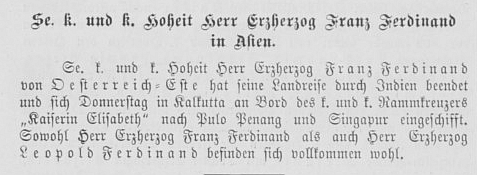
Franz Ferdinand is leaving India, in good health. Wiener Salonblatt 2. April 1893, p. 4

Franz Ferdinand is leaving India, in good health. Wiener Salonblatt 2. April 1893, p. 4

Lucknow to Calcutta, 28 March 1893

On the familiar line we rushed towards Calcutta. Everywhere the fruits in the field were ripe and people were hard at work to harvest crops and fruits. The heat had considerably increased and was nearly intolerable within the wagons. The atmosphere  lay sweltering and sticky in the country-side that extended itself in a melancholic  gray in gray in our sight. A hot wind  whirled thick clouds of dust into the air — thus the Indian plain made a quite desolate impression during the time of our departure.

Links

  • Location: Mughalsarai, India
  • ANNO – on 28.03.1893 in Austria’s newspapers.
  • The k.u.k. Hof-Burgtheater is closed until 2nd April, the k.u.k. Hof-Operntheater until 1st April.

Sohela to Lucknow, 27 March 1893

Even though the railway was only being constructed, as already stated, and only the base layer had been rather sloppily, nevertheless a train was put on provisional rails that took us and our baggage at a slow speed from Sohela up to the border river of Sarda where the railway bridge was being completed. Here our baggage was carried by coolies across a pontoon bridge nearby while we reached the opposite shore in a boat guided by a railway engineer. This proved to be a difficult task as the gentleman knew very little about naval matters and sent the boat twice into sand banks in the middle of the river so that we were stuck amidst the waves until wading coolies managed to liberate us out of this unedifying situation.

At the other shore a special train was waiting that took us, after everything had been loaded, on the line of the Rohilkund Kumaon Railway to Lucknow. A heavy storm raged in the sky with thunder and lightning and the first drops of rain started to fall when the train departed, First the railway crossed beautiful jungles, similar to those we had found in Nepal, with teak and shala woods. Then the landscape changed to the monotonous character of the Indian plain. We passed the time with sleeping and reading until we arrived towards 7 o’clock in the evening at Lucknow. As we had to change wagons and the transfer of the baggage made an immediate departure impossible, we used the pause to a stroll in the mild night in which the moon was shining brightly.

At  11 o’clock we entered the train that took us without interruption first on the line of the Oudh and Rohilkund Railway via Jaunpur and Benares to Moghal Sarai and from there on the line of the East Indian Railway to Calcutta.

Links

  • Location: Lucknow, India
  • ANNO – on 27.03.1893 in Austria’s newspapers.
  • The k.u.k. Hof-Burgtheater is closed until 2nd April, while the k.u.k. Hof-Operntheater is performing the comic opera „Freund Fritz“.

Bhanderia to Sohela, 26 March 1893

Today it was time to say good-bye to beautiful Nepal; saying good-bye to the Nepalese natives, namely the hunting masters and shikaris, those splendid fellows who gained our highest esteem during our all too short stay; saying good-bye to our brave Hathis that had carried us faithfully and diligently for three weeks on many difficult marches and hunts.

Filled with the most beautiful memories of this successful and extremely interesting hunting journey, of strange events and of a fancy-free life in tents in the natural jungle we left Nepal. As if heaven wanted to make our departure very painful, the day was gorgeous and cloudless. The blue mountains and the glacier peaks gave a parting salute to us. The green jungle with its mighty shala trees lay very invitingly in front of us, so that we started to another tiger hunt.

Almost everyone of the brave Nepalese came to express his regrets of our departure. The uncle and nephew of the maharaja had turned out in full dress for their final attendance call. The former wore a colonel’s uniform, the latter one of a captain in the Nepalese guard. The uniform consisted of a darkblue, enlaced coat and similarly decorated pants made out of a thick barracan cloth. The headdress was formed solely out of a gold circlet with a golden cockade which was ornamented more or less richly with gemstones to distinguish the different ranks. I presented the two gentlemen with my photograph and also a large gilded hunting knife, truly monstrous weapons, which caused quite a bit of pleasure for the brave gentlemen. They placed the weapons immediately on their uniforms and had their picture taken in this outfit.

Then it was the turn of the lower civil servants, the mahauts, the soldiers of the escort, with one word, everyone of this small people, in whose land we had spent three weeks in the most agreeable manner, came to pay their respect and to perform their selam, after which the people were paid. It was a pretty picture to see them march past, the mahauts on their elephants in front.  receiving pay and tips and expressing their thanks. A comical appearance made our native post master who, having just received his pay, asked for a certificate that confirmed the honest means of getting into possession of this sum.

The others all asked for written references confirming „good behavior“, a request whose granting kept us at work all morning as the writing, signing and sealing of the letters went on without end.  The people expressed real joy about the red-white of the stamp of my chamber administration as these were also the national colors of Nepal.

Finally the camp was dismantled and everything packaged. On our elephant, we waved to all our friends a final salute of good-bye; then the caravan started moving to cross the border and advance south towards Sohela, the next camp location. We had intended to hunt during the march on Indian territory up to Sohela as there were, just as in Nepal, favorable jungles but the Nepalese, uncle and nephew of the maharaja, would not move into Anglo-Indian territory for any reason.

Even though this interfered with my hunting plans, I could not feel bad about the Nepalese strict refusal to break their complete isolation of their country from the Anglo-Indian territory. The constant concern of an annexation of their country by England seemed to be all too real, given the experience of the neighboring formerly independent princes, and the systematic limitation of traffic between Nepal and India seemed to be the only policy to preserve, at least for the present, Nepal’s independence.

The friendly relations, however, which we had with the Nepalese, perhaps intensified by the personal presents of the hunting knives made the representatives of the maharaja willing to offer special concessions. They were as follows: The Nepalese agreed to supply one hundred elephants under the command of a native captain especially for the purpose of our planned hunt on Anglo-Indian territory. But this was linked to the condition that these people were to return on the same evening with their elephants back to Nepalese territory.

On Indian ground we were received by an English official and  a chief forester who is in charge of around 115.000 hectares of the most beautiful teak and shala woods, a most precious stock. These forests were operated by some sort of selection cutting, i.e. the demand for wood for the government is met by cutting the most beautiful trunks in a forest area without there being a cultivation in our manner. The rejuvenation  takes place by spreading seeds. The new growth is left to nature.

In view of this mode of forestry, the task of the chief forester is mostly  limited to the construction of roads to transport the wood out of the forest, to the cutting of wooden ties for the local railway currently under construction in the district and protection of the forest. Given these elements of his duties, the chief forester does everything he can to prevent forest fires. He even asked us vividly during the hunt to refrain from smoking — a policy limitation that was in sharp contrast to the surrounding free nature.

We moved first along a recently constructed road through the forest, then turned south and formed a line for a hunt. Then we crossed a grass jungle that was very rich in furred game and water fowl so that we shot muntjacs, black boars and swamp deer, but the game was relatively timid and many a bullet missed its target in the grass. Then the chief forester proposed to go to an especially fine jungle, namely a wood surrounded by a stream at whose shore tall reeds were growing . But the brave man erred in regard to the quantity of game in this part of his district. The elephants only managed to advance at great difficulty as it was necessary to incessantly cross swampy spots and fallen trees. With the exception of metal storks and cormorants, we found no game here.

Finally we asked the head hunting master to cease further hunts in this terrain. He then lead us into a water jungle in which our elephants were nearly forced to swim and where only frightened water rails took flight.  It looked like the head hunting master did not know his assigned district very well and only special hunter’s luck led us by accident to an especially suitable hunting ground where we not only immediately discovered game but also namely peacocks.

Suddenly I heard a peacock cry loudly to the left of me and saw a whole flock take flight, a certain sign that a larger predator was in the jungle. Truly, the welcome cry of „Bagh! Bagh!“ soon rang out and by instinct all elephants rushed concentrically towards the spot where the cry was uttered. The circle was quickly formed, two shikaris rode for a long time within it. Finally the grass started moving, the elephants trumpeted — but instead of a tiger it was a very strong male boar that moved towards me. I shot it and ask myself if the drivers had shouted „Bagh“ just for fun? Given the great experience of the Nepalese this did not seem plausible but must have been true as there was no more movement within the circle and all mahauts rode up with their elephants to have a look at the boar.

Then a panther jumped between two elephants. The panther had been hiding motionless in the grass, escaped through the line in the confusion caused by the unexpected appearance and fled into the neighboring jungle without any possibility of firing a shot. Now it was the turn of the brave Nepalese again to display their skill. In no time we had encircled the panther again and I fired when I could see its skin through a small opening. The panther was wounded, fled into the grass and was just starting to jump at my elephant when the resident standing next to me killed it with a shot. The panther was small so that the large caliber bullet of the resident smashed in the whole head while my bullet sat between the breast and the neck.

Even though there were still some very inviting jungles close by, the Nepalese asked to return home with the majority of their elephants in order to reach the Nepalese territory before the sunset. We could not deny their request and thus we rode on riding elephants to the camp at  Sohela, at a distance of 16 km from the camp at Bhanderia, while the Nepalese marched north in long lines. How much we would have wanted to follow our hunting companions north!

The camp was close to the railway line under construction that was intended to lead from Mailani, a station of the Rohilkund Kumaon Railway, north over the Sarda river to close to the Nepalese border. The construction of this branch railway line serves mostly to develop the boundless woods close to the border which constitute an important but currently non-productive capital stock.

The last evening in the tent camp we devoted to the compiled listing of the hunting results  of our Nepalese expedition. It refreshed such rich memories of those felicitous and happy days!

Links

  • Location: Sohela, India
  • ANNO – on 26.03.1893 in Austria’s newspapers.
  • The k.u.k. Hof-Burgtheater is closed until 2nd April, while the k.u.k. Hof-Operntheater is performing the ballet „Excelsior“.