Kategorie-Archiv: diary

diary entries of Franz Ferdinand

Benares, 11 February 1893

In the morning I again walked through the streets along the temples and the river — the same images, the same effect.

Towards noon the Maharaja of Benares, Brabhn Narain Singh Bahadur, paid me a visit. As splendid the gentleman was decorated with precious stones, his overall appearance was less than princely: His state carriage and especially his body guard which sat on discarded horses and partly wore old English uniforms looked really miserable. He is a charming friendly old fellow and apparently a passionate hunter who is never separated from his  express rifle carried along by a servant event to all his visits and public events. In response to my question he answered that he had killed 60 tigers in his state. That a group picture was taken by a photographer in front of the palace hardly needs a mention.

The return visit I paid in another of his palace which was in a deserted and deplorable state. On that occasion the Maharaja wore even more beautiful diamonds. The palace only contained a gallery of Europe’s crowned heads, ugly lithographs, which constituted the main decoration of the reception hall where the Maharaja and I sat down for a few minutes on some sort of throne.  After we had exchanged our photographs, the prince gave me an ivory carving he considered of being of very high value. Finally we went to the station accompanied by the Maharaja.  Our train would take us on the East Indian Railway to Agra by the way of Allahabad and Kahnpur.

Links

  • Location: Benares, India
  • ANNO – on 11.02.1893 in Austria’s newspapers. The Wiener Salonblatt spares but one sentence for Franz Ferdinand’s Indian adventures in its issue of 12 February 1893, p. 3.
Wiener Salonblatt, 12 February 1893, issue 7, p.3: Franz Ferdinand in India

Wiener Salonblatt, 12 February 1893, issue 7, p.3: Franz Ferdinand in India

  • The k.u.k. Hof-Burgtheater plays a drama “Eine vornehme Ehe“ by Octave Feuillet, while the k.u.k. Hof-Opermtheater offers Jules Massenet’s “Werther”.

Benares, 10 February 1893

Whoever arrives directly from the majestic cold of the Alpine world to Benares will believe to be in a madhouse. Gods and humans, religion and madness; mysticism and superstition; asceticism and luxury, echoes of deep truths and denial of common sense, godly praying men and crazy fakirs, burning Hindus and dancing bayaderes: all of this is grouped at the river in a hundred varieties and forms, bottles up the streets of the city, rushing, squeezing, pushing, driving — united in a maelstrom and vortex which threatens to envelop the starring stranger made speechless out of astonishment. Only slowly is it possible to collect, observe and think in the midst of this huge human aberration and the infectious manic force.

Benares, the holy city of the Hindus, is the largest place of an annual pilgrimage in India visited by a few hundred thousand pilgrims. It lies on the left, northern bank of the holy Ganges river an covers a large area — containing 222.000 souls — which is filled mostly by temples, mosques and palaces of Indian princes. There are, besides other religious buildings, 1454 Hindu temples and 572 mosques. The city, an ancient site of Brahmin erudition, was originally only dedicated to Buddhist believers until that was displaced by Brahmanism. In the middle of the 17th century incorporated into the Mughal empire its place as a holy city of the Hindus was temporarily lost, namely by Aurangzeb, as eager a believer in Islam as a persecutor of Brahmanism, who had all temples destroyed, scorning the Hindus, and erected partly on the ruins of these temples a large number of mosques along the shores of the Ganges. After the fall of the Mughal reign, having regained their strength, the Hindus built nearly one thousand five hundred new temples displacing the mosques. Even if their number and style might astonish us, we still notice a certain uniformity of style, a feature explained by the fact that all Hindu temples currently standing in Benares date back no longer than the 17th century.

The sun had hardly pieced the morning mist hanging over the holy Ganges when we were already at the shore of the river. Here we rented a short rowing boat and had us rowed up and down the river in order to gain an overview of the palaces and temples and life at the shore. Above the shoreline are a number of palaces that Indian princes such as the Maharajas of Nepal, Jeypore etc. had constructed as local residences for the large number of annual pilgrims from their state. Galleries with ornamented fronts flanked at both ends with massive corner towers are common. Between these palaces stand here and there many Hindu temples, some well maintained some in ruins many of which have been undermined by the active river while others incline so strongly that the difference to the vertical is way beyond that of the leaning tower of Pisa.

Everywhere large open stone stairs (Ghats) lead down to the water in front of the continuing rows of buildings. On these stairs there is a lot of activity going on in the morning which at first seems surprising to a spectator and defies description. Here the pilgrims and the majority of the population of Benares congregate to bathe in the holy river and thus receive absolution for all their sins. Here, the religious life, thinking, feeling and striving of the Hindus are pulsating. Here the scrupulous observation of religious obligations is transformed into crass fanaticism, indolence into enthusiasm. Laymen and priests, men and women of all ages, boys, girls and children push in masses to the get into the water. There a poor old man with snow white hairs, freezing from the cold, submerges himself in the water. Here a group of Brahmin take an expurgating bath. A grandmother old as the hills led by her nephew approaches the river. There a group of bathing girls whose joy is not suffocated by belief. Fidgety crying children are doused with water or dunked into the muddy broth by their parents. Everywhere, however, modesty is preserved and even in the water the light linen cloth are never removed.

The morning was very cool — we were sitting in overcoats in our boat — but the severe cold id not in the least impede the faithful in taking their bath or to remain in the water for extended time. The bathers drank from the disgusting water which has the power to absolve the mortal human of his sins thanks to Shiva’s grace. They sacrifice flowers and rice and other agricultural products. The Brahmins are performing their holy rituals especially festively and glance at the sun, murmur their prayers and offer their sacrifices in strange ceremonies. Pilgrims take the holy water of the Ganges home in large copper containers. The water is also sent out in all parts of the country. In all of Benares one can see carriers of this holy liquidity in the streets.

Just above the bathing places on the Ghat are pillars on stone slabs on which Brahmins are sitting who paint caste signs with diversely colored sandalwood paste on the front and cheeks of the returning bathers. Barbers too had set up their business and were hard at work.

The most terrible spawn of religious paroxism, true caricatures of mankind, however, are the fakirs who are legion in Benares. They sit motionless on the Ghats or on planks swimming in  the river, mostly naked, smeared in mud or ashes. Their livelihood is provided by the charity of the believers.

Amidst all the bathing places are the burning locations where numerous Hindu bodies are daily transformed. It is said to be especially godly to be turned into ashes or even die at the shores of the Ganges and serves as a pledge of entry into heaven. For this reason many dying have themselves carried from far away places to the holy river by their relatives to exhale their last breath in view of the flowing river. If death doesn’t strike quickly, the caring relatives will probably assist the process to be able to return home soon. The bodies are handled without piety according to the custom of the land. They are first shaved and washed under the open sky and then put on a wood pile and quickly burned while the relatives quietly and without involvement watch. Finally the remains are thrown into the Ganges close to the places where humans are bathing and drinking the murky water oblivious to the human body parts Vultures, dogs and ravens fight eagerly for so many half-burnt bone.

For a long time, I watched this activity as if to assure me that these disgusting acts were truly happening and not a dream — then I turned myself away with revulsion even ill will from this grizzly spectacle that scoffed human dignity.

Out of the skyline of temples and palaces, the large mosque of Aurangzeb with its large round dome and two thin minarets that tower over the whole city stands out. The mighty conqueror had built the mosque on this especially holy location of the Hindus. On steep dirty stone stairs we went up to the forecourt where a muezzin received us with bows and humbly invited us to go up to the top of one of the minarets. From the first platform, the mosque’s ceiling swarms of parrots and pigeons took off  terrified from our unexpected appearance. The further ascent was difficult as one could only advance at a snail’s pace in the narrow space with incredibly steep steps. The grand view over the whole city an the holy river, however, compensates for the effort. The numerous domes of the temples are glittering in the sunshine. A sea of houses lies at our feet. Majestically the mighty river flowed past as if he disdained the maniac actions of these humans moved like puppets by a dark force.

A walk through the praying crowd led us past holy cows, donkeys, goats, sheep and dogs. All those animals stand around in the pushing crowd — truly a drastic background of an image confusing the senses! A large number of vultures and red kites is sitting on the roofs or between the pedestrians eating all garbage on the ground. Goats and sheep intrude into the temples and small temples and eat the sacrificed flowers and wreaths from the idols. We reached a spot where a very holy fakir was mumbling prayers without interruption, having sat there for many years and being supported by alms from believers. Fanatics who want to become dignified fakirs try to obtain the first grade of deadening their senses by holding their breath until they turn blue and green and nearly suffocate. Day after day this procedure is repeated and continued until a state of perfection is attained to reach the desired goal.

A cistern,  the holy Manikarnika fountain, 12 m square, with steps that lead down to the water — said to be built in the form of a mythical pond in the Himalayas — is a place of special veneration for the believers. For us it is horror. Here the believers were bathing before they submerged themselves in the Ganges — or more precisely they wallowed in the manure and drank from the foul slurry of decaying matter, old dirt and  ill-smelling water.

Over steep stairs along a narrow road we walked to the main Baleshwar temple dedicated to Shiva — called the „golden temple“. The incredible turned into reality: as in the streets and even more in the temples the action of the pilgrim became still crazier than at the riverside. The streets consist mostly of a never-ending row of temples with beautiful and original architecture, proof about a fine taste in art and beauty. Temples and images of the elephant god Ganesha, the monkey god Hanuman, Shiva, the holy bull Nandi, — the Indian Apis — the Lingam in all possible forms and sizes followed one another in a colorful sequence. All holy places were decorated with wreaths by the pilgrims, sprinkled with Ganges water or turned into places of sacrifice of butter and rice. In between merchants were offering with great clamor praying books or small images of the gods while unemployed Brahmins approach to offer their services as guides. The closer we get to the golden temple the denser the pushing and shoving.

Passing by a large symbol of a bull which was being watered eagerly with the Ganges water, we reached the „fountain of insight“ (Gyan Kup), into which during the conquest of Benares by Aurangzeb, according to legend, the guardian of the most noble Hindu temple had thrown  the image of Vishnu which had been placed under his protection.Today, this fountain only offers foul water of which every pilgrim will receive a spoonful from a Brahhmin in exchange for a suitable baksheesh.

The Golden Temple which we could see very well from a balcony in a building opposite it, is around 200 years old, made completely out of red sandstone and with gilded cone-shaped ceilings paid by Maharaja Ranjit Singh from Lahore. This ornament has given the temple its name of „golden“. Within and outside, the temple is a true pandemoniums of religious ecstasy that drives the lives of the pilgrim to the highest pitch. A complete crash of human rationality is demonstrated by the behavior of the believers. Even though admission to non-believers is strictly prohibited, we nevertheless entered as far as the threatening means of the pilgrims allowed, guided by a Brahmin supplied copiously with baksheesh. What I have seen is sufficient to give a true image of the interior of the largest an most holy temple of the Hindus, to see the night of madness that overcomes those. The main idol in rich majestic surroundings is an object of a creative force, a Lingam, around which dance a fanatical crowd of beggars, women and men which garland, sprinkle and anoint it without interruption.

In between bells were ringing which were rung by the believers walking among torn flowers, Ganges water and excrement of the holy cows. Arranged around the main idol is a formal museum of other images and idols each of which has its own believers who shout and make noises to perform their rites. Even though we were inside this holy place for only a few minutes I felt dizzy from the relentless impression of so unexpected views. Back in the open air I breathed deeply. The surrounding of the temple is filled with countless lamentable, disgusting, crippled, leprous beggars of both sexes which ask for charity.

Even more horrible, if this was possible, is the temple of Annapurna close by, the temple of the nourishing goddess. All around stand cows considered so holy by the believers that they eat a mixture of all products from the temple cows to be absolved of their sins. Truly a horrible creation of a feverish religious delusion! What a crying hurtful contradiction — here too beautiful architecture, the proof of a blooming human mind, enclosed by dirt, garbage, madness. In the middle of the temple, on some sort of pediment stands a bed, lovingly prepared even with mosquito nets which, according to Hindu beliefs, is used every night by Vishnu’s wife, the goddess Lakshmi, for rest.

I turned to the bazaar and watched some architecturally fascinating facades as well as apparently less intensively visited temples on the way. We were often stopped by the pushing crowd, a true hellish impression in the manner of Brueghel. Here comes a group of pilgrims wet from their bath, there a group of women with Shiva symbols asking god for numerous children, fakirs in their horrible attire and leprous beggars asking for charity. Shrews instructed children on the street in the mysteries of the Hindu religion. Brahmins receive baksheesh from the pilgrims. Noble rajas pass in festive processions, followed by groups of servants and musicians, to the Ganges. Human body upon body only covered with light cloth are carried past me — an interminable change of scenes and images which only the orient an offer in its rich and ugly imagination. Aversion even disgust rose in me and crushed me. Overwhelmed by these impressions and tired, I rushed home to rest.

Newly refreshed I visited the monkey temple in the afternoon. This temple is dedicated to the god Hanuman and offers shelter to countless monkeys which walk around funnily in the interior of the building on its pillars and pediments, fed by believers with sweets and fruits. Only a short time ago there were many thousands of holy monkeys. But their tricks became too much even for the religious Hindus as they caused destruction in all neighborhoods and spared no object from their thievery. This was solved by capturing over a thousand of monkeys, put them in a railway wagons of a special train and drove them off into the countryside and set them free in the jungle. Thus the believers got rid of their tormentor without sinning against the holiness. In the middle of the temple stands a golden figure of the god Hanuman which is visited by both monkeys and pilgrims and is not free from the common dirt.

Here two snake charmers were displaying their art with a number of cobras and pythons. This spectacle repeated itself after our return to the palace when a conjurer presented an interesting fight between a large snake and a small animal looking like a polecat, the so called mongoose. The latter remained victorious. He had very skilfully jumped  at the snake’s head and bit off the animal’s head, even though his opponent fought back hard and had embraced it closely. It deserves to be remarked that entertainers and conjurers play an important role in all of India and distinguish themselves favorably in comparison to their European colleagues in performing their stunts without any preparations.

The dancers performing in the palace after the dinner were quite bitterly disappointing. They lacked all beauty, their dances were very boring so that we became very sleepy soon.

Links

  • Location: Benares, India
  • ANNO – on 10.02.1893 in Austria’s newspapers.
  • The k.u.k. Hof-Burgtheater plays the comedy “Schach dem König“, while the k.u.k. Hof-Opermtheater offers Weber’s “Der Freischütz”.

Darjeeling to Benares, 9 February 1893

At half past 7 o’clock we were awakened in Manihari Ghat at the terminal of the narrow gauge railway, crossed the Ganges on a steamboat and continued our journey at Sakrigali Ghat station with the East Indian Railway on to Mughal Sarai, a familiar journey to us. The landscape we were rushing through can not be compared to the luxurious delta areas. It is nevertheless very fertile, densely populated and intensively cultivated. The shores of the Ganges, being part of alluvial sediments, copiously supplying trade plants, bread and garden fruits, carry with them, like all „bread baskets“ of the earth, a character of monotony. The monotony of the Ganges plain, its fertile plains and green fields is only broken up by numerous mango groves and small hills which are peculiarly only sparsely covered with vegetation but are filled with rocks one on top of the other without a rule.

Towards 8 o’clock in the evening we arrived in Mughal Sarai, continued our journey on the Oudh and Rohilkund Railway, passing casually over a 1200 m long iron bridge over the Ganges and arrived after 8 o’clock in station Benares Cantonment. We were received in the station — in absence of the Commissioner — by Mr. Brereton, a communal councilor, and went to our quarters, Nandeshwar Kothi palace owned by the Maharaja of Benares, escorted by mounted police. Like all modern Indian palaces, it is built very airy, decorated without taste  so that only a few old pictures of earlier Maharajas catch the attention. We sat around the open fire which comfortingly warmed us as India is said to never have experienced such a harsh winter which might be related to the exceptional cold in Europe of 1892/93. In a Raja double bed of enormous dimensions, surrounded by Raja ancestors looking down astonished at me, I soon entered into the sleep of the just.

Links

  • Location: Benares, India
  • ANNO – on 09.02.1893 in Austria’s newspapers. Empress Elisabeth is still sightseeing in Barcelona. A visit to the monastery of Montserrat is on the agenda. Her ship was to set out to Marseille, France. Given the current outbreak of cholera there, her route might change. There was a heavy earthquake on Zakynthos with over 600 houses destroyed, an island Franz Ferdinand passed by on his route from Trieste.
  • The k.u.k. Hof-Burgtheater plays a comedy “Der Präsident”, while the k.u.k. Hof-Opermtheater shows Richard Wagner’s “Rheingold”.

Darjeeling, 8 February 1893

The desire to see the gorgeous mountains again must have been the inspiration for my thought that the fog must have been gone today. Not at all! The fog was still there even though the stars were visible at night and we were spending our last morning in Darjeeling.

As the fog, by the way, was not too dense and one could see the blue sky peak through in some places, we decided to ride to the 2870 m high and about 10 km distant Mount Sentschal or Tiger Hill. From there one should have a splendid view on clear days of the Himalayas, especially on Mount Everest. It was bitterly cold and despite warm clothes and coats we were freezing like on a European winter day but the low temperature especially made us hope that the ride would not be in vain and the desired view upon the proud mountain peaks granted.

The path led from the hotel to the serpentines steeply upwards to the English sanatorium for fever-stricken soldiers who lived in a number of small houses and seek recovery from their ailments. A small English garrison too, probably the highest placed in the world, is stationed here.

On a mountain ledge that in the surging fog resembled a cliff in the moving sea stoo a fantastic temple of Buddha whose construction style is similar to the Chinese pagodas, an architectural sign of the combination of art forms from different peoples and their local points of contact.

Up to here we had expected the weather to clear up as even the sun had made an appearance from time to time. But in vain!  The fog became ever more dense, one could barely see the man in front and so we had to decide to turn back and acknowledge the lack of success of our exertions.

Due to the cold we dismounted from our ponies and ran down to our hotel. Then we visited the bazaar a final time where money changers sat on the ground offering coins from Nepal, Sikkim and Bhutan among which we found rupees, peis (1 rupee = 16 Annas à 12 Peis) and Cowries ( 6400 Cowries = 1 rupee). The well known Cowries are sea snails that have served as coins since ancient times in the orient and especially in Africa (Cypraea moneta). Barbers followed their trade in the open road and merchants sold their goods in their stores.

A special mention merits a strange article available at every Tibetan merchant’s: Praying wheels made out of copper and silver. These consist out of a metal tube through which is inserted an iron bar on whose upper end is mounted a cylindrical box that can be turned. Inside this box is a long folded paper scroll with writings which is turned by the reel within the box.Even the turning of the prayers with the solemn pronunciation of them is considered by Buddhists as a confirmation of piety; the most pious prayers, by the way, also mumble the prayer while they turn the reel of the cylinder. A more drastic and easier form of prayer is the flying of long cloths inscribed with prayers which are fluttering in the wind on high bamboo poles near the temples and the houses and thus send away an protect the buildings from evil spirits.

We clearly have increased Darjeeling’s commercial life and have created the hope in many that it would be possible to make a large transaction especially favorable to the vendor at the last minute. As we were standing, fully packed, outside the gates of the hotel, we were ambushed by countless merchants with cloths, weapons, dogs, pheasants, hides, musical instruments of the most diverse kind and all kind of instruments both religious and secular. Among the devotees to trade stood beggar monks and lamas from Tibet and Mongolia who asked for alms for their temples.

„Lama“ is a honorific title of the priest of Lamaism that is a Buddhism transformed by  Tsongkhapa in the 14th century and popular among Tibetans, Mongols and Kalmyks. The highest priests  in this hierarchy are the Bogdo Lama in Tashi-Lhunpo and the more often named Dalai Lama, Ocean priest — that is the time and again reborn Buddha in human form — in Lhasa closed off to Europeans for the last decades and probably inaccessible for quite some years to come. Finally we had to end the commercial activities around us as time was pressing and fought our way through the standing crowd to reach the station.

Even though the weather had not been kind to us during our short stay here in Darjeeling, I still left Darjeeling very inspired and mentally refreshed. I felt that I could concentrate my mind in this gorgeous mountains an find a benevolent quietness which would make me more receptive for the amount of coming impressions on Indian soil. I had seen the jewel of the mountains, Kangchenjunga, even though for only a few moments. I had enjoyed the Alpine world in the tropical climate in its enchanting marvels, had been given a view on the confluence of peoples of so many races with all the resulting strange mixtures in all human endeavors of life and finally — last not least — breathed in my element, pure heart refreshing Alpine air after the fever and bacteria soaked atmosphere in Calcutta and the interminable smell of coconut oil, rose water, sandalwood and burnt Hindus.

Many of the large number of visitors to Darjeeling every year, despite a stay of two to three weeks, despite  the ascent of so many heights will not catch a glimpse of Kangchenjunga as the mountain giant keeps grumbling for months and refuses to show his honorable old head. I am thus not allowed to complain. As I was saying good-bye to Darjeeling, I felt a resolution growing in my breast to return one day to fully enjoy the attractions of this paradise to my heart’s content — if the powers of fate will mercifully permit it.

At 1 o’clock we departed Darjeeling. For the descent we first used the train but then had the good idea to ask the director for a handcar which offered a better open view. After some resistance against this too dangerous idea, our request was granted and soon we drove down the mountain at top speed in a handcar with twelve seats over curves and serpentines. The lower we came the more the clouds parted, the fog lifted and finally we were welcomed by good weather. What joy overcame us on this audacious drive! Nothing inhibited the full view upon the sea of green mountains, peaks, valleys and gorges over which we seemed to pass in the air as if we were swimming in ether, flooded by the golden breeze of the sinking sun, saying good-bye with its wonderful last rays.

When it started to get dark, the director who cared very much about our bones would not allow us to continue the drive under any circumstances; so we had to wait for the train back that took us to Siliguri. At night, train service is usually suspended on the mountain track. That is why there is no lighting of the tracks. For our trip, the locomotive was equipped with a powerful clear light  in whose shine the trees of the jungle, the lianas, the bamboo flew past like ghosts.

Finally we arrived in Siliguri to continue with the Eastern Bengal Railway on the small gauge track up to Manihari Ghat.

Links

  • Location: Manihari, India
  • ANNO – on 08.02.1893 in Austria’s newspapers. The government’s annual plans are still being discussed in the press. Paris still hot in turmoil even though some parties think that the relative cool down would be suitable to call for elections.
  • The k.u.k. Hof-Burgtheater plays Shakespeare’s “Ein Wintermärchen”, while the k.u.k. Hof-Opermtheater repeats once more “Die Rantzau”.

Darjeeling, 7 February 1893

The first look at dawn was towards the mountains or at least in that direction in which the mountains would be visible. Unfortunately we only saw fog, nothing but fog. In a sad mood I spent a few hours with the diary while the gentlemen of my entourage went to the bazaar to buy some things for me. Among others, they returned from their trip a scraggy true Tibetan mountain dog which I had had shipped home at once: a charming animal, with long hair, black, tanned, sized like a shepherd dog, with smart eyes and a black mouth — a special mark of the breed.

Hides of diverse animals especially that of a beautiful red panda (Ailurus fulgens) which I had seen in the bazaar, made me ask the commissioner to organize a hunt. He explained that all the good places are too far away but that here was a wood nearby where we could try our luck and hunt birds. Though this didn’t sound promising, we nevertheless made ready to go and rode in the densest fog on a small mountain track about 350 m down until we reached a steep mountain hillside covered in the most luxurious vegetation. We left our horses behind and entered the jungle maze in multiple parties. I regretted not having taken my nailed mountain shoes from Goisern. Between the trees, ferns and lianas there were so many steep and smooth inclines that I was in touch with mother earth at any one moment. Such mishaps did not diminish my pleasure to track through unknown and unaccustomed terrain which offered new views with every step. Especially the giant sometimes impenetrable ferns caught the eye. Our ornithological catch proved to abundant, letting us hint at the richness of the Ornis in this area in other seasons of the year.

Having Returned to the hotel towards evening, I was standing in the dining room negotiating the acquisition of interesting objects from Inner Tibet when Kinsky rushed in with the news that the mountains were visible. With a jump I was on the terrace and enjoyed the view for a few moments, a view on the mountains which will be carved into my memory for all my life. As if the spirits had had mercy with the human soul who had ventured from so far away to be at the feet of such unapproachable natural giants to appreciate them in all their splendor — the dense fog suddenly departed at high altitude and laid bare the heights in full splendor of the setting sun, „the five white brothers“, Kangchenjunga before us. In shy awe only dares the eye look at the full view at this majestic image,  locking in on it fully enchanted. A wall of fog as if grown out of the valleys lies just up to the throning peaks which emerge out of the clouds. A settled chapter of the history of the earth, the mountains, the constant in the change, look in Olympic calm on the growth, bloom and decay of peoples — these ephemeral beings in the aeons of existence. Little was granted to my view; but even the little is of such splendor that I could imagine the total greatness of the full picture which was denied to me. A feeling of human helplessness overcame me in view of nature at such a grand scale — even the most hard-headed person has to bow their head in humility and lift it again enthusiastically in view of what had been given to me.

Only one drop of bitterness in the goblet of joy  — that my beloved at home, far away from me, can not participate in this splendid spectacle, in the deepest emotions it awakens. There is truth in the plain saying; Shared joy, double the joy!

The mountain spirits seemed to regret to have experienced a human feeling and to have presented the virgin mountains on which never a human’s step was heard to the eye of mortals  — the fog rises, become denser and denser, the rosy tinted peaks fade away, their contours melt away and finally the magic image has disappeared.

Links

  • Location: Darjeeling, India
  • ANNO – on 07.02.1893 in Austria’s newspapers. The Emperor has visited the new building of the top-notch polyclinic in Vienna’s 9th district in Mariannengasse. His guide was the physician and writer Arthur Schnitzler.
  • The k.u.k. Hof-Burgtheater plays Shakespeare’s “Hamlet”, while the k.u.k. Hof-Opermtheater is performing Meyerbeer’s opera “Die Hugenotten”.

Darjeeling, 6 February 1893

Thus on this audacious human-created vehicle we drove up the Himalaya, the highest mountain range on Earth! Created by elementary revolutions, in nearly unreachable peak striving towards heaven, the Himalaya, „the snow helmet“, rises over the colossal mountain wall which separates the Aryans from the Mongols, India from Inner Asia. Never has an enemy crossed it, timidly they passed it by. Stretching over 24 degrees of longitude, from the Hindu Kush to the gap of Brahmaputra, the Himalaya stands on its northern en on the bare plateau of Tibet and on its southern end on the Indian subcontinental plain. It separates the climates, plants, animals, peoples and cultures of Inner Asia and South Asia.

Through the present valley we approached his region. rise to his southern precursors which look down on blooming, green, luxurious wooden mountains fanned by delicious air. We look out towards the peaks of the central mountain range. Beyond the northern precursor range lies wild bare and jagged highland. Across the wood covered mountains that border this valley to the north the railway winds itself up to Darjeeling, up to the foot of the biggest glacier groups of the Earth, up to the region in which tower Dhaulagiri (8176 m), Kangchenjunga (8585 m) and that highest peak on Earth we call Mount Everest (8840 m) or Gaurisankar. Kangchenjunga — „the five white brothers“ — whose giant mountain range covered in eternal snow, criss-crossed by glaciers and rising out of thick woods we have come to see lies in Sikkim, a small protectorate wedged between Nepal and Bhutan. It is linked to the Ganges plain by the audacious mountain railway that ends in Darjeeling.

Driven by the hope to be able to admire the magic of this incredibly beautiful and majestic mountain world in its fullest splendor, I looked out of my window long before sunrise to observe the weather and draw my conclusions whether we would have a clear, fog free day or not. Even though the morning was clear and the sunrise promised to e beautiful, I discovered in the west small, lengthy cloud streaks which are interpreted in our own mountains at home to all experienced weather prophets as a bad sign as they indicated rain or fog most of the times. Unfortunately, these unmistakable signs proved true here too. When we reached the foot of the outer mountains we saw the peaks already covered in fog.

After 7 o’clock we departed from Siliguri. The mountain railway Siliguri—Darjeeling, which is 82 km long and reaches an altitude of 2180 m is probably the most interesting railway in the world. Not so much due to its construction and installations but because of its incredible panorama views it offers. The railway has a track gauge of only 61 cm. To offer a free full view, it has open carriages and can absolutely be called an audacious and unique work. Please consider this: a mountain railway which reaches such heights without a tunnel and has cost in total — according to the chief engineer — only 231.000 fl. in Austrian currency! The puzzle is partially solved by the fact that the railway ha only construct a special railway bed for 24 km, while it could use the existing mountain road bed which winds itself up in the sharpest turns; the railway ascends in such serpentines and bends that, in many spots, one can already see, some meters above, the tracks to be driven over in the minutes to come Where serpentines and bends would not be sufficient to ascend a steep height, this is solved by having the railway continue straight for a time only to turn at a sharp angle into the opposite direction with the machine pushing, to ascend the heights in a zigzag way.

But what are all this technical arts against the splendor and diversity of nature!  Born in green Styria and loving the mountains above all, it has always been my most ardent wish to get to know the king of all mountains, the Himalaya, and to see the tropical mountain world. Even though I have read and heard so much about the extraordinary beauty of the Himalaya, what I now saw surpassed all my expectations and put me into a state of indescribable rapture.  The light clear mountain air alone is extremely refreshing — no wonder that we all by and then started yodeling in the waggon as if we were in the mountains of Upper Austria. Even though the fog unfortunately covered all peaks with an impenetrable veil and also the visibility from afar was lessened, that what we could see close up was sufficient to make the journey unforgettable.

The attractions of the landscape all around are truly amazing: a mountain higher than 8000 m, covered up to an elevation of 3000 m with tropical vegetation, mighty mountain ranges, deeply cut valleys, overhanging rocks, cragged slopes, boundless abysses — all green or becoming blurred in tender purple colors. And what a plant cover girdles the south end of the Himalaya! The vegetation makes one think of that on Ceylon; but even higher and more beautiful as the giant trees on Ceylon the trunks here with their luxurious leaf crowns strive upwards;  even thicker and wilder are the plants entwined around the trunk and branches. The trees are up to the highest branch covered with ferns, orchids and other parasite plants, while thick lianas connect the trunks with each other. And even cragged slopes, the wildest abysses are covered with a green carpet of thickly placed trees. At each turn, at each serpentine a new image captures us. Especially the many abysses many thousand meters deep which one drives alongside at shoulder length add much diversity to the panorama.

Like the character of the county, so the people have changed — we are in Sikkim, at border to Tibet and China. Here in Sikkim live tribes which even though they mixed their blood with Indian blood and have been influenced by Indian culture,  they remain in type and language close to the Tibetans. The Lepcha people which live in Sikkim and also in Darjeeling, are unmistakably part, despite some Aryan elements, of the semi-culture peoples of the Mongolian race.  Inner Asian imprints are also typical for the inhabitants of the small, dispersed mountain villages. Of pure Mongolian type are the Tibetans who have immigrated here from the north as traders of workers. The type of the Lepchas is completely different from all the peoples already seen. At first glance one notices the features of the Mongolian race:  the yellow-brown color of the skin, the broad face, the small slanted eyes, the strong bulging jawbones, the small stature, the coarse hair, the sparse growth of beard. Both men and women are extremely ugly. The latter have the strange custom to grease their faces with ox blood in winter as a protection against the cold which gives them an especially hideous appearance. The most extreme look are created by widows who color their noses black as a sign of mourning.

The men’s dress consists of a long colored kaftan kept in place by a broad belt into which are pushed weapons, plus at the upper end loose and at the lower end narrowing pants and high colored boots cut from a single hide or Cracow shoes. On the head, the lepchas wear felt hats or caps strongly reminding of Chinese caps. The neck is embellished by silver gems, small turqouis amulets or coral bands. Some men wear instead of the Kaftan some sort of shirt and cover it with an open coat made out of thick loden. The women have wide clothes with folds as well as belts and seemed to love jewelry very much as even the poorest adorn themselves with chain-amulets and especially turqouis ear rings. Some wear on their head a straight standing circlet of turqouis and coral. The braids which adorns both genders as well as the fingers are decorated with rings.

During the drive we came past some small villages. Our wagons nearly touched the houses and this offered us the opportunity to glance at the activities of daily life of the Lepchas who still are at a still very primitive level of civilization. A chilling impression during these observations make the ugly dirt which is everywhere. Strange is the common method here to determine somebody’s age. The Lepchas calculate their age according to the number of worn clothes. Thus one gets the answer: „This one or that one is seven clothes old.“

From time to time there is a stop at a station to refill water for the locomotives. These moments are used by the natives to close in to the wagons and offer many beautiful weapons, especially sharply polished knives.

At the elevation of 1525 m is a subsidiary of a Jesuit college of St. Xaver in Calcutta. Then it goes up even more and finally we drive past some patches of snow, the marks of the last strong snowfall.

The higher we were the colder it was and the thicker became the fog so that the view around became more and more limited. One could not see anything of the mountain peaks and also the valleys now began to covered in fog. Thus I had time to look at things at a closer range, to look at the fauna. The mighty giant trees with their aerial roots enchanted me not less than the huge diversity of ferns of which there were many species from the mighty tree fern which grows here in large quantities to the small ferns that resemble female hair.  Up to now I had seen tree ferns only as crippled specimens in our green houses. Now I could see thousands of these splendid plants at an elevation of 2000 m.

„At higher elevations, the beauty of the landscape is impacted by the many tea plantations;  because everywhere, even at the steepest inclines and at the most cragged slopes has the cultivating hand of man seeking profit destroyed the majestic jungle.and replaced by rows of tea plants. Against the ancient trunks of many hundred years is raged barbarically; as wood is of so little value here that one uses a simple method to gain more space for cultivation: The woods are simply burned to the ground on thousands of hectares. The prose of economic life does not feel constrained by the poetry of the enchanting vegetation. It is understandable then that the destruction of the woods ordained to death is proceeding in the cheapest way possible at large scale. But the unplanned destruction may cause grave problems. The wood will revenge itself for the neglect. A hurtful feeling rises in a friend of woods when he sees pillars of smoke grow out of fires that destroy parts of ancient wild nature — only to gain ground for the cultivation of tea. How large the economic interest may be, it can not excuse that tea has been the driving force or excuse to organize countless soirées and afternoon teas.

At 10 o’clock in the morning, we reached Kurseong Station, where Hotel Clarendon was festively decorated, and arrived at 1 o’clock in Darjeeling, in Tibetan „sacred place“. Here we were received by the deputy commissioner Mr. Waller and major Ommaney as well as a large crowd of Europeans and natives.  Darjeeling, founded in 1835, is now the capital of the district of the same name  (3196 km2), which the English have split off from the protectorate of Sikkim, whose raja resides in Tamlung, for an annual rent of around 3750 fl. in Austrian currency.

Due to its high elevation and its gorgeous climate, Darjeeling is a favorite summer retreat in India. Its mild climate, which equals about that of Meran, is given testimony by the fact that in this blessed place tea is planted at up to 2000 m, fruits at an elevation of close to 3000 m and the cultivation of grains is possible at more than 3000 m. The small town consists beyond the small native quarter with a rich bazaar mostly of villas, hotels and public buildings, in particular Sanatoriums and hospitals which overflow in summer with Europeans, mainly from Calcutta. Situated on a flank of the Jalapahar, a ridge of the main Himalaya range, Darjeeling is looking towards the north on to the mountain of Kangchenjunga, while in other parts of the world the eye can see numerous mountain ridges, peaks and green valleys of the mighty mountain. From time to time, the sun made an appearance and peaked for a few moments at the houses of Darjeeling The mountains remained covered in impenetrable clouds.

We first made ourselves comfortable in the Woodlands Hotel and then began to take a walk to a bazaar which turned out to be a rich ethnographic treasure for me. Here were interesting weapons, knives which could cut rupees with a single strike, strange sun dials on a stick, numerous idol figures in bronze, original jewelry, finally a number of musical instruments and drums, among them some made out of human skulls,  as well as pipes from human hip bones. The drums consist of two inverted skulls pushed together whose lower parts have been cut and replaced with hide. A drumstick with a metallic button makes it vibrate to create sound. The skulls are said to be of adulterers who were condemned to death in Tibet and whose heads are then reused for musical purposes. A drastic expression of deterrence theory! At a German trader’s I found a valuable butterfly and bird skin collection which I acquired for my museum. Darjeeling yields the most  in all of India in terms of butterflies and beetles; the diversity and color range of the individual specimens is truly wonderful.

Our hope that we could see the mountains even for an instance was not realized; the fog proved to be merciless.

In the evening, after the dinner which we took freezing in an airy glass saloon of the hotel, we were surprised by Mr. Waller with a Tibetan dance which was performed in an open space even though it was raining heavily. This did not cool the fiery ardor of the dancing artists. The accompanying music resembled Indian music in its monotony, with plentiful use of kettledrums and cymbals. The dance was much more intense, even wild and more adapted to the character of a rebellious mountain tribe. Especially the ladies were in their movements very active and accompanied the dance with a howling song which sounded like a war cry. Men and women did not dance together but separated according to gender. The dance illustrated, among others, the fight against wild animals. Two men who wore grotesque masks similar to our clowns rushed as „wild animals“ at one of the dancers and began to wrestle with him, which then turned into an alternating dance of the wild animals and the dancer. Dragons, lions and giant birds were brought alive drastically by the artists.

Links

  • Location: Darjeeling, India
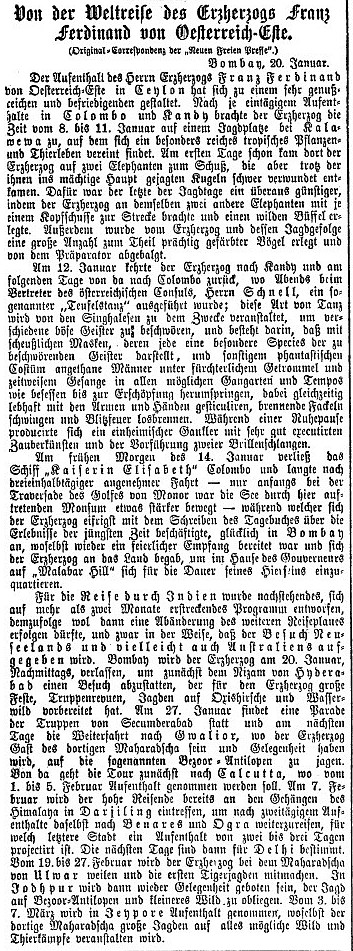
  • ANNO – on 06.02.1893 in Austria’s newspapers. The Neue Freie Presse offers a recap of Franz Ferdinand’s stay in India up to now and an outlook of his trip to Nepal in March.
Franz Ferdinand in India, Neue Freie Presse 6.2.1893, p. 3, part a

Franz Ferdinand in India, Neue Freie Presse 6.2.1893, p. 3, part a

Franz Ferdinand in India, Neue Freie Presse 6.2.1893, p. 3, part b

Franz Ferdinand in India, Neue Freie Presse 6.2.1893, p. 3, part b

  • The k.u.k. Hof-Burgtheater plays a comedy “Der Störefried”, while the k.u.k. Hof-Opermtheater is performing a ballet “Ein Tanzmärchen”.

Calcutta, 5 February 1893

In the Roman-Catholic cathedral of Moorgheehatta, dedicated to the Virgin Mary of the Holy Rosary, we assisted a festive mass celebrated by the archbishop Paul Goethals, a Belgian by birth and a member of the Jesuit order. In front of the church stood a honor guard company with a music band and the pupils of the Moorgheehatta orphanage who pleased me with a rendition of our anthem. „Gott erhalte“ was also sung by the choir in the church. The whole church was filled with believers among them I also discovered Braganca who had arrived that morning in Calcutta to spend a few months in India. We left the church to the sound of „O. du mein Österreich“.

I said good-bye to the archbishop, a most kind person, and drove to the St. Xaver Jesuit college where 800 students from various nations and religious creeds are taught the gymnasium curriculum. The numerous schools and colleges owned by the Jesuits in India are very popular among the natives. Attendance is growing year by year and even the English unanimously declare them to be the best schools in the country. The Jesuits follow the principle of not proselytizing for the Catholic religion in school but let them observe the creed of their fathers and only strive to train educated and honest men; a process in which they decisively defeat timidity and suspicion. The Fathers are almost all Belgians. The building is very large and contains a chapel, large school rooms, numerous living rooms for the Fathers etc. A large playground allows for recreation and physical training of the youth something the Jesuits rightly consider very important  The physical cabinet deserves a special mention. Its Rector, Father Lafont, demonstrated the instruments he has collected over the years with great enthusiasm. Among them are dynamos and multiple steam machines as well as a small phonograph which is the object he is most proud of and which played „Gott erhalte“ without any errors.

As the train to Darjeeling would depart only at 4 o’clock in the afternoon, the vice-king proposed to visit his countryside retreat in Barrackpur north of Calcutta. I accepted this proposal with pleasure. We embarked near the High Court on the steam launch „Maud“ and drove up the Hoogly amidst numerous ships, passed the large bridge, then the burial places where just three Hindus were transformed into ashes and then found ourselves soon between green smiling banks on which small villages and quite a number of modern Hindu temples alternated, as well as a few country houses of rich people from Calcutta which were partly visible through the rich green of the trees.

The Hindu temples are built in most varied forms. Some are round sugarloaf-like buildings, others are complexes of a number of smaller temples and structures whose individual parts resemble the dome-shaped roofs of Moscow’s churches. All temples have large open stairs that lead directly to the water of the holy Ganges river and are used by the believers to perform religious ritual cleansing at the foot of the stairs.

For quite some time we moved up the river. then „Maud“ landed at the park of the country retreat. Through a thick bamboo alley where I discovered a mongoose sitting near the road we reached the residence of  Barrackpur built by governor-general Marquis of Hastings. It is in Richmond style, characterized by its park of meadows and singly spaced trees.

Lord Landsdowne unfortunately suffered from a strong case of neuralgia which forced him to retire while we ate lunch with Lady Landsdowne and the wife of the personal physician  under a large Ficus religiosa tree. We had barely taken our seats when hundreds of red kites appeared and demanded to be fed on the spot and with such intensity that they had to be kept at bay with poles. During the lunch we fed the red kites with meat and enjoyed watching their ability to catch the pieces thrown in flight and also how tamely they took meat from our forks.

Naturally, there was the inescapable photographer present and only after countless takes we could say good-bye to Lord and Lady Landsdowne who had gained my complete sympathy by their kindness during my short stay in Calcutta. The vice-king used to be governor of Canada and resides now for four years in India and desires to return next year to his estates in Ireland when his regular term of five years ends. The office of governing and administering all of the Anglo-Indian Empire demands his fullest attention and he undertakes an annual inspection tour through the major cities of India and to the Maharatas, the hot season he spends at Simla at about  2700 m in North-western India in Punjab. He seems to be a passionate gardener and knows much about botany so that our conversations often were about the art of gardening and farming, areas he covers with much pleasure. Lord and Lady Landsdowne have two children who I also met. The son usually studies at Oxford while the daughter blossoms as a charming presence in Government House.

At 4 o’clock in the afternoon we departed from Calcutta. We left Barrackpur with the Eastern Bengal Railway, which crosses the Ganges plain in North-eastern direction and terminates at Damukdia Ghat on the right bank of the Ganges as a normal gauge track.  On a large steamboat we crossed the river and again used the Eastern Bengal Railway at Sara Ghat which leads from here in a northern direction to the foot of the Himalaya mountains on a narrow gauge track. To cover the distance from  Damukdia Ghat to Sara Ghat station is dependent on the season which influences the currents of the Ganges. Under favorable conditions it takes 20 minutes to cross. We used this time to eat dinner and, back on the railway, went to sleep early as far as the unfortunately also narrow gauged beds permitted. From Siliguri on, the Eastern Bengal Railway connects to the mountain railway to  Darjeeling.

Links

  • Location: Siliguri, India
  • ANNO – on 05.02.1893 in Austria’s newspapers. The Austrian annual government plan is revealed to the public and discussed in the press.
  • The k.u.k. Hof-Burgtheater plays a comedy “Wehe dem, der lügt” in the afternoon and another comedy in the evening „Der Veilchentreffer“, while the k.u.k. Hof-Opermtheater is performing once again “Die Rantzau”.

Calcutta, 4 February 1893

Early in the morning we wanted to visit the famous temple of Kalighat, in which humans were once sacrificed (now, the sacrifices that are offered are only black buffaloes and goats). For this excursion, we crossed a district of the native city with numerous bazaars where small images of household gods are sold. This temple is dedicated to the black goddess Kali, the wife of Shiva, whom, according to legend, was torn to pieces by her husband in the air. At that point, a piece of her finger landed on the spot which the temple of Kalighat was built.

The name of the temple means „step (ghat) to Kali“. The same word is also, by the way, attributed to the name of Calcutta, which has been transformed with time from Kali-ghat to Kalkota, Kalikut, Golgota, even with the considerations of mortality in ancient Calcutta to Golgatha (place of the skull). According to other linguists, the ancient name of Calcutta has been Kalikschetra. As an aside, our naming of the turkey as a „Calcutta chicken“ is derived from Calicut on the Malabar Coast.

Unfortunately, we were disappointed to learn at our arrival that the animal sacrifices would be performed later and the Brahmins did not permit us to enter the temple. Even our presence in the antechamber seemed to instil ill will as a lot of crones (who had come to bring offerings for the goddess) were shocked in seeing the unbelievers here. They complained loudly and turned around cursing. In the antechamber, we at least saw the wooden prongs in the ground between which the heads of the sacrificial animals would be pushed.It was a sign of good fortune; it grants a wish if the Brahmin cuts an animal’s head of with a single strike, while the opposite is attributed to ill luck. The people thus made sure that the neck of the sacrifice is under sufficient tension to assist the strike, though much cruelty to animals is naturally happening. The butchering Brahmin has made a large fortune, it is said, as he collects up to a thousand rupees per day for his performance.

At 9 o’clock a visit to the royal mint in Calcutta was on the program. The mint has been praised for its performance and size of its machine equipment. A really colossal enterprise which delivers 300.000 to 400.000 rupees on a daily basis without reaching its capacity limits. The silver and copper coins are in separate buildings.  The former mint was built in Doric style, the latter is in a large composite of building blocks. The director guided us personally through the rooms and workshops, explaining the manufacturing process of all the steps and even pointed and demonstrated the counting and packaging. Where it was possible, the most practical and fitting machines are used. The machine, which sorts the punched out coins according to their weight, removes the pieces that are either too light or too heavy. This reminds me of a thinking being. The transformation of silver bars into blank and beautifully coined rupees is done at an astonishing speed thanks to these machines.  One automatically starts to muse about the function of the famous installation on whose one side hares are chased and thrown into the machine only to emerge as finished hats on the other side! It is unfortunate that even the grandest mint, the most ingenious machine of the world, can not stop the price from dropping on the value of silver. This phenomenon will cause the Indian government much trouble. Apart from the coins for Ceylon and India, the Calcutta mint produces also coins intended for Africa and numerous English war medals.

In the afternoon, I drove with the vice-royal couple in a high coach to the final number of the three hours long military sporting event, which took place on the racing course in front of a large tribune and a large crowd of spectators, among them many pretty ladies.

At the prize competition of driving multiple guns with their teams they had to do very sharp turns between pegs close to each other and do figures of eight. Only a single of four guns managed to complete the task without error.

A quadrille of the mounted Calcutta volunteers were well intentioned, but turned out only average at best. This formation is composed from members of the merchant community and other peace-loving professions, mostly of older people who meet twice weekly to so called exercises and vividly recall their own patriotic civil guards. Their riding skills and the condition of their horses lets one assume that this formation will not pose much danger to an enemy.

Rather well did the English non-commissioned officers and soldiers perform their deeds in gymnastics and leapfrogging. Participation and interest of the highest degree were given by the audience to the tug-of-war in which ten men from an infantry regiment competed against ten artillerymen. Specially chosen strong persons stood opposite each other and the struggle went on to and fro for a long time. A general commotion made the two regiments whose men were all sitting in the audience. Bets were placed and all the competitors encouraged with shouts. At one time the infantrymen had already drawn eight men on their side, but suddenly, their luck changed and after a quarter of an hour the artillerymen won. In this moment four men collapsed from exhaustion and fell to the ground, but later recovered after some time.

Very funny was the equine tug-of-war that followed and was first performed by six natives on each side on horses without saddles. The riders of both teams gave their best with dexterity and endurance to keep themselves on their horses and also push or pull the opponent off his horse. But the forces were almost equally distributed so that in the end both parties could move further, so it had to be declared a draw.

Lady Landsdowne distributed the prizes to the happy winners. Then we returned through thick fog to Government House where a gala dinner and afterwards a soirée were awaiting us. This fog is characteristic for Calcutta. Each evening it descends, mixed with smoke, in incredible density over the city and departs only in the morning. The very high humidity and the constant fog are said to be the main reason why Calcutta’s climate is considered unhealthy and causing fever.

The dinner which was attended again by 80 persons who were followed by soirée, to which over 2000 invitations had been sent out. I admit — otherwise not fond of such mass spectacles — that I will remember this evening as an interesting experience;  as the colorful crowd of gentlemen and ladies from all ranks of society offered an unexpected catching image. Besides Europeans, one could see Parsis, Tibetans and Indian merchants, even the wife of a raja made her appearance.

The highlight of the party were the numerous rajas wearing countless diamonds on their national dresses. But not only their exterior attracted our attention to the rajas. In earlier times an important element in Indian history they live now thanks to the English supremacy in territories with a relative independence but are without political influence if some individuals do not manage through their individuality or their wealth to play a role.  Representing the traditional noble class whose traditions date back to the Indian Golden Age and usually blessed with fortune and wealth the rajas stand in high public esteem by the natives. At the same time they are closer to the English rulers than to the large mass of the people. They loom as representatives of an old inherited culture into the present and are the next object to be influenced by European culture. Both elements — the old and the European culture — influence as they have not yet intertwined and combined into a common strong bond and they constrain one another, standing unconnected next to each other.

The Englishmen guide the education of the princely sons intended to become rulers — Maharajaas or Rajas — in special Rajkumar colleges, academies that teach English, history even and  economics according to the works of J.S. Mill. At times, the education of sons of individual, namely powerful princes is given into the hands of an English instructor.

Usually at the age of twenty a ruler comes of age and is enthroned; but the Nizam was given the reigns of the government of Hyderabad already having completed his 18th year of his life, while other rulers are considered minors beyond twenty years of age. The ruler usually delegates government to a Darbar (state councilor), who in turn is only nominally in charge while the real influence lies in the hands of the English resident. This explains why the administrations are so well run; where the English influence is limited, the state of affairs in these raja states reminds of our sayings about Oriental despotism with arbitrary administration. Among the princes one finds all varieties — not a few London fops and pleasure seeking playboys, sportsmen and hunter, even oriental barbarians.

Out of the coexistence of the old Indian and the new European culture explains the phenomenon that the rajas in their manner and acting present a sort of double culture or — if one is more of the opinion of a „too much“  than a „not enough“ — a half culture. Stagnation on the current level is probably excluded as is a total reversion to the ancient Indian culture or a complete assimilation into European culture. Given time, these developments will likely achieve a harmonious balance.  To the future state of things in India, it might be not without influence whether this or the other of motives will gain the upper hand. England’s social policy will have to solve a difficult, but satisfying, challenge.

Some of the princes and other outstanding persons invited to the party deserved to be mentioned here: Maharaja of Rewah, Maharaja of Pattiala, Maharaja of Darbhanga, Maharaja of Bettiah, Raja Sir Surindro Mohun Tagore, Raja Sir Norendro Krischna, Raja Durga Tscharn Lal, Prince Mirza Katnar Kadr — a son of the royal family of  the Audh Prince Mirza Jehan Kadr, Nawab Abdul Latif Khan Bahädur. Nawab Seid Amir Hossein.

Among the guests presented to me were officers of the Indian regiments in Calcutta who presented their swords and offered them to my touch — a strange custom in the tradition of ancient knights. This symbol should be express with the highest level of devotion.

Links

  • Location: Calcutta, India
  • ANNO – on 04.02.1893 in Austria’s newspapers. Due to the recent cases of cholera in Europe, the United States has declared a prohibition of importing used clothes without a special official confirmation from a cholera-free area. In Russia, the famous clown Durow, well known from his performances in Vienna, was thrown into the jail of the Peter and Paul fortress in St. Petersburg for importing nihilistic literature.
The Wiener Salonblatt No. 6 of 5 February 1893, p. 3, reports about Franz Ferdinand's arrival in Calcutta an his reception by the vice-king and his wife.

The Wiener Salonblatt No. 6 of 5 February 1893, p. 3, reports about Franz Ferdinand’s arrival in Calcutta and his reception by the vice-king and his wife.

  • The k.u.k. Hof-Burgtheater plays a comedy “Gönnerschaften”, while the k.u.k. Hof-Opermtheater is performing Verdi’s “Hernani”.

Calcutta, 3 February 1893

A museum official had responded to my question that there was a salt lake near Calcutta with plenty of interesting waterfowl and advised to undertake an expedition there with the promise to personally show me the best spots. Thrilled by the chase we decided to devote this day to hunting and hastened early in the morning, armed to the teeth, to the meeting point where our guide should have been waiting for us. The ride went through many suburbs along the canals where we could observe the cumbersome moving of the ships and boats by the natives. Nearly every ship was loaded with wood and was drawn upstream by a rope fixed to the mast from the land. During this ride we learned about the strange method used by the natives to pump water for irrigation purposes from the lower canals to a higher one. They applied ropes to both sides of an ox stomach hide and then standing in pairs on each side catapulted the water with the help of this sack up into the higher canal, often to a considerable height. At  home one would use at least a simple pump. In India where labor is so cheap, this method seems to be more profitable.

Who did not show up at the meeting was our informant. He let himself be excused due to sickness. Instead we were met by a canal inspector who explained that there was nothing to hunt here but vultures. Boats could take us there to hunt vultures. Not very pleased with the bad news we decided to go to that place and everyone floated there in his own boat down the canal after the usual local discussions among the boatmen and their clamor. During the trip, one of my entourage shot two domestic ducks with a confident double shot which were pointed out to him as wild ducks by an Englishman.

After a short drive we saw a multitude of vultures and black kites circling in the air or sit in trees in their hundreds. We had reached the spot where we were supposed to disembark but soon noticed that it was the place where all of Calcutta deposited its garbage, rubble and waste — the transfer of the garbage was performed by a small railway. No wonder that thousands of vultures, harriers and black kites, among which the Indian pariah kite formed the largest group, had selected this place for foraging. We drove on lowries in between two not exactly clean walls of garbage and reached a flaying house around which lay many gnawed bones and a kettle of around 400 vultures. We shot some of them but gave up the hunt as these carrion-feeding birds could not really move in their fully cropped state and their despicable appearance in this place. They did not seem timid either as one could shoot one or the other with a bullet without the others taking off. I was glad to escape this disgusting place full of bacteria.

As we still wanted to fulfil the original goal of our excursion, namely the hunt for waterfowl, we had us rowed to the other side of the canal to enter the wet jungle of the salt lake. We waded up to the knees in the marsh but had to, at any moment, evade underground watercourses and fought our way through only with difficulty — all, only to realize that we had been completely misinformed. There was actually no game here, although I saw some herons and storks on a mango tree but these seemed to be just passing through the area,

With a few salty blessings for our advisor we left the marsh all wet, had breakfast in the boats and then returned to Calcutta. In the skyline of the city we could detect a marriage procession; At the front a shouting crowd and carriers of pictures of saints and artificial flowers; then in a palankeen the barely fourteen-year-old groom armed with a huge sun screen, In a closed  palankeen followed the bride which we couldn’t see, guarded by a mounted escort; the closest relatives in carriages with servants carrying wedding gifts and fruits in large tin bowls.

Towards evening Kinsky and I went for a drive through the avenues of the Maidan and watched for some time the military-sportive exercises among them tentpegging which were held on the racing track,

At sunset we returned home by the river. The last rays of the day star basked in gold every yard and  boom, the complete  forest of masts of the moored ships in the waves.

At 8 o’clock we met for a small comfy dinner organized by the Austro-Hungarian consul Heilgers in the Bengal club of merchants.

The day was to conclude with a musical choreographic soirée at Raja Sir Sourindro Mohun Tagore — a member of a noble family from a Brahmin caste and a multi-millionaire — who had developed a special passion for music and musical history. He is the editor and publisher of quite a number of related poetic works and even a composer. A number of his works ha been shown in the 1892 music and theater fair in Vienna.

After a long drive through the native city we reached our destination. The whole road in which the raja’s domicile, the Pathuriaghata Radsch Bati palace, was located was illuminated bright as daylight by lamps. The private and life guard of our host, a comically clad group stood in line when I entered through the gate of the palace and I was received by the Raja, a tiny old man with a kind timid face. He wore the  commander decoration with a star of the Franz Joseph order, happy about this distinction awarded by His Majesty. A dear friend of our country, he invites every compatriot he reaches to dinner and is a most friendly host.

On the steps to the private rooms of the palace stood a life guard clad in an ancient dress and armed with long swords and engraved shields. The large reception hall as well as all the spaces we visited are designed without a common style and are richly equipped with European paintings, mostly copies of works from the Italian school, so that we sat down under a whole series of Venus and Amor illustrations, when the first part of the production, the musical section, started.

It began with a blessing the raja had made in Sankrit in my honor in a meter called Särdülavikridita and using our anthem in Hindu style as melody, performed on Indian instruments and presented by multiple singers. The words of this blessing were : Dikpäläh paripälayantu satatan tväm Francis Ferdinand — Kirttis tvadgunamadhuripranayini nityam samälingatu — Sarvaträbhyudayo jayascha bhuv ane nityänuvarttyastu te — Kalyänarn kurutäm sadaiva bhavato Dhatä Bhavo Madhavah. In translation: May the (8) guardians of the world always protect you, Franz Ferdinand! May  Fama which holds your grace dear due to your virtues always embrace you! May victory and luck in this world never part from your side! And May Brahma, Mahadewa and Vishnu spill their blessings over you!

The following lists the numbers of the program:

1. A South-Indian song by Pandit Anantra Sästri, a virtuoso from Southern India, supported by the instruments Rudra Vinä, Tumburä, Bänyä and Tablä. The Rudra Vinä is a classic Hindu instrument, which is highly used in Maisur and other parts of Southern India.It has four gut strings, on a second field three musical wires and is played with the finger cups. The Tumburä is an old indoor Hindu instrument which is played with the tip of the index finger and was allegedly invented by the celestial musician Tumburu, who has given his name to the instrument. Usually it serves to accompany vocal and instrumental music and sets the base note. The Bänyä is played with the left, the Tablä with the right hand; they provide the beat. These instruments are recent inventions. As inspiration served Mridanga whose lower head presents Bänyä and whose upper one Tablä.

2. A presentation on the Surbahär by Sangitä Upadhyäya Kali Prosonno Banerdschi, a Calcutta native and professor at the Bengal Music School, accompanied on the Tumburä. The Surbähar is a large Setär, invented by  Mohammed Khan in Lucknow about 70 years ago and especially suited for the  Aläpa, i.e. melodious music.

3. A presentation on the Dschaltaranga by Babu Kristo Lal Banerdschi, a Bengal native, accompanied by the Tumburä, Bänyä and Tablä. For the Dschaltaranga or the musical bowls which are known in Sanskrit as Sapta Scharäva one used in ancient times Terracotta bowls while today porceline bowls are now commonly used. The tuning is done by water which is filled into bowls. The bowls are hit with two  sticks.

4. A presentation on the Nyästaranga by Sangitä Upadhyäya Kali Prosonno Banerdschi, accompanied on the Esrär. The Nyästaranga is an instrument  formed like a trumpet; It is placed on the outside of the larynx, so that the vibrations of the vocal chords produce a clear and strong tone. As stated, one finds this instrument only in India. In the Sanskrit language it is called Upänga. The Esrär is an indoor instrument which is played with a bow and is a combination of a Setär and a Särangi.

Satisfied by this highly interesting strange production we walked in a solemn procession in the palace courtyard where we sat down on a balcony to enjoy the second part of the program — large scale processions and a choir.

1. The songs of the Bäuls, accompanied by Änanda Lahari, Gopiyantra, Khanjäni and Mandirä. Bäuls are a sect of religious beggars which go in colorful dress from house to house, seeking alms by dancing and singing. Many of these songs contain simple and beautiful metaphors. The Ananda Lahari is a shepherd’s Instrument which Bäuls and other singing beggars use; it has but a singing beggars. It has but a single gut string which is touched with a wooden prong. The Gopiyantra is also an instrument,with which shepherd songs are accompanied. It has a single string which is made to sing by the touch of a finger tip. The Khanjäni is a shepherd instrument in the manner of a tambourine. The Mandiräs are small bowls made out of bell metal whose mission is to set the beat.

2. Nagar Kirtana, accompanied by the Khol, Karatäla and Kiimsringa. The Nagar Kirtana is a song invented in the 15th century by Tschaitanya, the great religious reformer of Bengal; This song should be heard according to the opinion of Tschaitanya in public streets to win the people over to Vishnu. The adherents of the Vishnu creed usually organize a Nagar Kirtana feast when they receive their spiritual councilor in their home. The procession consists of a group of singers that follow people with flags, Khuntis and other symbols of the Vishnu creed.

The Khol is a small drum covered in leather which usually accompanies the Kirtana and other religious chants. It is a sort of derivation of the classical Mridanga. The Karatälas are cymbals to play the beat. The Räm-sringa is an instrument played outdoors and used for religious processions to increase the ceremony’s festive nature.

3. Dschaträ, performed by a group of young girls from Manipore, in the North-east of Bengal. The Dschaträ is a sort of mythological presentation which unites the character of medieval mysteries in Europe with a primitive opera. This is very popular in Bengal. The content is usually about the shepherd games of Vishnu in the incarnation as Krishna and his affairs with shepherdesses from Brindäban.

4. Sonthal dance. Some Sonthals, members of one of the ancient tribes of India had been especially transported to Schamsandarpur fortress, a country retreat of the raja Sir S. M. Tagore — from Bengal, iin the district Bankura — and then to Calcutta.

The third part of the festive presentation performed in the reception hall was a dance called  Nautch,  performed by four young female dancers accompanied by the instruments Särangi, Mandirä, Bänyä and Tablä. The Särangi is an ancient instrument that serves to accompany female voices.  The Nautch girls (dancing girls) are known in cosmopolitical circles under the name of Bajaderes (from the Portuguese Bailadeira = dancer). The music is rather monotone. The dance is also not very varied; the girls sing and sway their hips, assume gracious positions and spin in circles like a gyro. The dance girls are indefatigable and dance for hours if one doesn’t stop them. Strange cases with pearls covered their ears. The girls‘ dresses were splendid and also covered with jewels. Three of the artists seemed to be of pure Indian origin with rather plain faces. The fourth dancer, however, was a beautiful young Jewess from Baghdad with most beautiful eyes which she, by the way, knew expertly how to use as she sent fiery glances in all directions much to the discomfort of our dignified host.

During the intermission the king of music showed me his valuable collection of instruments which is unique in the world and contains all instruments of India in their most original forms and shapes. He had sent part of it to the Vienna music exhibition. The walls of the collection are covered with membership and honor diplomas of musical associations and societies from all parts of the world; About these credentials of his artistic endeavor the raja is very proud.  In between the instruments stand small ornamented house altars; one od the altars contained objects used and worn by the raja’s ancestors: their clothes, their turban and as his father has been also a very keen musician, his compositions etc. This Hindu piety shown by our host towards his father amazed me very much. Also a vitrine with numerous decorations and medals of the raja had to be paid tribute to.

At the end of the festive presentation which I thanked our charming host very much we were decorated according to the Indian manner with wreaths and given gilded betel leaves, as well as sandalwood oil whose smell persists for a long time. Then the brahmin of the house spoke a long blessing. To the sound of the British and our anthem we returned home.

Links

  • Location: Calcutta, India
  • ANNO – on 03.02.1893 in Austria’s newspapers. In Paris, the defense of Gustave Eiffel gave their final speech in which they declared that Eiffel had acted correctly and only earned about 15 millions francs, half of it in Panama railroad shares of questionable value, instead of 33 or even 73 millions. In Copenhagen, three Norwegian seamen had been arrested for cannibalism. After a shipwreck, they had eaten their Dutch colleague.
  • The k.u.k. Hof-Burgtheater plays Shakespeare’s comedy „Was Ihr wollt“, while the k.u.k. Hof-Opermtheater is performing Rossini’s „Barbiere die Sevilla“.

Calcutta, 2 February 1893

Kinsky, who had fortunately recovered from his fever, guided me in a small coach through the native quarters early in the morning, as I had wanted to see it but it did not offer as much of interest as Bombay and Hyderabad did. The streets are, if this is possible, even narrower, the houses not ornamented and presenting less variation. In the shops and on the streets there is the same bustling life as in the other cities but it is not as colorful as the natives here mostly wear dirty white clothes.

Our chain of visits we started today with the big museums in which are housed the zoological, mineralogical, geological, ethnographic and applied arts collections. The museum has quite some interesting and valuable treasures. To see them all would require many days. Only the arrangement and and grouping of objects, the lighting in some rooms, the cleanliness and care of the maintenance in all halls and rooms leaves much to be desired. First we were led through the rich mineralogical and geological department which houses also many parts from our countries. In a less pleasant state is the zoological collection, especially the mammals. The humid climate and the mediocre taxidermy were given as excuses. The animals are mostly stuffed according to a scheme and have nearly all the same stature and color so that it is difficult to distinguish at first glance an otter from a mongoose or a member of a similar species. Interesting in this room are the donated collections of antlers and horns of all of India’s cloven-hoofed animals  as well as a comparative display of human and ape skulls as proofs of the „Darwinian“ theory among whose supporters I do not count myself, by the way.

Next to the mammals were the reptiles which were in much better condition, whereas the birds are presented very unfavorably. Nevertheless I was highly interested as all the species of the Indian Ornis were represented here. With a bit of fantasy one could orient oneself and thus find information about the names and other dates for the next steps of our journey. The collection is very rich in fossils and scientifically structured. An especially large Megatherium stands in the middle of the hall. On the ground floor is the collection of conchylia, sponges and corals and is notably by various specimens from Singapore and the surrounding areas.

Our visit ended with the applied arts collection which offered an erudite survey about the various local products in this area. Everything is to be found here from the most simple domestic industry product to the most beautiful and artistically executed objects in which silver and copper play the most crucial role.

Spurred by the things seen in the museum I procured numerous objects in the Calcutta subsidiary of  S. J. Tellery & Co., among them musical instruments of the strangest kind as well as old painted pictures of illustrations of Indian sagas in which Vishnu as Ramachandra and in the incarnation as Krishna with his shepherd girl are the most common.

For the afternoon it was planned to visit the famous botanical garden in the company of the vice-king and his wife. The botanical garden lies on the right bank of the Hoogly, South-west of the suburbs of Haura.

In a charming steam yacht given the name of vice-queen „Maud“  we drove down the Hoogly river, through all the moored ships whose number is legion. Notable are especially large sailing ships,  English and American four-masters with two to three tons of loading capacity which are moored four to five next to each other. Between the ships drive countless boats of the natives, some fast as a dart, some more staid. Some use slender canoes, some square cloddish vehicles similar to a dahabeah which is rowed by its crew with hand and feet while the gesticulate like apes. Strangely formed are the river steamboats which have a large superstructure and a small draft, a rear wheel and a small machine; they look more like a swimming house than a steam ship.

A drive of 20 minutes brought us to the landing point of the botanical garden. On the opposite shore lies the palace of the deceased king of Awadh who has been dethroned by the British government due to his atrocities in the year 1856 and who lived in Calcutta afterwards. He was given a monthly stipend of 150.000 rupees. His hobby was a collection of many hundreds of living animals, especially snakes. He also maintained more than 10.000 trained colorful pigeons which could perform flight maneuvers according to flag signals. During his thirty year period of internment, it is said that he has never his palace and never entertained a single European.

The botanical garden was founded in 1786, is operated by the government and occupies a space of 110 hectares. As far as beauty and diversity of the plants and trees are concerned, this garden does not match that in Peradenia (neither did Victoria garden in Bombay); though it is a pretty place with many small ponds and streams supplied by the water from Hoogly river and well worth a visit. Just at the entrance the viewer’s glance is led to two beautiful straight avenues: One consists of Palmyra palms, lean and straight as an arrow, the other of  mahogany trees. Notable too are all kinds of Indian conifers, casuarinas and palm trees of different species as well as interesting climbing palms. In the middle of the park stand two large orchid houses and a greenhouse whose iron frame has been covered not with glass but only with climbing plants and coconut fibers to protect the plants against the overwhelmingly strong rays of the sun.

The pièce de résistance of the garden was one of the largest trees in India, a mighty Banyan tree (Ficus indica) which produces new trunks in the very well known manner of aerial prop roots. Counting all the aerial roots that emerge from the main trunk, the total radial area occupied by the tree covers about 300 m. Notable too are the Herbarium and the well-endowed library of the botanical garden.

On the return trip from the botanical garden, we went on an excursion with Lord W. L. de la Poer Beresford — the military secretary of the vice-king — a bright optimistic gentleman who is serving already his fifth vice-king and has spent 26 years in the country. The coach of Lord Beresford brought us to the surroundings of Calcutta and through many native villages, then through Haura and finally over Hoogly bridge back to Calcutta. Lord Beresford, who guided the four horse team himself, proved to be an excellent coachman; driving is a difficult task in streets full of children, beggars, animals and carriages.

In the Belvedere, the official residence of the lieutenant-governors of Bengal, beyond the zoological garden in the suburbs of Alipur with its interesting bamboo lined avenues we were invited to a dinner at half past 8 o’clock. The residence whose oldest parts have been built more than a century ago has been renovated and enlarged since so that the style of this pleasing building with its beautiful facade has to be called „mixed“. A shade giving park encloses the building.

Many dignitaries and generals and their wives participated in the dinner at which I sat between the governor’s wife and the consul-general’s one, baroness Heyking. Only one toast was spoken, namely to the health of Our Majesty the Emperor by the governor. This fact surprised everyone as it didn’t happen before that a toast to a foreign ruler was given without toasting at the same time to the health of Her Majesty the Queen. But the vice-king had expressively ordered this proceeding.

The dinner was followed by a soirée, attended by around 300 persons, among them a large number of exceedingly pretty young women whose looks would have qualified to have participated in the earlier dinner too. Also all the rajas currently residing in Calcutta and its surroundings had come and were presented to me. With the assistance of my interpreter I exchanged a few words with every one. One could observe strange types among these Indian princes and enjoy the majestic treasures they were wearing. Only those who have seen it in person can appreciate the splendor and value of the jewels which the rajas wore on their turbans and on their breast.

Especially a pair of brothers distinguished themselves among the rajas by the display of their splendor and wealth of their treasures. The younger one wore a collier of seven rows of pearls which in their sameness and size must have had a value of one million guilders. On the turban and on the breast of the older brother alternated colossal emerald drops lined with dove egg-sized diamonds in the latest style. These stones, it is said, had been part of the French crown jewel collection — Empress Eugenie is said to have worn them — which has been sold a few years ago by the French government. The dear rajas were all very friendly and gave the nicest assurances to the interpreter. Towards midnight we finally returned to Government.

Links

  • Location: Calcutta, India
  • ANNO – on 02.02.1893 in Austria’s newspapers. The Romanian crown prince Ferdinand is paying a visit to Vienna. In London, the Bonapartists try to raise 200.000 pounds to finance the election of Prince Victor in scandal-ridden France.
  • The k.u.k. Hof-Burgtheater plays the comedy „Krieg im Frieden“, while the k.u.k. Hof-Opermtheater is performing Richard Wagner’s „Lohengrin“.