Kategorie-Archiv: diary

diary entries of Franz Ferdinand

Vancouver — Banff, 8 September 1893

As the train that was to drive us on the Canadian Pacific railway through the Rocky Mountains was only set to depart towards 11 o’clock in the morning, I quickly went to see two fur traders who also offered stuffed animals. This happened to a lesser intent for acquisitions but more to get a cursory overview of the fauna of Northern Canada. We saw here mighty sea lions from Vancouver island, Wapiti antlers and heads, buffalo horns, mule deer whose heads with the hanging ears made them resemble mules, blacktails — the latter two species noticeable for their short but very strong pearled antlers whose numerous ends were turned upward and forward — mountain sheep and white mountain goats; among the birds were various Arctic loons and Northern long-tailed ducks, geese and white-headed sea eagles.

One of the two traders, a German named Zimmer, is an original character: He calls himself Indian doctor and carries the title of „professor“ in his ads. His medical activities however is limited to giving the most unbelievable medicines and mixtures to the Indians in exchange for furs. These are mostly not tanned and of a quite deficient quality. The shop presents a state of extreme disorder. The oiled furs are piled up, among them are medicines and healing herbs. An engraving showing a life-sized Emperor Wilhelm is hanging above a pile of mammoth bones and wapiti antlers; some thick-bellied spiders and scorpions are grouped around a Prussian Pickelhaube; various dogs and rabbits are milling around in all rooms. Finally I still started to buy some things and came to an agreement with the old man who owned also beautiful furs of grizzly bears, sea otters and mountain goats. At the end, he grabbed a bleached wapiti antler and said to us: „Whoever among you is the Royal Highness, I offer this as a present.“

We left Vancouver on the daily passenger train of the Canadian Pacific Railway to encounter one of the most interesting railway lines of the world. This railway leads across the whole of Canada from Vancouver to Montreal and forms the quickest connection between the Pacific and Atlantic Ocean, crossing first the most beautiful parts of North America, namely the famous Rocky Mountains, the American Switzerland, before it descends into the almost endless prairies. Then it leads North of the Great Lakes and finally reaches its Eastern destination of Montreal; the length of the railway including the side tracks is 4677 km.

The government transferred 1140 km of completed railway lines valued at 33 million dollars to the company without compensation and handed it 25 million dollars in cash in order to build this enormous line as well as land of 10.116 km2 which will in perpetuity free from taxation and fees. In 1884 the company was further awarded 22,5 million dollars. The total cost of the Canadian Pacific railway were 250 million dollars. In 1884 the top of the rocky mountains was reached from the East by the Kicking Horse pass and in the following year the connection to the line leading to Vancouver was established.

What enormous difficulties had to be faced for this audacious enterprise! The high mountain ranges with their steep slopes, the avalanches and rock slides, the numerous rivers and gorges and not the least the climatic conditions seemed to stop the advance of the audacious engineers. Technical marvels had to be created in areas where near and far no human being was living, apart from some nomadic wild Indian tribes. The track laying sons of the 19th century were in some areas the first White people to set foot in valleys and mountains that were now to become the location for a triumph of modern technology. The construction was eased only by the fact that it was not difficult to supply and transport the material as the mighty cedars provide excellent wood for rail road ties. Water and stone was missing nowhere. In contrast labor was very expensive as it could only procured with difficulties. The struggle against nature was constant.

Our train consists of a long row of sleeping cars that are equipped with seats that can be turned down at night to form beds which are a bit short but overall quite nice. A central corridor connects all wagons so that one can circulate freely in the full train. As no restaurant wagon can be taken along due to its weight on the steep passages of the rocky mountains, from time to time such a wagon is attached to the train. The observation car permits a better view of the beautiful nature than from the compartments so that those who do not fear the nasty coal dust and the cold have a splendid sight from this wagon. A mighty locomotive with strong headlights and a plow mounted in front pulls the train. For some stretches a second and yes, even a third machine have to be added. Guard houses, barriers and other safety installations are unknown here. Three hours before the actual passage of the train a man on a hand car drives along the line to clear away any obstacles and report them. What eventually happens later is left to the attention of the train driver and — good luck.

The otherwise so well equipped sleeping and parlor cars also have their disadvantages: The windows are low and small due to the upper folding beds, so that one always has to stoop deeply to have a look on the passing scenery. The known ruthlessness of the Yankees makes that the agreeable opportunity of free circulation through all wagons is lessened by the fact that everyone is running here and there, romping and shouting children create a constant chaos and there is always a draft.

Fortunately the railway director had assigned me my own wagon so that I had not to endure this and also was not affected by the otherwise general prohibition of smoking. Usually there is only one class of wagons but there are also so called colonists‘ wagons attached that form a sort of second class.

First the railway track follows alongside a long sea arm that reaches far inland and out of which cheerfully jump salmon while herons stand on the shore and fish and small quacking flocks of ducks fly up. Then the track turns into a small plain that extends over a cultivated area of meadows along the shores of the Fraser or Thompson rivers. Soon however a fresh invigorating air is blowing towards us. The mountain lands engulf us. On both sides we see green heights that are ornamented with a full complement of forests. Now and then a small calm sea or a small river is glittering in the dark green space.

The further we advanced the higher the mountains rose. Mighty rock formations are overhanging and the valley walls were moving close together, the valley getting narrower. wir Unfortunately we soon passed through a zone of burned trees whose bare erect trunks are sad reminders about the senseless destruction for the railway construction. The fires created then were often carried further by the winds and took on horrible dimensions, burning whole ledges and mountain tops so that we drove for hours through regions where the forests were dead. Now and then the destruction has spared a small spot where like an oasis in the desert a beautiful green patch looks down upon us. Now too one can see pillars of smoke rise from forest fires caused by hunting Indians or other forest rangers. How many millions of the most beautiful trees have been thus destroyed in vain!

About an hour later the train reached a station. These stations actually serve only to restock the water for the locomotive boilers around which in time small settlements of workers or trappers grew. Some miserable wooden hovel with two or three rooms always claims the name of „hotel“. Mostly poor or rather depraved looking fellows, a short pipe in the mouth, stand around the station and observe the travellers in the carriages with curiosity.

At nearly every station I left the carriage to refresh myself with the gorgeous mountain air that we found truly exquisite after the numerous hot days spent in the tropics.

Unfortunately we were pursued by unfavorable weather. It rained for nearly the whole day ad the mighty peaks of the rocky mountains were almost continuously engulfed in fog and clouds. We passed through many tunnels and many narrow gorges created by steep rocks standing very closely, while below us Fraser River, a true mountain child, was crashing down into the deep and its splashing revealing the snow water by its milky white color. Automatically it reminded me of our our Enns, that features in some parts a similarly splendid wild water. On the rocks and stones at the shore one often sees crouching Indians who are with a rare calm and endurance fishing salmon. The animals caught are cut into strips and hanged on poles in small open huts and smoked. Hundreds of these smoke huts with beautiful red salmon flesh are visible alongside the river.

Towards the evening the rain stopped, the fog lifted and the mighty forms of the mountains become visible. On the heights we could see the first snow. The mountain suddenly changes completely in character that — if this comparison is permitted — reminds of African forms: sandy ledges without any undergrowth and sparsely covered with pine trees create quite a desolate impression. High and steep rock walls, irregularly layered and all appearing in yellow rise up into the air while in the valley only miserably meager herbs grow.

Until it became completely dark we were driving through such a bleak monotonous landscape.

Links

  • Location: Glacier Park, Canada
  • ANNO – on 08.09.1893 in Austria’s newspapers.
  • The k.u.k. Hof-Burgtheater is closed for summer until 15 September. The k.u.k. Hof-Operntheater is performing the opera „Freund Fritz“

Vancouver, 7 September 1893

We had to stay a day longer in Vancouver to give the hunting organizers time for their preparations for our expedition into the Canadian Rocky Mountains and I thus planned for today to hunt in the vicinity of the city with a hunting expert and kill a grouse or some other animal. The expectations about its results were very divided. Some said that we would encounter game, most however proclaimed that the right season for this was already over. My undertaking seems to have been enough to displease the heavens — already early in the morning it started to pour down and a cold wind blew and howled over the roofs  so that the hour of departure had to be delayed until the rain had begun to relent. Then we drove out of the city in a high light carriage with three of my gentlemen and the hunting expert who was dressed very impractical in an immaculate black salon dress and equipped with thin half-boots and a black hat.

Our path first led to a long wooden bridge across a sea arm, then continued along a gentle mountain ledge that at first was covered only by burnt dead forest but later was stocked with luxurious beautiful trees especially on the opposite side. Across a second bridge we reached a large island that carries the lovely name of Lulu Island and is settled rather densely by farmers. Between the forest lots were fields primitively cultivated with potatoes, oats and barley. Agricultural machines were buzzing everywhere, while cattle and horses were grazing on small meadows — the first true meadows we had seen for nearly a year. The farmers‘ houses were in no way different from those in Vancouver.

We had reached the scene of today’s action and the hunting expert advised us to range at the edge of the sea through the reed but stayed behind for good reason given his half-boots. The reed was not especially high but was difficult to cross due to the many intervening streams. Just at the beginning of our journey we saw, out of reach, some geese and ducks lift off from the sea but then the location seemed dead. A great bittern and three  common snipes constituted our total catch as we later only saw a single one of the promised ducks fly over our heads. Instead we encountered plenty of dead salmons with dark red meat that were partly floating on the water surface and partly had been swept on land by the high tide.

As it had started to rain again on this unsatisfactory expedition, returned to the hunting expert and asked about his further plans. A local expert was called and assured us that in the island region there would be plenty of grouse and pheasants. He indicated multiple fields and depots as the best hunting grounds. We went to these in the pouring rain after having eaten a snack in a barn. In a forest lot overgrown with tall ferns we found not a single living being — it was then said that the grouses must be in the fields as they were not in the forest. Thus we assiduously rushed criss-cross across the oat fields but also without results as before in the forest until finally the hunting expert explained that the farmer had apparently shot the grouse himself and we thus were unlikely to encounter such game. We thanked him very much with some winged words for this belated friendly information and mounted completely soaked into our carriages to return to Vancouver where we made preparations for our departure and ended the day with a truly bad dinner.

Links

  • Location: Vancouver, Canada
  • ANNO – on 07.09.1893 in Austria’s newspapers.
  • The k.u.k. Hof-Burgtheater is closed for summer until 15 September. The k.u.k. Hof-Operntheater is performing the opera „Margarethe (Faust)“.

Vancouver, 6 September 1893

Vancouver is of a fully American vintage as the area now covered by the city had been dense jungle in 1885 that had to make way for the small but rapidly growing settlement. Six years after its foundation, the settlement could already be declared a city which now has 20.000 inhabitants and is besides the capital Victoria the most important city of British Columbia as the endpoint of the Canadian Pacific railway and starting point of the transoceanic steamer lines to  Japan and China continuously gains in importance and is in pole position in the fish and wood trade of the North.

The construction stages of Vancouver followed the often described American pattern: first roads, then electric lighting and finally domestic buildings. The latter, incredibly sketchy and for the most part built out of wood can be divided into two groups: They are either „practical buildings“ and thus nothing more than boxes for keeping humans and their possessions or they are „beautiful buildings“ that resemble with their turrets, bays and red paint, an output of a complete lack of taste and constructed in villa style, the houses children put together out of the material from the well known building block kits. These villas are often surrounded by tiny gardens of only a few square meters where the lawn is well tended and appears in a luxurious green. Cities such as Vancouver consist of a core of houses that contain shops and public buildings. Having passed through them, the regular rows of houses end as often only one or two buildings stand in a long-winded avenue with an overblown name. In between is land for sale and the roots of chopped giant trees and the remains of burned trees emerge out of the dense weed.

Such a community makes for a very chastening impression as it immediately shows that its inhabitants are only directed towards profit, the quick earning of money and organize their lives only according to this task and are bereft of the sense for beauty or comfort. What is not profitable, public structures, avenues etc, is mostly discarded. Instead the electric railway whizzes through the streets and many thousands of telegraph and telephone wires are hovering over our heads.  Everybody rushes to do business, urges and hastes. One does not see happy faces. Friends rush past each other without a heartfelt greeting as this would cost them time. Sometimes dubious figures or ragged Indians can be seen in the streets whereas the latter offer a disgusting sight in their degeneration totally ruined by the consumption of fire water and in nothing resemble their proud ancestors, the former owners of this land.

The streets in the most central part of the city of Vancouver are covered with tarmac, all others with much dirt. The sidewalks consist of strong planks of the most beautiful cedar wood. Public buildings have been constructed according to the local taste very quickly and in no less than pleasing form such as the  court of justice, multiple schools etc.

The largest landmark of Vancouver is Stanley Park, a reserve Reserve on a peninsula surrounded by sea bays which still has part of the gorgeous ancient trees that are protected here from profiteering utilization.

The path to the long wooden bridge that connects Vancouver to the park over a sea arm shows on both sides how the splendid jungle are cleared here. A ruthless war of annihilation is undertaken against these 500 to 600 year old cedars, thujas and Douglas fir trees that have reached a height of more than 100 m and a circumference of the trunk of 8 to 10 m and now have to make way so that space can be cleared. The most gorgeous wood that would represent a fabulous value at home is used here to almost exclusively as fuel for locomotives. In most cases a forest is burned down as the saw and the ax are not working fast enough. It hurts to see these mighty patriarchs of the wood be destroyed in vain and on thousands of hectares to see only the remains of former beautiful stocks as withered trunks rising into the sky that are charred at the bottom.

Fire kills these giants that are then, if necessary, cut down and completely burnt. The digging out of the roots means the final step of making the soil fit for agriculture. The cleared ground then remains fallow for multiple years before it is plowed and cultivated. In the whole surrounding area of Vancouver is full of smoke and glimmer. Everywhere one hears the ax strike and even there where there is currently no prospect of starting cultivation at the moment the wood is still burned down by fire in the mean time so that the obstacle is removed for all future eventualities.

After these images of destruction the eye refreshes itself by the sight of the splendid forest of the Stanley Park, the trunks full of ancient force that had set roots here hundreds of years before and under which only the elk and the bear moved while only rarely the steps of a redskin or the call of a wapiti interrupt the deep silence. Now there are everywhere beautiful paths and English inscriptions that prohibit hunting or any kind of destruction and announce the names of various parts of the park. Pale ladies drive around under the the trees for a stroll or arrange picknicks under the shady tree cover. Many of the tree giants has grown over-mature in time, its trunk foul in the interior and the tree top dead but it still remains standing for a human lifetime, imposing by its huge dimensions. One of these dead colossi has a circumference of 12 to 16 m, so that 12 persons can comfortably be accommodated in its interior. We see here cedars, thujas, Douglas and other fir trees, especially the beautiful balsam fir (Abies balsamea) with blueish-gray leaves on the lower side as well as spruces.

Even though the giant trees stand in rather close proximity and thus permit little light to penetrate, the undergrowth is extremely luxurious. We meet here  particularly tree and bush species that are common in Europe too such as maple, alder, hazelnut, poplar, willow etc. Noticeable is the mighty growth of the raspberry and blueberry bushes that form almost small trees and from which one could even make cuttings. Long moss and lichen hang picturesquely from the lower tree branches and the thick entanglement of the undergrowth. The park is enlivened by the numerous channels and bays where one can spot large salmons jump into the air. The mountainous mainland of Canada on the opposite side creates an effective background for the park.

As there was no game in the park despite the hunting prohibition, a zoo has been created at the exit — apparently as a replacement —  in which two American black bears (Baribal, Ursus americanus), two beautiful sea eagles with snow white heads and tails as well as a much harried monkey were living in their cages.

After this truly enjoyable excursion I returned to the city to watch for some time the  outstanding games of some members of the Lawn Tennis Club. I would have gladly joined the game but I lacked the courage given the skills displayed here.

Links

  • Location: Vancouver, Canada
  • ANNO – on 06.09.1893 in Austria’s newspapers.
  • The k.u.k. Hof-Burgtheater is closed for summer until 15 September. The k.u.k. Hof-Operntheater is performing the opera „Aida“.


Vancouver, 5 September 1893

After the beautiful evening, a dense fog appeared as a herald of the close coast. Already at 4 o’clock in the morning fog signals of our ship given with the steam whistle and siren in five minute intervals. As one could hardly see from the middle of the ship to the fore, the commander did not dare to continue the journey but had the machine stopped and awaited the morning while continuously sending out acoustic signals. At dawn our identification signal was whistled and soon repeated by a fog horn of a signal station at the coast — a convincing proof for the precision of the navigation on board. At 9 o’clock in the morning we finally started moving again, an hour later veiled contours of mountains became visible and we now could drive again at full speed. In time, the rays of the rising sun pierced the fog so that more and more some contours of the coast, mountains and wooded slopes could be recognized.  Further signs of land was the copious driftwood we saw, among it mighty cedar trunks. Many white butterflies were fluttering around the ship and also small birds paid a visit to our rigging from time to time.

The fog lifted, blue spots became visible in the sky and we saw, even though there still was a layer of fog on the sea, quite clearly the quite high coast of the American continent and could perceive even with the naked eye mighty spruces, cedars and thujas whose high trunks rose straight up. Small white houses of settlers were gleaming under the dark green of the trees.

„Empress“ steered into the Strait of San Juan de Fuca that separated the British island Vancouver from the mainland of the United States, Washington state, so that we had at the same time territories of two states in front of us. The sun provided agreeable warmth and after a number of cool days the passengers were comfortably sunning on deck.

Towards 2 o’clock in the afternoon a trumpet signal announced that Victoria, the capital of British Columbia, had become visible and soon we anchored in the harbor. The city is situated on the South-east coast of Vancouver island and Victoria harbor entertains vivid trade and shipping as a mutual place of exchange for ocean and river steamers with the harbors of the Strait of Georgia and Fraser river. The bay offers a quite friendly view. Around the bay the city is built on a ring of green hills and islands. The city reveals at first glance its modern American character: the streets run straight, the houses are mostly built out of wood in a tasteless fashion, painted reddish and covered by a forest of pillars that carry a network of telegraph and telephone wires as well as the cables for the electric lighting. In the harbor, the masts and parts of the aft of the sunk steam boat „San Pedro“ protruded sadly out of the sea.

Our stay in front of Victoria lasted but one hour that was spent for the medical examination by the harbor administration and the embarkation and disembarkation of passengers. For this purpose the giant harbor wheel steamer „Yosemite“ whose beam engine towered over the deck approached the „Empress“ closely. Apart from the passengers embarking to Vancouver there were also a whole crowd of nosy persons on board and long before the steamer had docked, a lady shouted from it who among the travellers was the prince. But I did not grant her the pleasure of my appearance and thus she had to return on land without having seen me.

Right from the first approach to America we had be exposed to one of the plagues of this country —  reporters who are notorious for their unavoidable aggressiveness and wanted to interview us immediately. The departure of „Yosemite“ shut off this fruitless undertaking and we too hoisted the anchor, steering through a number of smaller islands that presented themselves quite picturesque with their beautiful trees breathed upon by the blueish mist of the evening air. In a small channel we encountered the maneuvering English Pacific Squadron, — consisting of the flagship „Royal Arthur“, a mighty armored ship of 7700 t, a corvette and two gunboats — intended primarily to protect the fishing industry in the Bering sea and which is stationed in Esquimalt, about 48 km South-west of Victoria.

In the Strait of Georgia we enjoyed one of those rare beautiful sunsets. The sun showed itself almost in a Nordic way as a  crimson ball in the foggy air before it disappeared behind the mountains of Vancouver island. The purple contours of the islands created a sharp contrast to the evening sky.

To recover the delays from this morning caused by the fog, we drove at full speed on all boilers so that we managed up to 18 sea miles per hour. The second captain told me with a smile that the the commander and the first machinery engineer had only recently been married and where doing their utmost to reach their home in Vancouver as quickly as possible. I found this marital bliss very touching and very agreeable for all passengers as we thus could expect to land already in the evening. Quite many maritime journey would come to an end more quickly if the ship captain only had been married recently.

We still had to pass through a narrow channel. Then we saw many electric lights that indicated the presence of a harbor nearby. At 10 o’clock in the evening the „Empress“ moored at a mole, on which I immediately, despite the darkness, discovered Imhof who was expecting the arrival of the ship and whom I was to meet here. What a joy to meet a good friend, after such a long absence from home, who comes directly from there to us! No wonder that Imhof still had to answer our questions deep into the night and had to give us all kinds of news. That he also brought the mail, made him doubly welcome.

The hotel we stayed in which was also owned by the Canadian Pacific Railway Company instantly showed the discomforts of American hotels we were already expecting: The bad or better said non-existing service, the annoying ban on smoking and the lack of salons and smoking rooms where one could while away some time after dinner. Finally the cooking. I am certainly no gourmand and count eating among the least of life’s pleasures. Anyhow I can not become friends with the English way of cooking that is used in America too. All roasts are prepared in the same manner „à Ia roast beef“ and are notable for their one and only taste, the vegetables are only boiled with water and another dessert than the inevitable pudding seems to be totally unknown.

Links

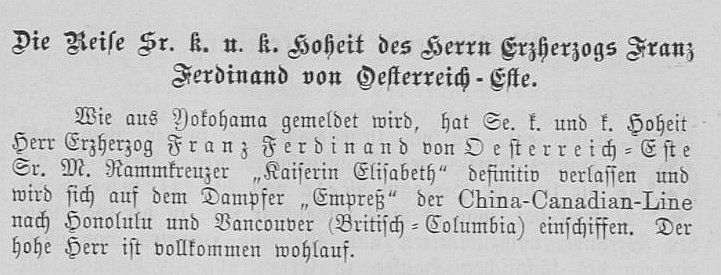
Wiener Salonblatt No. 37 notes the safe arrival of Franz Ferdinand in Vancouver.

Wiener Salonblatt No. 37 notes the safe arrival of Franz Ferdinand in Vancouver.

At Sea to Vancouver, 26 August to 4 September 1893

During the first two days the weather was mild and agreeable, we could spend the time on deck in light clothing. Then we came into the vicinity of the Aleutian Islands and the region of the North and North-east winds which carry ice cold air from the polar regions so that the thermometer suddenly dropped to 7° C.  and the temperature difference was keenly felt. A few days ago we were exposed to 34° C.! All passengers put on winter clothes, furs or plaids and the air heating of the cabins was activated.

Life on board takes a rather regular turn. At half past 7 o’clock the gong calls to breakfast. The meals are eaten in a  beautiful spacious dining room. Otherwise we spend most of the day on the long deck. A very active committee consisting of the second captain and some passengers arranges a number of games which entertain the majority of passengers. Those who do not want to participate in the games sit, covered in plaids, in long cane chairs and read or run to and fro to stay in motion. These „runs“ are especially popular after the meals, namely among the English and American ladies who do almost incredible things. They would probably break the best records by running arm in arm of two or three persons with very long not always gracious strides and turning the edge of the deck unsafe.

During the first days my time was spent adding my travel recollections of our stay in Japan. Later I met more and more of our fellow passengers among whom there were some kind people. Opposite of my cabin lives an English painter who thankfully is able to speak French. He travels around the world for the third time, while his wife is undertaking this „small journey“ already for the eighth time. The turbulent life seems not to please the artist anymore. When we asked him if these numerous voyages of his wife were not burdensome, he answered: „Enfin, c’est une maladie comme une autre!“ Among the passengers on board is also a Prince Galitzin, who has lost an arm in Paris  in a rather prosaic way, a rich tea merchant with two blond daughters as well as a number of other ladies of various ages.

With a charming small American woman I play daily multiple games of tennis without being able to make conversation with her as she only speaks English. But we nevertheless entertain ourselves very well. Clam and another American woman are the partners. Our ground is actually terrible because it is much too small, about half the normal size and covered at 3 m in height. During the pitching movements we furthermore stand on shaky ground. We also have to always pick up the two available balls ourselves that roll around on the whole ship after each play so that there is always a small chase and search. This all does not disturb our pleasure to play tennis on the open sea.

Three other games I often participated in require a certain skill in throwing disks and rubber rings at certain numbers. Cricket, which the English would not miss, was always very agitated so that already on the first day a gentleman had broken a finger and two further players left the field of battle with injuries. A ball organized by the entertainment committee was a failure as nobody wanted to play music and dance at first and later when the Wagner enthusiast played a waltz, even though he considered this beneath him, only American couples began to dance so that the ball ended quickly. If all the ladies in the New World obey the custom of only dancing with their husbands, how boring must balls be on that continent!

Besides the games on deck, especially during the evenings, singing was honored both in individual and choir form. But due to the complete lack of good voices and the circumstance that the participants tended to sing off-key on principle the performance did in no way equal the effort put into it and produced no entertaining feasts for the ears.

With true English rigor the strict Sunday rules were executed. The paymaster performed a service. In the morning and afternoon endless chorals were sung. No game was allowed to be played. Even the Wagnerian had to stay away from the piano and when our hunters tried to play a harmless game of cards in the bar room, this was instantly prohibited. In the evening of 3rd September there was even a disputation between two Protestant pastors that the passengers listened to with devotion. One of them was Anglican, the other a Norwegian missionary, actually an unfortunate misshaped man who had lost nearly all the knowledge of European languages and customs during his six year stay in the interior of China and became the butt of jokes and taunts on board. Special hilarity was caused when he was photographed by Hodek in the costume of a Tibetan Lama.

Until 1st September the sea remained calm only a North-eastern wind produced some light ripples — weather conditions that are actually not to be expected during this season. The horizon was cloudy in the morning and the evening but the weather cleared up a bit up to noon. During the first nights we had beautiful moonshine. The color of the sea was no longer the beautiful blue or green that we were used to seeing. It was more of a leaden blue turning toward black.

A large number of various guillemots, seagulls and stormbirds were flying around our ship. Even a small representative of an albatross species showed up. But I could not determine these sky fliers more closely as there existed no sufficiently knowledgeable expert about the named bird species as this was a very unexplored and quite unknown field of ornithology.

On 30th August we passed 180 degrees longitude and now the 24 hours lost on our journey towards the East were recovered so that we countered two consecutive days of 30th August.

The ship covered 350 to 360 miles per day. In favorable winds, the sails were also set but this did not have a visible effect on the speed.

As mentioned,  the calm weather until 1st September changed and wind jumped to South-east and brought so high waves with it that even the giant „Empress“ was mightily thrown around even though the ship is well adapted for the sea and moves quite comfortably. Nevertheless all passengers became more or less sea-sick and when the weather did not calm down on 2nd September there was almost nobody else on deck beside me and my gentlemen. Staying on deck, by the way, was not very comfortable due to the cold and breaking waves. The next day returned us the sun and we had once more as beautiful a journey as earlier.

On 4th September, the next to last day spent on sea, a collection was made among the passengers and the amount collected was donated for crew games that were quite animated and offered the English sailors the opportunity to display their skills. The program covered 12 numbers among them an obstacle race over rope barriers and banks as well as through life-savers. The competitors had in the „Finish“ to crawl through a wind sail  strewn with flour and caused many hilarious scenes. Also a flat race,  a sack race, a tug-of-war and a „potato race“ were organized. In the latter those could claim a prize if they managed to be the first to to put a certain number of potatoes that had been distributed on deck into a bucket. Then followed cock fights,  a long jump etc.

After the dinner a festive air dedicated to captain Archibald and his officers composed and authored by the Wagnerian was performed by a mixed choir with dreadful dissonances.

Finally came the moment where I was pleased not to speak English as this lack spared me a bad fate. After the canons had ended,  the name of one of the gentlemen rang out among the circle: „Speak, speak“, so that the miserable chosen one could not but rise and give a speech. This custom was upheld until nearly all the gentlemen had spoken and the ship and the happy voyage praised sufficiently. When later everybody’s ship uncle Prince Galitzin with a friendly smile and some encouraging words awarded brooches and photographs of the ship to the ladies and gentlemen who had been the most skilful at the games, the speech torture was repeated for its uncomfortable victims.

Finally it was again time to sing but I fled as everybody was fully committed to mercilessly present all their complete repertoire and enjoyed the splendor of the cloudless starry sky on deck.

Links

The Wiener Salonblatt No. 35 reports FF's departure from Yokohama towards North America.

The Wiener Salonblatt No. 35 reports FF’s departure from Yokohama towards North America.

  • The k.u.k. Hof-Burgtheater is closed for summer until 15 September. The k.u.k. Hof-Operntheater is performing the opera „Die Afrikanerin“.

At Sea to Vancouver, 25 August 1893

In the morning appeared Baron Biegeleben to greet me at the head of the embassy staff and consul general Kreitner as well as the gentlemen of the Japanese entourage whose helpfulness and unceasing industry I fully acknowledge. Also the officials and court servants assigned to us, among them my friend the lifeguard and the man with the always drawn sword who we nicknamed the „executioner“, came to thank for the decorations awarded to them. For the permanent memory about the common voyage I had myself photographed with all the gentlemen of the staff. Then a festive service was held.

Finally the difficult moment had arrived of having to say good-bye to our brave ship, the gentlemen of the staff who I all came to esteem and who were always eager to make my life on board as agreeable as possible, and the brave crew. „Elisabeth“ had become my home during the eight month voyage while she carried us so faithfully across the distant seas, I have felt content, happy and every time after a longer stay on land I always returned with a feeling of joy on board that a traveler experiences when he returns to the home ground from a foreign land.

Here I learned about the good military mind and the excellent team spirit that rules among our naval officer corps. Thanks to the prudence and care of our dear commander who spare no efforts and was day and night at his post to fulfil his honorable but difficult task in any moment, thanks to the excellent leadership of our first officer, thanks to the efficiency and diligence of our navigation officer, finally thanks to the dutiful devotion of the whole staff the destination of our joint voyage has been to the pride and joyful satisfaction of all successfully reached. The quick journey of the part made by steam in connection with the relatively short stay in the various ports had placed many demands especially on the machine room crew that has always fulfilled them in any relation.

With great satisfaction I need to mention the truly exemplary behavior of the crew that kept to their stations and fulfilled their duty faithfully even under the most trying situations, especially so in tropical climates, without having access to the same conveniences of making it more bearable that I had available. A very strong mention is deserved finally by the fact that our crew always acted without blemish on land despite the not always good examples shown to them by American and English sailors. Despite the most tempting promises, not a single case of desertion has taken place.

Our navy has met once again fully the high expectations set in it, and led our flag proudly through the wide ocean to distant lands. Providence has guarded the ship that had to prove itself on its first journey, a favorable star shone above it, as no earnest danger imperilled „Elisabeth“ and no accident happened. Among the number assembled on its planks, death has claimed no victim and no severe illness has struck us.

I walked once more along the front of the crew assembled on parade on deck, said a heartfelt good-bye to all the gentlemen of the staff and entered the gala boat with the commander. When the staff rushed to the bridge and the crew moved to the salute positions and a thunderous hurrah rang out three times to the sound of our anthem, tears ran down my cheeks — I am not ashamed to acknowledge this. The memories about the time I spent on „Elisabeth“ are among the most valuable of my life and will always stay with me.

The „Empress of China“ was ready for departure, but the gangway was still filled with lively commotion. The gentlemen of the embassy and the consulate with their ladies had come once more to greet us. Relations and friends of the other passengers had turned up to say good-bye. We exchanged a last handshake with Becker and Jedina, the machine of the “Empress of China” started to work and the giant ship turned towards the exit of the port. From the Japanese warships and „Elisabeth“ shouts of Hurrah were heard, the music band oft he latter played our anthem and „O, du mein Österreich“. Next to the exit of the port, we exchanged salutes by signals and waved at our faithful companions of our voyage until “Elisabeth” was but a small white spot and Yokohama also slowly disappeared out of our sight.

On board of „Empress“, a totally new life was beginning as I could no longer move as freely as on „Elisabeth“ and I was limited to the so called promenade deck. The bridge was considered a sanctuary not to be entered. We miss the military signals, commands and calls, the shrill whistle of the boatswain, in a word everything that makes life homely for a soldier on a warship. Instead of our fast sailors we see stiff Englishmen, moody Americans and slant-eyed Chinese; instead of German, Italian and Croatian sounds we only hear English and English once more. Neither reveille nor retraite are sounded, only the dull sound of the gong calls to breakfast, lunch and dinner. The music band that used to please us twice a day with pieces from home is here replaced with an enraged Wagnerian who mistreats a lamentable piano from early in the morning to late in the evening so that one could become furious and wants to become a member in a piano protections society.

„Empress of China“, built in London in 1891, is a beautiful large ship owned by the Canadian Pacific Railway Company. This railway company has three of these steamers in service between Hongkong and Vancouver in order to thus gain passengers for their line across Canada. Whether these covers the costs I do not know as the costs of service are huge and the number of passengers most of the time small.

The key dimensions of the ship are: 139 m length, 15,5 m width and depth. The deplacement is 5904 t, loading capacity is 3008 t; the direct force three times expansionary machine has 10.000 indicated horsepower and provides the steamer with a maximum speed of 18 knots per hour. Coal consumption is 200 t in 24 hours at full power. The rigging consists of four pillar masts with gaff sails. The interior board lighting is fully electric. The ship has space for 170 first class passengers, 26 steerage and 406 deck passengers. At the moment there are 72 of the first category, 7 of the second and 160 passengers of the third category on board. Captain of „Empress of China“ is R. Archibald, reserve officer of the British navy. The crew consists of 71 Europeans and 142 Chinese. My spacious and comfortable cabin — except for a short bed — is located under the bridge and next to the deck salon.

As on any English passenger ship one is quickly turned into passenger number „XY“ and has to comply with the general board instructions that especially strictly limit smoking.

For some time we continued to drive alongside the Japanese coast, escorted by „Yaeyama“ on which had embarked our ambassador, the two legation secretaries and consul general Kreitner. Finally we heard a hurrah from „Yaeyama“ and then we in time lost sight of both the warship and the coast — we steer in the open sea!

Links

  • Location: Yokohama, Japan
  • ANNO – on 25.08.1893 in Austria’s newspapers.
  • The k.u.k. Hof-Burgtheater is closed for summer until 15 September. The k.u.k. Hof-Operntheater is performing the opera „Die Jüdin“.

Yokohama, 24 August 1893

Unfortunately the departure was looming. The last day I could spend on „Elisabeth“ had arrived, as already tomorrow „Empress of China„, on which I intend to embark and which has entered Yokohama this morning, is leaving for America. The boxes and suitcases had already been packed, but I made a quick trip on land to buy some dwarf trees. During a visit to this purpose of a large trade garden shop, I could not be more surprised about the diversity of the dwarf trees as well as the variations of crippling that are inflicted upon the individual specimens. A spruce not yet one foot tall that I bought was apparently more than 50 years old.

At a breakfast, I assembled the most senior of each rank and stayed the rest of the afternoon on board, occupied with checking various matters for the further voyage.

Apparently, in consideration of my impending departure, I enjoyed today for the first time since my arrival in the vicinity the privilege of viewing Fujiyama, the holy mountain with its blunted cone, in a fully clear atmosphere.

When it started to turn dark, a great farewell party began that the gentlemen of the staff and the crew had organized in my honor. In a smart well-thought-out procession representatives of all the countries and people that we had visited and seen on our journey were to march past me, living images of a repetition of the up to now to happily completed voyage. Already for quite some time, the preparations for the party had been going on on board. All artists and artisans were fully occupied in creating the costumes, decorations etc. Nevertheless the secret was mostly kept from me and only now and then one could see a pitch-black savage or a Japanese rush through the battery after rehearsals.

As soon as the commander came to fetch me, the whole staff had assembled in front of my cabin while the crew that was not part of the procession were distributed across the deck in groups. The deck was brightly illuminated and namely an electrical sun threw light as clear as daylight against the castle from where the procession started. Our brave band master had composed a pot-pourri to remind us about the individual phases of the voyage. As much as possible the national music pieces of the respective countries had been inserted so that the festive procession was accompanied and commented by the musical production in a fitting way.

The procession was opened by Egyptians from Port Said, fellahs and Nubians, then came black Somalis and smartly dressed English soldiers in their traditional red coats from Aden; Ceylon sent Singhalese and multiple Buddha priests from Kandy; India was represented by a group in which also beautiful Indian ladies were to be seen. The two best figures in this group were fake Mahmood, namely Petty Officer Second Class Ivicich, who had borrowed the dress and turban of our servant Mahmood and thus looked strikingly similar to the Indian, furthermore a rich Parse, played by our gunsmith who had borrowed a long coat from our ship chaplain and has been filled up to a embonpoint to look most original. Very authentic and true to nature, armed with the genuine ornaments and weapons, marched our Islanders, the Kanaks of Numea, the Papuas of the Solomon Islands and finally the Dayaks from Borneo. From Australia came Aborigines as well as farmers, squatters and bush nags.

Very funnily portrayed was the arrival of the long expected mail in Hongkong by a trumpeting post master. The sons of the Heavenly Kingdom, pig-tailed Chinese, scuttled past in pairs, followed by a whole group of Japanese and musumes, clad in Kimonos and equipped with all kinds of Japanese musical instruments that were fortunately not played. The small Tyrolean who had already played a female role as Amphitrite during the equatorial baptism made again a cute impression as a musume.

At the end of the procession marched boatswain Zamberlin holding the flag in his right hand and followed by a formation of 20 of the tallest and strongest sailors. He stopped in front of me, held the flag high and made a speech to me with a real patriotic content in which he mentioned the happy end of the voyage on „Elisabeth“ and that the navy will always do its best at any opportunity and fulfil the expectations placed upon it. If His Majesty Our supreme Warlord will call his peoples to fight, the navy will again take up its stand and fight with its blood for the Emperor and the fatherland, always protecting its holiest sign, the flag and honoring it. With a  hurrah to me the brave man ended his speech that moved me to tears as his enthusiasm expressed in a simple way came from his heart. Each of us felt that Zamberlin spoke exactly as he felt. His words were those of a patriotic thinking soldier and Austrian.

May in our navy and our army always NCOs be formed and kept who have the same their uprightness and  capability that distinguishes Zamberlin, men who have the heart in the right spot! Such persons are the pillars to support their commander, the bright example for the young crewmen. Certainly a profound education and a body of knowledge is necessary in order for a soldier to perform his duty in all cases, but this is not enough. To successfully defeat the enemy, the crew must see the execution of their duty as a matter of the heart.

I then marched past the front of all the participants where I often had difficulties in identifying the individual crew members in their disguises whom I have encountered closely during the various expeditions on water and land. Namely the identification of the dark-colored savages was of considerable difficulty. The organization of the procession was not only a success on an overall level but also in the details as I could ascertain during the inspection of the individual figures and groups. I can only wish that those who organized the party with the goal to please me and create a good memory about the performance of the successful images of the journey will be rewarded for their considerable efforts.

A dinner to which I had been invited by the ship staff took place on the iron deck transformed with an artistic hand into a garden salon. For the last time we were united in that place where we have so often met with the gentlemen of the staff — in all parts of the world that we passed through in good and bad days we lived through — to exchange thoughts, impressions, sentiments in a cosy talk and to think about the dear distant home.

As everywhere where soldiers meet for a meal, the first glass was emptied to the health of our supreme warlord to the festive sounds of the anthem. Then the commander gave a warm speech about me to which I, deeply moved by the thought of having to leave „Elisabeth“ tomorrow and be separated from the gentlemen of the ship staff, replied from my heart and expressed my innermost thanks and hoped that our beautiful navy will be successful in any venture as it did during this voyage and desired that the gentlemen would return home safely feeling that they have loyally fulfilled their mission.

During the dinner I was surprised by the officers presenting me with the apt gift, an image painted by the practised hand of Ramberg and which showed in its frame a number of views of the visited countries and a world map with the route of the voyage highlighted. Painted in aquarel the picture is outstanding by its accurate impression and its technical perfection. It is a splendid testament to the uncommon skill of the artist.

Links

  • Location: Yokohama, Japan
  • ANNO – on 24.08.1893 in Austria’s newspapers.
  • The k.u.k. Hof-Burgtheater is closed for summer until 15 September. The k.u.k. Hof-Operntheater is performing the ballet „Excelsior“.

Yokohama — Tokyo, 23 August 1893

In the morning I again tried my luck to do some shopping in Yokohama and in fact this time guided by the kind Baron Siebold who was completely familiar with Japan and all its aspects thanks to his stay of many years here and also speaking the Japanese language. Unfortunately my efforts were unsuccessful as I tried in vain to find silk and brocade like I bought in Kyoto. I everywhere received the answer that the cloth would have to be ordered first from Kyoto. In contrast I managed to enlarge the board menagerie with lovely white bantams — a full aviary — and enlarge it with one of the already rare cock with their tails of multiple meters in length. I also sent two very cute bears on board that soon became the darlings of the crew and learned in the shortest time to wait in place. Hopefully they arrive at our home healthy as they are intended to be the grace and live in the castle moat at Konopiste.

In the afternoon I wanted to be back in Tokyo and, to evade the lurking eyes of the police, sent Clam and Pronay directly to the capital where they too were festively received by a crowd of over a thousand people and a corresponding contingent of policemen, while I with Siebold exited at the next to last stop and entered Tokyo in rickshaws. The maneuver succeeded too so that we could spend a few hours fully unrestricted and eat a dinner in a restaurant of the beautiful Ueno park.

Links

  • Location: Tokyo, Japan
  • ANNO – on 23.08.1893 in Austria’s newspapers.
  • The k.u.k. Hof-Burgtheater is closed for summer until 15 September. The k.u.k. Hof-Operntheater is performing the opera „Freund Fritz“.

Nikko — Yokohama, 22 August 1893

As the merciless railway administration had been only willing to provide a special train at no other hour than at 5 o’clock in the morning, we had to get out of bed early to say good-bye to Nikko. At 11 o’clock in the morning we were back at the station of Yokohama which rises in the North-east of the city on land reclaimed from the sea.

Situated like Tokyo in the province of Musashi, it has grown to its current importance out of an unimportant settlement on the West side of the Tokyo bay. Since it had been declared a treaty port in 1859, it thus was opened up for trade with Europe and America. The glory to have breached the system of isolation from foreign trade inaugurated by Ieyasu and enlarged by his nephew Iemitsu belongs to the Americans and especially to Commodore Perry’s expedition in 1854 that ended with the opening of the ports of Shimoda and Hakodate for American trade. Since then Kobe, Osaka, Nagasaki, Hakodate, Niigata and Yokohama have been opened overall as treaty ports and for settlement by foreigners so that the latter settle here in specially designated city quarters and are allowed to travel in the surrounding area of nearly 40 km without special permits.

Instead of Yokohama, by the way, at first Kanagawa, a bit to the North, had been designated as a treaty port but was replaced by Yokohama because of Kanagawa’s location on the Tokaido and thus the thereby always threatening conflicts between the foreigners and the samurai entourage of the traveling daimyos. Yokohama today plays the principal part among the treaty ports as the junction of all steam ship lines that connect Japan to Europe on the one hand and America on the other hand, as a destination for nearly all warships that enter Japan and numerous trading ships and coastal vessels of all kind.

Yokohama, counting 143.000 inhabitants, is quite rightly the point of contact of Japan with the West and the East, the point of entry and departure of trade. This is the reason for the international character of the city which is expressed both externally and in its population.

A quay road built at considerable cost runs alongside the harbor. Custom houses and other mercantile establishments like depots and loading docks serve trade. Nearly 3 km wide extends the foreign settlement in the harbor which has been rebuilt after a fire in 1866 larger and more beautiful, criss-crossed by broad well tended streets and containing residential houses, banks, offices, clubs, hotels and consulates. Numerous foreigners, by the way, only have set up their business location in Yokohama while they have built their residences in a crescent-shaped hill range called Bluff to the West of the city in order to breathe sylvan air and enjoy the beautiful view upon the harbor.

The predominant population are naturally the Japanese but the colony of foreigners, mostly Englishmen and Americans. is large enough to be noticeable in the streets as a leading factor of urban life, so that during a stroll through the city one meets foreigners everywhere, not in the least the sailors landing from the warships who look for relief from the deprivations of long sea voyages.

Even though I had requested to spend my time in Yokohama Incognito and thus to forgo the Japanese entourage, the rickshaw I used to wander through Yokohama and do some shopping was followed immediately by he police prefect, a police official and two reporters which caused understandable commotions in the streets. After other attempts to get rid of this entourage had been in vain, I sought help by using a ruse by going to the Grand Hotel, breakfast there and then leave by the small rear door and take another rickshaw. But the pleasure of the liberty won did not last long. The police soon had been on my tracks and finally arrived at full pace, so that I could only call Sannomiya on the phone. He was soon on the spot and freed me from the undesired entourage. Barely a quarter of an hour later, the procession had again assembled like shadows following my heels. I even believe to have observed that one among the entourage was writing down carefully every object that I bought. Finally I rushed on board not without enjoying the company of a police official following me in a barge.

For the acquisition of those objects I was looking for, Yokohama was not quite an enjoyable place. Even though the number of shops is legion, it was quite difficult to find something matching my tastes which had apparently been developed and refined by the stay in the actual factories of the Japanese art industry, namely in Kyoto. Yokohama’s shops are filled with curiosities in the true sense which is targeted towards the foreigners, especially the Americans who are only seeking to buy some characteristic objects of the country and whose demands have apparently not been quite so beneficial for the local production.

When I offered my opinion to some merchants, they admitted the correctness of the observation but added that it was precisely the mediocre goods if they are only large, colorful even loud and quite baroque that made them bestsellers for America and also for England, while the stylish, discrete and tasteful and thus more valuable objects are little sought.

In the evening I had invited some of the gentlemen of our embassy as well as the Japanese entourage to a dinner on board where songs from home made all guests merry.

Links

  • Location: Yokohama, Japan
  • ANNO – on 22.08.1893 in Austria’s newspapers.
  • The k.u.k. Hof-Burgtheater is closed for summer until 15 September. The k.u.k. Hof-Operntheater is performing the opera „Der fliegende Holländer“.

Nikko, 21 August 1893

The Japanese say: „Nikko minai uchi-wa kekko-to iuna“ — who has not seen Nikko, should not talk about beauty. Nature has in fact contributed everything to make the region of Nikko, „the sun`s brilliance“, the most attractive scenery in Japan as is often claimed. The bearer of that name is not an urban settlement but a mountainous district of volcanic character about 600 m above sea level. In a narrower sense the Japanese consider Nikko to be the surrounding area of two villages in the valley of the Dajagawa, called Hachiishi and Irimachi, the former extends alongside a long straight road to the river shore.

In the center of the region and in a row of rising mountains stand the up to 2540 m high Nantai-san, also called Nikko-san, like the Fuji one of Japan`s holy mountains to whose tops the believers go on pilgrimages. A rare wealth in waterbodies enlivens the quietness of the woods, clear lakes mirror the surrounding heights, streams flow downstream, building small waterfalls of which about thirty can be counted in a surrounding area of 25 km. What however makes up the incomparable decoration of the landscape is the rich vegetation that covers mountain and valley in the form of huge giant trees, monumental Japanese cedars that consecrate the valley in their inviolate nature and their festive earnestness. In this valley, two of the most brilliant persons of ancient Japan are buried, the great Ieyasu and his nephew Iemitsu.

Attracted by the splendid nature many representatives of foreign states as well as Englishmen and Americans spend the hot season in the region of Nikko, so that the temple city also has resorts and the holy and the profane live together peacefully.

Unfortunately the weather was not favorable to me and about the charms of that region that had been described to me in the most vivid colors in words of ecstasy, I saw little, if not to say nothing. The rain poured down in streams, the fog hung low to the bottom of the valley obscuring the woods and mountains as if the holy places were to be hidden from foreign viewers who had come not to sacrifice and believe but to watch and enjoy. But not only nature, art too has contributed to make Nikko a landmark in Japan. These works we could enjoy despite the bad weather so that we started our tour early in the morning.

At first we entered a lovely temple garden to call a chief priest out of his house who was visibly surprised about such early visitors but finally composed himself and unlocked Sambutsu-do, that is the hall of the three Buddhas. It completely resembles the buildings we had already seen and is only distinguished by three gilded images of giant dimensions. One shows the goddess Kwan-on with her thousand hands, the second Amitabha  and the third again Kwan-on with a horse head.

Greater interest produced a pillar outside the hall. Called Sorinto, it had been built in 1643 to keep away bad influences. It is 13 m high, produced out of copper in cylindrical form and is crossed in its lower third by two pairs of horizontal cross beam at right angle that rest on their ends on narrow copper pillars. The upper end of the middle pillar is decorated with a row of lotus flowers one above another from which hang small bells.

Under the fully covering canopy of touching branches of Japanese cedars we walked toward the temple mausoleum of Ieyasu. Deep silence, festive quietness prevails in the area of the dignified trees whose dense foliage does hardly permit a ray of sunlight to penetrate. The red brown trees straight as an arrow and measuring multiple meters in circumference contrasted with the delicate light green moss that covered the ground. While one is often disappointed by the view of much praised wonders of nature, here the opposite effect happened. I had not imagined, despite all descriptions, that the effect of these giant trees covering important areas would be as outstanding and was nearly overpowered by it.

Already in 767 the priest Shodo Shonin had built the first Buddhist temple here in Nikko and thus laid the foundation of the sanctuary of this place. But its real significance Nikko only reached since shogun Ieyasu was buried here in 1617. He had been placed among the gods by Mikado as an „eminence of the first rank, light of the East, great incarnation of Buddha“. The temple site consists of a complex of buildings and courtyards in terraces that are connected by stairs and gates. Through the branches of two rows of Japanese cedars we can see the gate that is over 8 m high and made out of granite and to which some broad steps lead. The prince of Chikusen had built those in 1618 with material taken out of his quarries. In the first courtyard the eye is captivated by pagoda glittering in bright red lacquer that rises up to five storeys and displays on the level of the lowest story images from the zodiac.

The stairs that continues at some distance is crowned by the Ni-o-mon, the gate of the two kings with rich and in part artful illustrations of lions, tigers, unicorns, tapirs and fabulous animals that serve here in part as guards in part in their mythical function. Stepping out of the gate we are on the first terrace surrounded by an intensely red colored wooden wall and are truly struck by the harmonic total impression of the stylish buildings, the rich variety of artistic details, the splendor of the colors, the vivid motion and noble quietness of the decoration that all flow together. In three exceptional buildings with pleasing forms all the necessary objects for the religious ceremonies to honor Ieyasu as well as those used by the shoguns and the temple treasures are kept, while another splendidly decorated building houses the collection of Buddhist writings. A cistern dates from 1618 and supplies the holy water intended for washings. It has been chiseled out of a piece of granite and is protected by a roof that rests on twelve granite pillars.

A small courtyard whose front is closed off by a stone balustrade and which is reached by a stairs contains no fewer than 118 bronze lanterns, each of which a piece of art, donations of daimyos and other noble donors whose names are preserved for eternity on the lanterns. Another number of bronze lantern and candelabras — some of those are said to be from Korea, others from the Netherlands — are noticeable by their size as well as their rich artistic decoration.

Through the second large temple gate called Jo-mei-mon we arrived in the third temple courtyard. This gate deserves to be labeled as a jewel of the Japanese art of building and decoration. Here masters of their trade worked together to combine the huge with the delicate in order to set an enduring monument to the skills of their time that astonishes us and commands our admiration. A richly ornamented, curling roof resting on gilded dragon heads protects the gate that is borne by mighty pillars covered by tiny geometric designs and painted white. The capitals of the pillars show unicorn heads while the cross beams around the gate carry dragon heads and in the middle there is a fight between two dragons depicted.

A building of the courtyard contains a stage for the Kagura dances, another one the Goma-do, an altar to burn incense while a third holds the three sedan chairs that apparently are used on each 1 June by the three god spirits of Ieyasu and two other great man raised to divine status and are then carried around in a festive procession. On the dance stage one of the female dancers bowed deeply without pause and was probably willing to perform a sample of their art with her colleagues that we had already encountered in Nara. The borders and walls of the terraces are covered by artfully created stone reliefs showing all kinds of birds and plants.

Through the Chinese gate or Kara-mon we approached the main temple whose swing doors are decorated with arabesques in gilded relief. Guided my multiple priests we entered, having put on wool slippers over our shoes, the interior of the temple that has vestibules at both sides that are exceptional by their masterfully executed wood carvings and paintings on a gold foundation as well as rich ornaments. The praying hall of the temple is very simple and contains the Gohei and the mirror in the background. Also in Ieyasu’s temple mausoleum government measures in 1868 have displaced Buddhist rites by Shintoist ones so that all the symbols and tools of the former have been removed from the praying hall.

The holiest of holies to which leads a path through the praying hall is closed off by a gilded portal. In view of this, we enjoyed the preferential treatment shown to a traveller who was not a simple tourist in the country but the latter does not have to endure many inconveniences connected with traveling in an official capacity. Seeing the sanctuary is strongly frowned upon, no foreign foot is said to have entered this holiest of spaces. Before me however the gates opened up. I confess that I experienced a special satisfaction, that I was overcome with a sentiment of traveler’s pride at the thought to be able to view a sight no European has seen so far and perhaps will never be. I will be thankful to my brave friend Sannomiya to the rest of my life that he knew to unlock these hidden masterworks of human art and fantasy .

The sanctuary is divided into multiple rooms one of which contains an altar with the golden Gohei and the metal mirror. The artful images of Buddhist beliefs are covered by cloth. An understandable historic interest is awakened by a suit of armor of the brave shogun kept there. It is very simply equipped and covered in black lacquer that had protected the man who had been raised to the state of a god. He had created the power of his house in the turmoil of battles. In a weak candle light we could see the undecorated iron dress until the priests illuminated the mysteriously dark room with a few lanterns and our sight fell upon a richly gilded shrine. The priests prostrated themselves in front of it, touched the ground with their front and finally opened some kind of tabernacle where behind a curtain as the last cover was the Sanctissimum — a painted figure showing Ieyasu in a sitting position. This image of a god may not awake any religious emotions. Instead the works of the shrine that contains the idol, the decoration of the walls and the doors I found very charming. My only regret was that the circumstance of the lack of the necessary illumination to examine these gems of Japanese art more closely that were presented proved difficult so that we had to make do with an overall impression.

Here there was in fact an abundance of decoration of the shrine, the walls and doors by painting, gilding and carving. The developed artistic wealth of motives and their perfected representation seems overwhelming at first but arranges itself into a complete harmony at a closer look, to a genial quietness. Ieyasu, who has performed great deeds as a human by shaping the history of his country for the next three hundred years, has created miracles as an idol as his memory has inspired to such a high level of artistic performance that we were seeing.

From the place that surrounds the image of god we walked to that which contains the ashes of the dead, climb more than 240 stone steps covered by moss and stand at the grave of Ieyasu. A high stone pedestal carries a bronze urn that contains the remains of the shogun. In front of the pedestal  are symbols on a stone altar, an incense burner, a vase with lotus flowers and other flowers as well as a large crane standing on the back of a tortoise and holding a page in its beak as a candlestick — everything valuable works of bronze. A stone balustrade surrounds the grave site. The entrance leads through a massive bronze gate guarded by two lions. Earnest is the place that Ieyasu himself had selected as his grave site and the noble simplicity of the grave is touching. Art which had been highly celebrated in the buildings at the foot of the grave seems silenced as if those that had made the pilgrimage up here should not be disturbed from thinking about the dead by decorative illustrations.

Again we returned to the main temple to enjoy the impressive effect that the harmony of the architectural structure of the temple site with the scenic surrounding and the majestic woods are producing — and the magic of this effect is still increased by the deep quietness at the grave monument of this forceful warrior to which today the rain poured down in a melancholic way.

The temple treasure that we also paid a visit contains like other rooms of the same kind valuable devotional presents of notable people, thus weapons, armor, saddleware, all kinds of tools for festive processions, prayer rolls, furthermore a scroll of more than 50 m with images of the history of the country or the gods. A special mention is merited for the ancient Kakemonos, that show falcons in realistic natural scenes that have been taken from falcon hunts that apparently are still happening in Japan. In earlier times it is said to have been possible to buy some objects kept in the temple treasury from greedy bonzes by using money and good words — and naturally more from the former than the latter. When this mischief had caused much attention due to the great dimension it had grown into, a precise inventory of the temple treasures was undertaken to curb such activities.

After the temple grave of Ieyasu the two other temples that we rushed through more than visited closely did not produce the same level of interest.

The head priest of one of the temples who greeted us in a splendid purple dress had once been a mighty daimyo in the Northern provinces and had placed himself in the fight between the Mikado and the shogun on the latter’s side. Defeated and bereft of his land, the daimyo was shown mercy and he was assigned the position of head priest as some sort of pension as well as a title of count.

The second temple site, the mausoleum of Iemitsu, built in part into a deeply cut valley, in part on a ledge of a mountain is situated close to the grave site of Ieyasu and is much less brilliantly equipped but still remarkable as here Buddhism has won and thus the full installation that this sensuous cult requires is still present. The temple guards posted at the temple gates represent a great collection of the most horrible grotesque faces. We can see here a red and a green devil, two audacious golden kings and two human figures that are horribly created using the full variety of the rich Buddhist fantasy. The red colored one represents the god of thunder who carries gilded clubs in the hand and slung across the back carries a band with nine flat drums out of which flashes spark. The other monster in a light blue color represents the god of wind and looks at us with crystal eyes and a Satanic expression, sitting on a block of stone and keeping a bag of wind slung across its back shut with its hands. Bronze votive lamps indicate the veneration that Iemitsu enjoyed.

From here I drove directly to Nikko or more precisely to Hachiishi and crossed once more the foaming Daja-gawa whose shores were connected by two bridges. One serves the common traffic while the other, Mihashi, is reserved for the Mikado and is opened only twice annually for pilgrimages. At the spot where the Buddha priest Shodo Shonin is said to have had a miraculous revelation more than a thousand years ago the bridge was built and rests, shining in red lacquer, on stone pillars inserted into the rocks.

In the small city I turned to buying furs of which there was a great selection here and which also has cultural historical connections as before the changes of 1868, those that treated leather and other raw materials etc. besides others were counted, in contrast to the Heimin or members of the common people, as Etas or unclean, that is a despised caste outside of the rest of society that had to live in special places or parts of a city — a position that probably is due to Buddhist influence. Below them only stood the Hinin, the non-humans, a class of poor people only created under the Tokugawa that were only permitted to live on uncultivated land.

Among the raw hides in stock I found also some that might be unknown at home, thus furs of the Japanese antilope, of monkeys, bears of Yeso island, two species of badgers, otters whose species seemed to be different from those at home,  seals and large squirrels. Also furs of martens varying between chrome yellow and ocher as well as original slippers made out of fur. Soon a heavily burdened rickshaw made its way with the goods bought to our hotel. As the paths in the surrounding area of Nikko have been restored to good condition at great cost in consideration of my announced visit, as I was told, I did not want to see this sacrifice made in vain and decided despite the pouring rain to undertake a drive to the waterfall called Urami-go-taki.

Of the much praised scenic beauty we unfortunately saw nothing due to the rain and had to make do, peeking out from our umbrellas, with the meadows and woods close by in their fresh green. The woods were composed of various species, thus oaks too and maples. Small hamlets and villages that looked sad in the rain lay on the route.

Our rickshaw runners had covered a very difficult laborious piece of slippery road without a bed when they stopped at a tea house from where we started an upward march on foot to a romantic gorge. Soon we could hear the roar of the waterfall and finally are in a valley bottom enclosed by high rocks. Here a mountain stream roars out at a height of 15 m in a splendid cascade over a wall of rock down into a funnel-like basin. Due to the important slope above the wall of rock and the vertical position the water mass pours down in a wide arc, so that it is possible to walk under the waterfall and behind it without being exposed to a greater danger than of being touched by a fine spray. Urami-go-taki is not one of the wonders of its kind but offers at least in its narrow gorge a worthwhile spectacle, namely because the earth sends out small streams out of countless folds, cuts and gaps that quickly descend over the rocks to the bottom of the valley.

Behind the waterfall stands a Buddha statue, at which the native tourists tend to leave their carte de visite in order to provide testimony about the astonishing event of their presence for posterity. The local vanity seems to exist not only at home but also in the Far East, but in a form that is much more tasteful than the usual disfiguring marks on walls and rocks. It thus would be strongly advisable for our travelers and tourists to adopt the Japanese custom.

During the return drive I stopped at a small villa that was charmingly situated at the shore of the roaring Daja-gawa. The villa was owned by Sannomiya and served as his summer quarter. I spoke with his wife who had lived for quite some time in Vienna and was speaking German perfectly.

Driving past an avenue of 100 stone Buddhas we returned to Nikko to do some shopping and then roll through a splendid alley of Japanese cedars that I had seen only in the darkness of the night the day before. Passing under these trees one feels a whiff of a proud past. Remarkable are namely the numerous twin trees that have grown together up to the top third of their height.

A much praised landscape that has the bad habit to show itself occasionally dressed in rain resembles a human of good reputation who has been caught making a mistake and stands to be completely damned by sharp tongues. I will be fairer to Nikko. It behaved like a beauty who knowing her charms and effect likes to present a sulking face — and Nikko has been sulking at me continuously. Still I was charmed, despite the incomplete impression I have received, and may imagine the full magic that the holy ground of Nikko may produce in the brilliance of a beautiful summer day.

In the evening we did what was the most opportune: We did let our mood be spoiled and assembled to a happy dinner that was spiced up by funny stories told by ship captain Kurvaka of the Japanese entourage who unfreezing more and more told them in a comic mix of French, English and Japanese words. Finally, Jupiter pluvius allowed us to burn off some fireworks just as the cute musumes were serving black coffee.

Links

  • Location: Nikko, Japan
  • ANNO – on 21.08.1893 in Austria’s newspapers.
  • The k.u.k. Hof-Burgtheater is closed for summer until 15 September. The k.u.k. Hof-Operntheater is performing a ballet „Cavalleria Rusticana“.