Kategorie-Archiv: diary

diary entries of Franz Ferdinand

Tandur, 21 January 1893

After a bad night spent in an unaccustomed way, the first thing I saw was the honor guard of the troops of the Nizam of Hyderabad which were receiving me in Wadi at the border of their „state“, more precisely a territory of a prince under British protection. Even though equipped with all the trappings of power and ruling an area of 214.000 km2 with 11.5 millions of inhabitants, the Nizam of Hyderabad or Golkonda is not really an independent but a tributary Maharaja, guarded by an English resident and a British occupation force under the pretense of protecting the Nizam.

I lay still in bed and could not leave it quickly and only watched through the window at the festively decorated station. The honor guard consisted of beautiful black people with twirled moustaches and sideburns.

The area we were driving through to Tandur was without charm, a large plain, only now and then broken by low ridges where cultivated areas alternate with large, bare and sterile areas on which barely a thorny bush grows and stone and where rock formations ad erratic blocks become visible. In the fields one can see the cultivation of flax, ricinus, jowari (a type of sorghum), cotton, maize and tobacco. Peculiar is the manner of plowing fields which still relies on very primitive plows, simple tree trunks with a root hook. The harrow is represented by tied brushwood and the fruit is simply uprooted by hand in places where scythes and sickles are unknown.

Everywhere one notices destroyed or decayed forts and other types of fortifications near the villages – as the houses of the natives are already built out of stone. These ruins are monuments to the time when the rajas and princes of the land were living in constant feud among themselves. Also there are Portuguese forts with round corner towers and crenellated walls still standing.

After a 22 hour train ride from Wadi with the Nizam’s Guaranteed State Railway we reached Tandur where a three day hunting expedition was planned. The Nawab Vicar ul-Umra, a cousin of the Nizam’s minister, followed by many Englishmen and shikaris, had come to welcome me at the station. Among those present was also the commander of the Nizam’s troops, Colonel Nevill ((Colonel Richard Nevill C.I.E.  entered the Nizam’s service in 1874 as Major, appointed Commander of the Indian Empire C.I.E. for services rendered to the Colonial and Indian exhibition in 1886 as representative of the Nizam. Died in 1896.)) who had entered our train already at Wadi and told me his life story in fine Viennese dialect even though he was born an Englishman. He had formerly served in our army and has been a captain of the Haller hussars, During the visit of His Majesty in Milan in the year 1857, Nevill served as an orderly of His Majesty. At the battle of Magenta, acting as adjutant to Gyulay, he had received the military honors cross with wartime service decoration. He retired honorably after that campaign and moved back to England from where he later went to India to enter into the service of the Nizam.  As Generalisso, he is said to occupy an important position at his court,

It took quite a long time until we were ready to go as the transfer of all the baggage necessary for the hunt required extensive time and the communication with the natives proved difficult. In their ardor they often picked the wrong pieces instead of the right ones. Finally, everything was ready. In a large golden coach drawn by four artillery horses we drove first through Tandur which still had walled enclosures and fortifications then some miles across the countryside to reach the hunting camp about 16 km distant which we were set to occupy during the next thee days. I was truly surprised to see a complete tent city in a large open square arrangement equipped with the highest possible level of comfort and luxury.

In the middle of the camp opposite its entrance stands the large dining hall tent. It offers room for a table for 20 persons and has a large parlor in front of it under a tent roof with the mo are the tents intended for us. Each one of us was allocated an individual tent with an excellent bed, a very elegant desk and some furniture and swell rugs. The tent for me had furthermore a flag pole with my standard on it and was remarkable by its size and has the appearance of a house. The 18 tents we occupied are surrounded by a separation wall outside of which stood 40 tents for the bands of servants, cooks, hunters and grooms. About 400 natives which were to serve as laborers and trackers are housed in leaf huts among which graze cows, buffaloes, goats and sheep in herds which would supply our daily meat as, to express it in military terms, the commissary requirements of our camp exceeded 500 men.

At the camp entrance stood a native honor guard of 30 men to which were added seven large elephants, intended for the coming hunting days, and 20 richly decorated majestic Arabian horses supervised by two equerries in green uniforms.

This hunting camp in a truly grand manner I owed to the Nizam of Hyderabad who had asked about my health by telegram and whether I was satisfied with the prepared accommodations,

After the arrival in the camp, the Nizam’s son was presented to me to whom I expressed with the help of an interpreter my pleasure about this grand reception in the Hyderabad territory.

Then we inspected the horses which were presented by the equerries of Nizam and the elephants whose long tusks were protected from splintering by thick, richly decorated iron rings,

As soon as our baggage had arrived, I changed into hunting dress and explored the surrounding area with Wurmbrand while other gentlemen went for a ride. During our short expedition I bagged many representatives of many new bird species unknown to me, among them tiny quails (Turnix dussumieri), — called „button-quail“ by the English — and doves, singing birds and chats.  On small tamarinds I found for the first time a large number of the artfully braided nests of weavers.

The flora was not very richly represented, only a bushlike Rosaceae with rich yellow flowers was noticed by me which found use as an offering in temples after the practical Indians found the gold sacrifices of former times too costly. Thus instead of yellow gold, they sacrifice yellow flowers  Who doesn’t remember the lamentations of Calchas about the decreasing propensity to sacrifice …

Very favorable news about the tigers arrived. It is said that they have seized a tied calf and were in a jungle nearby according to the shikaris. In the evening I received a telegram from Mr Jevers of Colombo which contained the good news that a large elephant probably the one I shot and wounded on 8th January. It was found dead about 1000 m from the place where I had shot it,

Links

  • Location: near Tandur, India
  • ANNO – on 21.01.1893 in Austria’s newspapers, On its front page, the Neue Freie Presse informs its readers that the former Serbian king and queen have reconciled themselves after an earlier scene in Biarritz. In Bornemouth, England, was arrested Cornelius Herz, one of the key operators responsible for the Panama scandal, He is expected to be rendered to France for prosecution. The newspaper reports that Franz Ferdinand spent his time in Bombay mostly by sightseeing.
  • The k.u.k. Hof-Burgtheater is playing the comedy „Die Welt in der man sich langweilt“, while the k.u.k Hof-Operntheater had a special honorary event for invited guests, a théâtre paré.

From Bombay to Tandur, 20 January 1893

Having used the morning to prepare the mail, I drove to Tellery again to complete my shopping, third time being a charm.

At noon there was a group photography to preserve a fixed memory of my visit at Government House of me, Lord and Lady Harris and all the staff of the house.

Then I inspected the stables of Lord Harris. In open boxes Australian carriage horses as well as English and Arabian riding horses and polo ponies are quartered. Acting as an equerry of the governor is his personal doctor who masters this task as outstandingly as the medicinal one. The horses are in fine condition, although some are broken down due to the sharp turns, namely on chivvies on hard ground. In all of India, one preferably uses Australian horses, tall and strong with their characteristic carp back, as carriage horses. The price of these horses fluctuates between 380 and 1550 fl. in Austrian currency. To ride and play polo one uses in British India mostly Arabians and some locally raised animals. Very funny are the 12 to 14 hands high ponies of which first-rate specimen can be had for the ridiculous price of 12 to 17 fl. in Austrian currency.

Now it was time to leave Bombay behind. I said good.bye to Lady Harris and drove with Lord Harris to the station where the special train of the vice king was awaiting me which the vice king has been put at my disposition for the duration of my journey across India. With heartfelt thanks I and the governor parted ways and soon the train rode towards our next destination, Tandur, where we were expected to hunt tigers.

Well acquainted with the English grasp of the relationship between comfort and luxury and expecting to see the special train of the highest magistrate of India equipped to the utmost Oriental opulence, I was truly astonished about the simplicity of the fittings and equipment of the wagons of this train which would leave many an Englishman to miss their familiar comfort, especially in matter of the bedding. Especially remarkable was the fact that the wagons and even the individual compartments were without direct passages, corridors or doors so that the „cell mates“ of the neighboring compartments could only communicate during the rare way stations.

From Bombay to Tandur which lies in a south-eastern direction of Bombay, we made use of the Great Indian Peninsula Railway to Wadi. It first crosses Bombay’s suburbs, then past Parel and the government salt mines across a large bridge over the estuary that separates Salsette island from the mainland and then turns towards the mountains.

The physiognomy of the area changes quickly. High mountains, rich in bizarre forms, assembled out of regular parallel layers that display themselves as long strips or lines, followed by valleys dedicated mostly to growing rice. Small palm tree groves, some tall palm trees alternate with thin Euphorbia hedges, but the vegetation is not as rich and majestic as in Ceylon. Higher up the mountain, the valley are narrower with dry yellow grass and some crooked trees, steep and abrupt ridge. In the valleys and canyons deep down below us one can see teak trees (Tectona grandis), wild bananas, Ficus religiosa und Ficus indica.

The railway is built similar to the one from Colombo to Kandy with steep ascents, crosses many tunnels and offers charming views on the fancy rock needles, the long, narrow and steep wall-like rocky ridges, the mostly bare tops of the Western Ghats. Ghats are called the stair-like steps  of the numerous parallel mountain ranges on the Indian West and East coast bordering the Dekhan high plateau. To the south the seemingly less wild than arduous Western Ghats at an average altitude of 1200 m and the lower and less important Eastern Ghats continue in mountain ranges of up to 2630 m that are covered in woods, called Nilgiri Hills (blue mountains). At Lanauli Station the railway reaches its highest point and continues almost at an even altitude across cultivated land. Late at night we passed  Poona, 119 km south-east of Bombay, the favorite summer retreat of the governor. The same location also has camps for all troops that maneuver there.

Links

  • Location: Poona, India
  • ANNO – on 20.01.1893 in Austria’s newspapers, The Neue Freie Presse reminds its readers about the centenary of the execution of Louis XVI of France iby guillotine on 21st January 1793 which plunged Austria into two decades of war first against the French republic then Napoleon. Much space is devoted to the report about the fourth ball of the city of Vienna. The weather is still dreadful, even though some sport is taking place on the frozen Danube canal.
  • The k.u.k. Hof-Burgtheater is playing the comedy „Magnetische Kuren“, while the k.u.k Hof-Operntheater combines the opera „Freund Fritz“ (l’amico Fritz) by Pietro Mascagni with Carinthian songs „Am Wörthersee“.

Bombay, 19 January 1893

Early in the morning we drove in gala coaches of the governors, escorted by a part of the guard, to the docks to inspect the Lloyd ship „Elektra“ which arrived two days ago. The docks built and owned by trading companies are impressive structures both in their extent as well as their requirements for the installation of the necessary equipment for the transport of goods. It is a testament to entrepreneurship which makes one feel meek if one compares it to home. Beside the docks stand warehouses through which the stream of arriving and departing goods flows: As the blood flows without interruption in the numerous branches of the veins in a human organism, bringing blood to the heart and moving it away again, so here barrels and bales roll without interruption on rails to and from the warehouses. In these grandiose warehouses on can feel the pulse of moving goods. The steam cranes look like the arms of a giant working for mankind — Gulliver among the Lilliputians —  lifting the heaviest burdens like child’s play. Without rest and recovery, in constant motion, the dock acts as the motor of the goods trade; seemingly chaotic it is still obeying a very strict order built by the organizing force of the merchant …

„Elektra“ arrived from Shanghai  filled with tea and hides, and added cotton to its load for Trieste. The mighty ship had hoisted the flags, like all the ship the dock, and presented itself in all her glory. Having inspected the „Elektra“ closely, I can recommend the well known comfort of the Lloyd ships as they continue to set standards in friendliness and cleanliness. It is joyful to hear that Englishmen too prefer to make use of the Lloyd ships. Certainly a moment that looks very favorably to our Lloyd, especially as the competition among the different shipping companies is such that it goes beyond the true demand and poses risks for real enterprises that continue to preserve outdated traditions and specific manners of a local character. Where this goal is questionable to achieve, one may not refrain from even larger government subsidies than at present, as these subsidies will be rewarded with golden fruits by a management that appreciates the importance of the enterprise not only for the shareholders but also the national production and the monarchy’s reputation whose flag is represented by Lloyd ships in all oceans. With the warmest wishes for a happy completion of the journey I left the Lloyd ship „Elektra“ not without adding greetings for home to her cargo.

In Victoria Park which we visited next and which is maintained by the municipality, Bombay has a zoological-biological garden — a tropical Schönbrunn — that merits the fullest praise even it can not match Peradenia garden on Ceylon. Tigers, bears, panthers, gazelles and antelopes, ostriches and monkeys were mourning their loss of liberty in small iron cages that were grouped between tastefully arranged bushes. Special consideration is given, according to English taste, to the grass which due to intensive sprinkling presents itself in a lush green, like a velvet carpet.

Having plundered Tellery’s treasures again we undertook a shopping trip through the most bustling streets of the native district.

The houses which are inhabited up to the roof, even overfilled what has a very detrimental effect on cleanliness. On the ground floor one finds always merchant shops and bazaars: here all kinds of goods are sold, many European ones among them, always surrounded by a shouting crowd. It is a pleasure to see many of our national goods in these shops, namely paper, perishable goods, hardware, glassware, woolen blankets and hats, the latter all from Strakonitz in Bohemia. A bustling trade is happening also with Austrian cologne which the Hindus drink as a replacement of the forbidden wine – a fact that speaks to the excellent quality of the local stomachs as well as to that of the product.

Some of the old houses with about two hundred year old wooden decorations, small gables, bays and pillars made out of indestructible black wood as well as small mosques and Hindu temples interrupt picturesquely the long rows of houses. Especially Kalbadewi temple with its color and statues of monkeys and fakirs attracts the eye.

The noisy crowd in the street is composed of the peoples of Asia, Africa, Europe and Oceania, a moving tower of Babel. Colorful images are moving past the eyes of the visitor. The largest contingent are naturally the Hindus. Among them move busily Parsis and Muslims, silent Arabs in black burnooses ride by coming from the horse market. Sometimes one can see an Afghan and begging Tibetan monks.

Remarkable is the courtesy of all natives towards the Europeans to which they always approach in friendliness. Out of the mass stand out the fakirs that is all kinds of religious beggars without distinction, although the Indians use this word only for Muslim beggars while they use a different word for Hindu caste ones, namely Goswami (Gosain), Jogi for the adherents of Shiva, Bairagi for those of Vishnu. These fakirs who abstain from the world and all its pleasures demonstrate their abstention outwardly by covering their body with yellow or gray clay and paint their front with sandalwood and vermilion powder. These ascetics and penitents move in this hideous attire, a consequence of a fanatical belief, from house to house. All too often the supposed abstention of the fakir is but a cover for a carefree life without toil. The Hindus give the fakirs always a helpful hand and offer them unlimited hospitality, sharing everything with the beggars – often even the wife. Under the mask of a fakir one even finds hard criminals who thus evade the watchful police or are safe from them as, due to the fanaticism of the Hindu, a native policeman can hardly dare to lay hands on a fakir. Native police have blue uniforms with light yellow lapels and caps and are said to perform with distinction.

All kinds of vehicles are moving in the roads from native small wagons drawn by two zebu oxen and whose sides are most often painted to the elegant European Landau carriages.

The native drivers treat the fast zebu oxen incredibly harshly: To get them to move fast, they wind their tails in circles. This barbaric practice may even break the tail bone. The fate of a local horse team seems to be comparably fine compared to the sorry zebus.

After lunch in Government House where I met the promising son of my host, temptation was approaching in the form of one of the largest jewelry dealers of Bombay, Harichands. prime supplier to all Rajahs. Treasures valued in millions were laid out in front of us: diamonds as large as a dove egg. rubies, emeralds, sapphires and pearls, partly loose partly as necklaces, rings and diadems. The sparkling, glimmering, glittering, the shine, flame and flare of fire splitting in all colors created an irresistible attraction that overwhelmed all senses. I have not seen something of equal quality in Europe and believe no crown jewels can match the treasures of Harichands. The man is literally rich in stones and asked for prices so high that we were unable to come to an agreement, thus I resisted temptation, largely out of necessity and not out of desire.

At 5 o’clock in the afternoon, a garden party in Parel  — a summer retreat of the governor about 4 km out of Bombay — was on the program. There on the road one could see all the inhabitants who welcomed us warmly. On the green meadow in the midst of the park stands a dais covered in red cloth. On the dais sat the high society of Bombay: Officers, dignitaries, eminent Parsis, Hindus and Muslims.

In front of the dais was laid out a large square, some kind of riding school in which the life guard of the governor rode a quadrille on their Australian service horses. The members of the life guard is composed solely of Sikhs, descendants of those fanatical warriors whose lands in Lahore and all of Penjab had been made part of British India after a tough fight in 1849. The Sikhs are beautiful, tall people in fashionable uniforms, long red tunics with a row of brass buttons and steel chain epaulettes with white trousers, top boots and a large red turban on the head, wrapped in a colorful cloth. The saddles, bridles and horseshoes are European and in excellent condition. The horses look well even though many among them are rather old. The well prepared quadrille was performed with high precision: especially well executed were moulinets, deployment and various difficult winding tours with turns. At the end the riders as well as the arrangeur Captain Gordon were applauded by all.

During a break the governor introduced me to a number of ladies as well as eminent Muslims and some local Rajas sparkling with diamonds.

The second part of the equestrian production consisted of a tent pegging, a lance game in which four pegs are pushed into the ground which have to be picked up with a lance by the riders approaching at full speed. Again, they demonstrated their skill and aptitude in horsemanship.

At the end of the party, the governor showed me the park of the palace of Parel. The building is not beautiful, a former Portuguese monastery. The park has a large immured pond at whose rim we appreciated the glorious sunset.

The evening was completed by a large gala dinner and a musical soirée in Government House. Some ladies made an attempt to sing multiple love songs after which a violin player performed an undefined piece. Finally a conjurer offered some tricks, some of which might have attracted the most vivid hilarity of our amiable house wife.

Links

          • Location: Bombay, India
          • ANNO – on 19.01.1893 in Austria’s newspapers. The Neue Freie Presse informs about the struggle among Italian, Croatian and German speakers in Istria. With German being the official language for government matters, the  other two at least have a common enemy. Trieste is also battling with the snow.
          • The k.u.k. Hof-Burgtheater is playing a comedy „Gönnerschaften“, while the k.u.k Hof-Operntheater presents the comic opera „Gute Nacht, Herr Pantalon“, followed by a ballet „Die Sireneninsel“.

Bombay, 18 January 1893

At 6 o’clock came the wake-up call. The morning was fresh and nice. The inhabitants of the villa district Malabar Hill through which we were driving seemed to be still in deep sleep as everything was quiet in the villas and gardens. The destination of our drive was the cemetery of the Parsi, the famous “Towers of Silence”. One of the most respected Parsi, Sir Jamsedji Jijibhai Bart., as well as Mr. Nüsservanji Behramji, received us at the foot of the hill and guided us over long stone stairs to a blooming garden that did not disclose the presence of a cemetery nearby. Close to the entrance gate sits a dog that has two supplementary eyes in color above the natural ones. The dog’s comportment according to the Parsi beliefs depends whether the dead enters the other world under good or bad auspices. If the dog looks at the dead person, this is regarded as a good sign while the opposite is seen as ill fortune. Just at the entrance to the garden stands a temple in which the whole fire is burning which, they say, the Parsi have brought from their ancestral homes and which has been kept alive ever since.
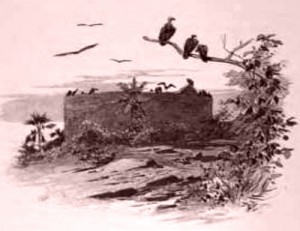
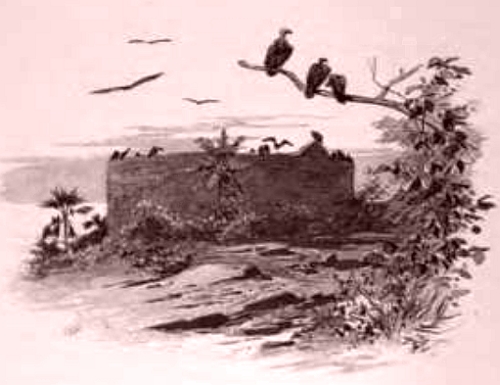
Tower of Silence, p. 102

Tower of Silence, p. 102

Continuing on the garden, one meets five flashy white towers round as a circle. The tallest is 7.5 m high and has a circumference of 90 m. On its rim sit a legion of vultures and ravens. Up a few steps lies the entrance by a small iron door. One is allowed to approach the temple only up to 30 m but a model in the garden offers information about the interior of the burial place. Within the towers constructed with much effort – the largest is said to have cost over 360.000 fl in Austrian currency – is a cone-shaped platform terminating in a duct separated into ring-formed divisions. The outer division is intended for men, the middle one for women and the interior one, closest to the duct, for children. Four guardians, the only people allowed to enter the temple, undress the dead and lay them out in the proper division. Immediately hungry vultures set upon their prey and within an hour the body has been consumed except fort he bones. The sun dries the skeleton which is then lowered down the duct and poured over with water and chalk. The duct leads to four radial canals equipped with coals and sand filters ending in large pits where the last remains of the skeletons are left to their fate.

“Anyone belonging to Ahab who dies in the city the dogs shall eat, and anyone of his who dies in the open country the birds of the heavens shall eat.” (1 Kings 21:24). What the prophet Elias said to the king who had laden himself with a large guilt through his wife Jezebel, as a punishment has here become a horrible reality, a terrible truth. The birds of the sky eat the dead, devour the just and the unjust, nobles and inferiors. “Erectos ad sidera vultus“ all those who lived are now in death carrion for the birds.

From this place of human abasement bereft of all piety, where the winged gravediggers croak a dark “Lasciate ogni speranza”, thoughts are fleeing to the churchyard in the native mountains. Here, the precious dead lie in the earth that covers them protectively in order to fulfil the word: “for dust you are and to dust you will return.” Over the graves are set crosses, simple wooden crosses but built and erected with care, with the love the living have received with a smile and now with tears speaks to the dead: “Rest in peace.” Thus in thoughts, we departed from these eloquent Towers of Silence.

The next visit was to the animal hospital Pindschrapol which was founded by rich Hindus. A complete aberration of religious sentiment! Innumerable animals without owners, sick, covered in hideous eczema, with wounds of all kinds are spending their time until death – more merciful than those men in their aberration of the prohibition of spilling blood out of a feeling of pity – takes them away. In a courtyard stood, like biblical sisters announcing a famine, about four hundred cows. In the next courtyard, horses, real nags, in a third courtyard behind bars, dogs, monkeys, sheep, parrots, chicken, doves, myriads of flies and gadflies buzzing in a choir of pain and plague.

A more pleasant view was the large Crawford Market halls. They are said to cover with courtyards and gardens an area of 60 hectares and are built in the European manner out of stone, iron and glass. They are divided by a central hall with a 43 m high bell tower into two wings and a row of individual market places. The right wing of the market halls is for flowers and fruits, the left one for vegetables and spices. There our attention was caught by majestic roses, Chrysanthemum, Jasminum, a variety of exquisite bananas, trees with apple-like fruits, and mangoes. Also the strangely colored and formed pumpkins and cucumbers, Curcuma roots, Cardamom as well as spice mixtures well known to the European gourmets as curry powder. Also samples of the local smoke and chewing tobacco etc. In special halls are offered fish, cow and sheep meat as well as chicken. The large fish market displays hundreds of sea fruit, from the small Bombay ducks (Bombil) to vast monsters which the local palates will still find tasty. Living animals are sold here too. We took this opportunity to increase the ship menagerie with mynas, parrots and a green leaf bird but we could not come to terms easily with the local merchants.

While the scented, rich market hall full of vegetables of all kind with its diverse activities of supply and demand presented a picture of life, so the next encounter we witnessed, a Hindu burning, was a dark counterpart for us. Seeing the destruction of a body bereft of all sensual matters, the dissolution of matter in a handful of ash.

Mr. Tribhowandas Mangaldas Nathubhai, President of the “Bombay Hindu Burning and Burial Ground Committee” and a number of its members received us when we entered the burial place. The location and even more the behavior of the mourners at the ceremony does not show any form of piety. In an oblong courtyard on whose end stand banks and chairs are moored four iron poles a meter high in a distance of every ten meters. In between, the wood for the burning of the body is stacked. Out of the rest of one of the burnt pyres, two Hindus were collecting ash and burnt bones with complete indifference to dispose those scarce remains of a human body in a vase decorated with flowers that is then thrown into the sea.

I just wanted to go when I heard singing and cymbals. A funeral procession was entering the courtyard. In front marched singers and musicians, then on two bamboo sticks, only covered with some bands, the body, borne by four men. Relatives made up the rear of the procession and showed no exterior sign of emotion or compassion, not even as lucky heirs – only indifference, terrible indifference. The music which was insulting to the ears starts even during the final hours of the dying as it is intended to assist the magic to drive away bad demons of sickness. What failed to work against these might nearly have driven us away. But we were asked to take a seat on the banks and could now observe closely the act of burning the body. The body of a very tiny young woman was covered completely in red cloth, sprinkled with a red powder and decorated with flowers. The poor woman must have died only hours ago as the body had not become stiff.

It is Hindu custom to burn the body only shortly after they had expired, a practice which makes the job of the district coroner harder to note deaths, especially in the case of high numbers during cholera epidemics when it even becomes impossible. Often Hindus only inform the authorities of a death after the burning of the body has taken place. A cholera epidemic is often a good opportunity for Hindus to poison an obnoxious person with arsenic ,which triggers symptoms similar to those of cholera, or opium, burn them quickly and announce it as a cholera death. During earlier times when the authorities were not used to examine with vigor, the killing of girls with opium was a common practice which resulted in a huge scarcity of women in some parts of India so that the remaining few resorted to polyandry.

The body of the young Hindu woman was laid on the earth, water was poured over it and carried three times around the prepared pyre by the husband and a relative, then the mourners laid down wheat and sugar on the body and set it down on the pyre with the head towards the east where she was covered with six large logs. With a fire carried along from their own hearth in an urn  the husband ignited sandalwood, walked three times around the pyre carrying the burning wood and touched each time the toes of the body which lay exposed from the shroud and finally set the kindling and the bundles of straw at the head of the dead on fire, igniting the pyre. In that moment, the husband cried out with hurt emotion, perhaps more for us than for his own feelings until his apparently less emotional relatives took him away. The pyre was burning, crackling, smoking. Eagerly the fire consumed the victim as if it wanted to take it away from the indifferent glances of the humans.

A second funeral procession approached. Again the dead was a young woman, apparently from a rich family of higher caste. Without a veil, the young deceased lay on the bier. The rosy tint on her cheeks indicated that she had only recently passed over to the empire of death.

Having seen enough of this cruel spectacle, I turned to go. At the exit of the burial place there is a house in which rich mourners of the highest caste wait for the ceremony to end and often call for dancers to shorten their waiting time – a revolting want of tact.

Quickly the dead must pass on into nothingness, making way for the coming generations: The Parsi devoured by the birds, the Hindu by the fire and thrown as ashes into the sea – in the animal hospital however the poor animals are kept artificially alive in their suffering, for them earth offer space and humans compassion.

To fully make use of the morning we visited also the Natural History Society’s museum which offers under the direction of Mr. Phipson a vivid image of India’s fauna. Right at the entrance crocodile hides, giant buffalo skulls and some living Indian squirrel catch the eye. Numerous cabinets hold the most important specimen of birds as well as countless butterflies. In containers filled with alcohol swim hundreds of different snakes and scorpion species, spiders, beetles and walking leaves which are part of the locust family. Numerous abnormalities and rarities are special attractions. Antlers of capital Sambar deer, abnormal horns of gazelles and black bucks, various skins of bears, tigers, panthers, snow leopards and other already bagged Indian cat species. A Hindu boy’s foot recovered out of the stomach of a crocodile, giant snake hides (python), scorpion twins, a collection of living snakes, a green whip-snake and two cobras that constantly start off against the walls of their glass enclosure. Special recognition is due for the installation of the objects according to the needs of science but also out of love for nature which goes beyond dry annotation and classification and always strives to bring all objects closer to the viewer’s understanding through placing them in a systematic and tasteful context, and by alternating them with trophies, pictures and photographs comprehensible to the layman.

Mr. Phipson offered kindly to supply me with a number of spare birds for my collection, an offer I gladly accepted.

Vividly satisfied from the impressions of the exhibition I drove to Mr Tellery (S. J. Tellery & Co.), a compatriot in whose shop all industrial art products of India are represented. This place is a real temptation for the eager shopper. Everything manufactured in Bombay, Madras, Haidarabad, Maisur, Agra, Dehli, Benares, Calcutta, Afghanistan and Birma has been made accessible there. Statues of gods and idols in bronze, silver and marble; vases, plates, cups made out of copper or gilded bronze, carvings in ivory, inlaid sandalwood boxes, Kashmir blankets, Fulkaris from Penjab, cloth with designs with applied wax glitter from Peshawar, printed calico from Madras with illustrations out of the great Indian epics Rämäyana and Mahabharata, tulle for dancers woven in Dakka, rugs from Bijapur with the famous peacock and shikan pattern, weapons and signs, elephant spears and halberds, musical instruments, small tables and Qur’an stands – a complete chaos of the most enticing things. Soon I gave in to temptation – a whole wagon-load was brought back on board which made the responsible officer despair.

With loving care for our material health, consul general Stocking invited me and my entourage to lunch in the house of the Bombay Yacht Club, an enticing call we willingly followed. The yacht club is situated within the “Fort” in an airy house at the edge of the harbor on Apollo Bandar, within a garden and having a lovely view on the harbor and the islands on the opposite side. This made the lunch even spicier and the rest afterwards sweeter.

Refreshed we drove in the afternoon with a fast steam launch of the navy yard from Wellington Pier across the harbor to the 10 km distant island Elephanta, famous for its rock temple.

During the trip one can enjoy the view of Bombay , of the islands and thanks to the intense light the contours of the mountains on the mainland. Going on land at Elephanta causes some difficulties as one has to transfer first into smaller boats and has to balance over different smooth and slippery concrete blocks. A non-punishing walk under palm tree brings one, after climbing long stone stairs, to the temple of Elephanta. Lingering young Hindus make up the living background and offer for purchase nests of bayas to the travelers as well as matchboxes with various beetles and cherry stink bugs that shine gloriously metallic.

Elephanta island, also called Gharapuri, city of caves, is worth a visit alone for its rich vegetation that displays itself to the visitor’s eyes drunk in colors. This island is full of palm trees, lianas, tamarinds, banana trees, bushes and flowers enchantingly formed and colored, with rare butterflies, glimmering beetles, flashy birds flying around. Even though nature has richly given treasures of the fauna to this small gem of the archiple of Bombay, the main destination of this trip to this island is an ancient home in the midst of the island for those gods that create, maintain and destroy.

The island owes its name to the ancient colossus hewn into stone in a distant time. These statues now stand in Victoria garden next to the Bombay museum, weather-beaten into chunky masses so that one can barely recognize the famous masterwork – a giant elephant fighting with a powerful tiger. The large temple caves still exist in whose shadowed light are kept safe many holy artifacts of Indian gods all with Brahmin legends of their own. Guided by an English veteran soldier with a medal of honor who serves here as Cicerone, we went down into the temple caves. Like the elephant colossus, once the guardians of the temple entrance, the lobby has become a victim of the elements during the centuries too.

Only the temple itself, guarded by mother nature herself, still exists. It is divided into different parts. The first is dedicated to the god of earth Shiva (Mahadewa), creator and destroyer at the same time. On the opposite side to the entrance to the main temple borne by a double row of pillars stands the decorated pillar of Trimurti (trinity) which shows Brahma, Vishnu and Shiva. As symbols, this trinity is carrying a drinking vessel, a mythical lotus flower and a poisonous spectacled cobra. The walls of the temple are covered with sculptures showing scenes from the life of Shiva, his birth, the marriage to Kali (Parvati) and other sometimes frightening scenes. Three smaller square domed buildings contain each a lingam, a symbol of nature created. On the left side of the main temple lies the temple of the elephant god and god of erudition, Ganesha, whose sanctuary is decorated with images of his many wives.

All pillars are arranged symmetrically and the pictures pay much respect to the anatomical relations and are in part artfully done so that the completion of these works and even more the construction of the enormous temple halls make us marvel. The rooms, covering an area of 1564 m2 constructed during a time without modern technology, machines or explosives, had to be excavated out of the hard granite rock only with hammer and chisel. A few hundred years ago these holy halls were inhabited by Brahmins, their followers and the dedicated temple singers and dancers. Without interruption, multitudes of believers, namely women seeking fertility, came and went. The Portuguese in their holy fervor chased the “tax collectors and scribes” out of the temple during their occupation of East India. If one believes the stories, they even tried to destroy the temple with cannon shots, obviously overkilling it, and thus damaging the ancient art on this monument, in part even destroying it.

Today, pious Hindus still make a pilgrimage with their families from time to time to Elephanta temple on holy days, to that witness of a majestic past. Much more eagerly are these impressive remains of a glorious art work observed by the foreign traveler who will find knowledge and pleasure there.

The end of the day was devoted to the attendance of grand official festivities in Government House. The dinner was followed by a ball to which the high life of Bombay was invited. For me this assembly of the leaders of the “upper ten” was not only interesting from a social point of view but also as a choreography because the English custom of pleasure dancing is different from the one we use. Especially one imported dance called a barn-door dance, accompanied by monotone music, straddles the middle between a haltingly dance mazurka and a bear dance. A honorary quadrille that I performed with Lady Harris did not really work as the figures performed were unknown at home. Lady Harris did not really appreciate this, while Lord Harris found the funny aspect in this situation. As in our square only the wives of the highest dignitaries and the civil servants of the top salary class were invited, multiple centuries were present in a small space, so that I thought longingly about a quadrille I danced at home. For the rest, I abstained in view of the challenges of the coming days. After midnight, a supper was served during which I had to pull crackers with Lady Harris in the center of the hall to the amusement of all.

Links

      • Location: Bombay, India
      • ANNO – on 18.01.1893 in Austria’s newspapers. Back in civilization in Bombay, the readers of the Neue Freie Presse are informed about Franz Ferdinand’s activities of almost the same day.
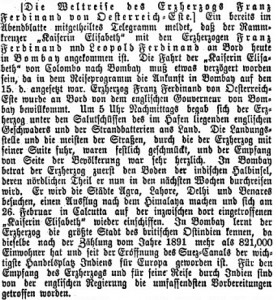
Notice about Franz Ferdinand's arrival in Bombay in Neue Freie Presse, 18 January 1893, p. 5

Notice about Franz Ferdinand’s arrival in Bombay in Neue Freie Presse, 18 January 1893, p. 5

      • The k.u.k. Hof-Burgtheater is playing Schiller’s „Maria Stuart“, while the k.u.k Hof-Operntheater is repeating „Romeo und Julie“.
Bombay, 17 January 1893

A thick fog covered the sea during the morning and only with great effort did the sun finally win. When the veil was lifted, the profile of the city of Bombay and the surrounding hills and mountains became visible in the distance. More and more precisely did the contours reveal themselves, more and more did the tropical light illuminate the image. Soon we could appreciate the view of the wide ranging city with its large public buildings, its numerous towers, its factory chimneys and its imposing harbor which contained uncountable numbers of the largest passenger and good steamboats as well as local coastal ships.

Bombay is the capital city of the regency of the same name. It and the regencies of Bengal and Madras, the Northwest provinces, Oudh, the Punjab, the central provinces in Dekhan, as well as the provinces of Assam and Birma are all direct possession of England. The indirect possessions are the vassal, tributary and interest-free states under the protection and the subsidiary states under protection. Among the protectorates are the Rajputana Agency, the Central India Agency, the local tributary states Baroda, Haidarabad, Maisur, Kaschmir, Sikkim etc.

The multidimensional government of the Indo-British Empire (with the exception of Ceylon and the Molucca Strait settlements) is led by the governor general (vice king). Madras with the Lakedives and Bombay (with Sindh, Aden, Perim) is led by special governors; Bengal, , the Northwest provinces, Oudh and the Punjab are led by lieutenant governors; Assam, the central provinces and Birma are under chief commissioners. British India covers an area of 4,032.141 km2 and counts according tot he 1891 census 287,223.431 inhabitants.

Bombay had been transferred as a dowry of Princess Katharina of Portugal to King Charles II of England in 1661 and has been under English rule since then. The name Bombay is said to be derived from the Portuguese böa bahia — good harbor — while others say that it is derived from Mumbai, the wife of Shiva.

May it be one of India’s protective goddesses or the maritime perspicacity of the Portuguese that has given this important East-Indian city its name, it is beyond doubt that Bombay’s maritime trade and traffic has grown to epic dimensions. In the year 1892, 757 steamers with 1,325.039 t, 410 sailing ships with 54.685 t and 48.602 coastal vessels with 1,393.676 t have entered or left the harbor. The value of total imports of Bombay in the year 1892 was 367,323.303 rupees = 277,329.094 fl. In Austrian currency, that of the total exports was 367,323.303 Rupees = 277,329.094 fl. In Austrian currency. The word rupee comes from Sanskrit rüpya which means beautiful and also silver. The value of a rupee circulating in the Indian possessions of England, a silver currency (à 16 Annas), is equivalent to the value of 75.5 Kreuzer in Austrian currency in the year 1892.

At the moment, the city has a population of 800.000 souls, lies in the south of the 18.4 km long and up to 6.4 wide island of the same name. This island borders in the north on the large island of Sasashti (Salsette) which is connected by dams with it and over which a railway leads from Bombay to the mainland. In the south, the island splits into two hooks which encircle a large bay, called Back Bay. The smaller more Western of these hooks is Malabar Hill, the long extending Eastern one is called Colaba. Malabar Hill which has given its name to the Western hook is the southern end of the western of the two basalt stone ridges that cross the islands on their long sides parallel to the coast. The Eastern hook Colaba is fully flat and ends in the south in reefs which carry lighthouses.

These two hooks and the area that covers the plain north to them up to the plains called “the flats” and stretches out beyond the suburbs of Byculla and Mazagon is the area on which Bombay stands.

On the south-western end of Malabar Hill stands  Government House, then the Walkeshwar temple and at the highest point of the whole peninsula the crowning “tower of silence”. It is the place where many rich Europeans as well as rich natives of Bombay are living where they have constructed charming manors among gardens and trees in a healthy air cooled by the light wind coming from the sea. Part of this city of villas that reaches beyond Camballa Hill faces towards the water surface of the Indian Ocean. Colaba hook is occupied by barracks of an English infantry regiment and fortress artillery.

To the north of this part of Bombay lies, between Back Bay on the one side and the harbour in the east on the other side, the European city called “Fort”. Here the old town encircles in the form of a semi-circle the former now partially dismantled castle as well as the newer city districts among whom it is important to mention Elphinstone Circle (the Green) with the cathedral and the Town Hall and the districts along Elphinstone Road and Mayo Road.

The main ornament of Bombay and the pride of its British citizens is the row of grandiose public buildings in the west of Back Bay. Among these are most prominent: Government (Presidential) Secretariat; University Hall and the large bell tower of the university library; the colossal building of the Courts of Justice; the Public Work’s Secretariat; the Post Office and telegraph building, Elphinstone College. The Royal Alfred Sailor’s Home lies in the harbor with a view towards Bombay’s east close to Wellington Pier (Apollo Bandar). From here rise on the Eastern coast in a northern succession the yacht club, the government docks, the custom house, the armory, the castle, the mint,  the Victoria and Prince’s docks, the P. & O. company dockyards.

Where the relatively small Colaba hook widens towards the north, beyond the esplanade district and Victoria station, the native or black town is situated in the form of a triangle whose shortest side is turned towards the European city. This town, about 15 km north of “Fort”, seems like a world of its own. Black Town, enclosing Crawford Market and Pindshrapol, the animal hospital), constitutes with its strange customs and activities, its color and squalor a stark contrast to the European city with its international business life, its banks, clubs, merchant houses, palaces and squares in the British manner. Here in the European city, as well as in the native district whose narrow living homes offer but the most scare minimum of existence to the most populated areas which is almost unbelievable for our imagination – on 10 km2 live almost 400.000 people creating a enormous range of activities in the streets and narrow lanes. In the bazaars, the small shops, the workshops all kinds of cries, sounds, creaks, hammering, shouts of merchants and coachmen are heard. The colourful crowd is busy at work, enjoys and talks.

The Back Bay which is situated between the hooks of Malabar Hill and Colaba is rather shallow and thus cannot be used by ships. In contrast the harbor east of the city is rather deep and large. In the East of Bombay, multiple islands large and small rise out of the sea. One can also see the bizarre forms of the pointy ridges of the mountains of the mainland.

All warships displayed the full complement of flags (“große Flaggengala”) and saluted the hoisted flag of the entering “Elisabeth”. After we had anchored, the acting officer of the consulate general, vice consul Prumler, came on board and brought the mail.

Two very friendly telegrams from the vice king and governor general of the Indian domain, Lord Landsdowne and from the chief commander of India and commander oft he troops of Bengal, General Lord Roberts were welcoming on Indian territory. Then my entourage supplied by Her Majesty the Queen for my trip presented itself. It consisted of the gentlemen General Protheroe, Captain W. E. Fairholme and Mr. J. A. Crawford.  They presented the program for the next two months that starts with a journey to Haidarabad. At 5 o’clock, the governor of Bombay, Lord Harris, with his entourage came on board for his official visit of me and to offer me an apartment in Government House for my stay. Lord Harris who has been occupying this position for three years was received by the British anthem and all honors and escorted into my cabin where we had an extended conversation.

After the return of the governor back to the mainland, I took leave of “Elisabeth” and its staff for the next two months, I once more inspected the troops and to the sound of the guns and the salutes of all warships in the harbour, went on land at Wellington Pier (Apollo Bandar) which was decorated most festively with flags, cloths and flowers. There I was received by the governor and the heads of all administrative departments. An English honor guard consisting of strong and tall guys with red headdress and ancient rifles presented arms while the fashionable governor’s life guards were waiting by the side of the wagon to accompany us through the city. Many ladies had assembled in a reception tent, small girls were scattering flowers onto my path. Like a victorious triumphator I progressed to the visible pleasure of the governor.

In a government wagon with Australian horses à la Daumont we continued the triumphal procession across the city being everywhere greeted vividly by the crows behind the screen of soldiers along the road. The windows up to the fourth floor were all filled with people which cried out and waved. The part called “Fort” offers the impression of a large European city. The government buildings alternate with large private houses, parks, monuments, cricket fields. The streets are very wide and have very comfortable sidewalks. Everywhere there are tramways – without congestion – and European wagons. Only the strange not always tasteful design of the public buildings, the “Indian style” a mixtum compositum of all the various oriental and European styles as well as the very colorful activities of the members of all the different races and nations made one think of the orient, of India.

The largest part of the population of Bombay is constituted by Hindus, of which there are 543.276. They are divided into a number of castes whose signs in flashy red, yellow or white spots on the forehead can easily be distinguished at considerable distance. The richer wear white clothes, the poor wear only a loincloth with the feet always naked. The head is covered with a turban in numerous colors. The Hindu do not look like beefy. They grow tall, thin and nothing less than muscular. The Hindu women seem to love gems as even the poorest among them who serve as carriers in the city have their noses and ears pierced with small stones with filigrane silver and gold ornaments of often considerable weight. The nose rings disfigure the whole face as they hang down to the mouth which must make kissing a rather uninviting proposition and in any case rather more difficult.

A much nobler class than the Hindus are the Muslims of Bombay, numbering 155.247 persons, which distinguish themselves from the Hindus by always wearing trousers. The very religious women cover their faces but most have given up this annoying custom and look Europeans in the face in a very friendly manner.

The most respected and at the same time richest element of Bombay are the Parsi. As their name indicates they are of Persian origin, they are even assumed to be the first native population of Old Persia. The conquest of Persia by the Arabs in the year 641 and the fanatical conversion of the natives to Islam with fire and sword forced a majority of these adherents of Zorroaster into emigration to Gujarat, a coastal district to the north of Bombay. A small part of Persians remains to this day in the Irak province of Adjemi.

The Parsi are fire worshippers which they worship as the most important purification in contrasting the spirit of the light (Ormusd) to the lord of darkness (Ahriman), according to the moral of good and evil based on the saying of Zoroaster.  The adherents of these doctrines opposed by Islam found refuge and peace in Gujarat. Their ancestral language, however, they switched for a Hindu one and made it so much their own that they prefer to speak it today. From here the Parsi spread out across all of India, namely they constitute a large number among the inhabitants of the rich and large harbor city of Bombay where they have always represented capital and industry. Their main trade is shipbuilding. As director of the naval yard in Bombay up until recently acted a Parsi whose ancestors held the same position since the foundation of that institution. Among all the peoples of India, the Parsi were the first to cooperated with the Europeans and until now still have the closest connection with them.

The dress of the Parsi does not differ much from that of the other Indian natives. In recent times, the fashion of the Parsi dress has approached European styles so that some of them wear clothes completely in the French style. As headdress the men use either a tall strangely pointed cap made out of oilcloth or silk whose form they have adapted from the headdress common in Gujarat, or they use a modernized version of the Persian felt cap with a colorful shawl wrapped around. The women of the Parsi use silk or woolen colored trousers and flashy colored body dresses made out of one piece that is tied around the waist and then thrown across head and shoulders.

Most Parsi women have beautiful eyes but long crooked noses, bad posture, either too flat or two fat forms as well as a gangly, sleepy gait. The girls wear the same clothes as the women with the difference of a plaid reserved to girls of nubile age.

Among the foreign looking Orientals one can see on the streets of Bombay also Arabs and Persians who are engaged in the business of importing horses, peddling Jews from Baghdad and Afghans who work solely as knife grinders in Bombay just as they do in Ceylon.

The so called Portuguese of Bombay are descendants of the Portuguese conquerors and natives converted to Christianity and carry the names of Portuguese noble families as all inhabitants of a village did acquire the name of their new rulers. The occupations of the Portuguese are mostly domestic servants, cooks, as well as some administrative assistants in trading houses. They are a mushy degenerate people, instantly recognizable by their type and their neglected superficial European dress.

Industry and wholesale trading are divided among the three main groups, the Hindus, the Muslims and the Parsi, in rather sharply drawn boundaries. Thus the Parsi are, for example, the owners of the 72 cotton factories of Bombay. The Muslims are the largest importers, the Hindus the largest exporters, the latter one under the mediation of European trading houses. During recent years, the Muslims as well as the Hindus have become more and more emancipated from the Europeans and enter into direct contact with European merchants and factories. This trade can hardly be to the Europeans’ advantage as the commercial ideas of morality and firmness of the Orientals are of the vaguest nature and the European trader will find it hard to procure legal assistance in an emergency than Europeans located in Bombay.

By Queen’s Road, a very broad road close to the sea, we drove to Malabar Hill where, as mentioned before, are situated a number of villas, small airy bungalows, half hidden in cleanly maintained gardens under palm trees, tamarinds and numerous blooming climbing plants. Right at the top of the hook lies Government House, a row of single story bungalows in whose midst stands a somewhat taller building which serves only as a dinning and ball room and which is enclosed by an airy veranda. The governor and his family as well as a number of secretaries and adjutants are living there, almost each of which has his own bungalow equipped with all comforts. Fitting to the local climate, these bungalows are constructed very airily, the walls are made out of paper, doors, windows and verandas everywhere so that time and again I imagined myself to be in a big bird cage. If these bungalows can not provide enough space for a larger number of guests, tents are pitched which turns Government House and all its annexes into a large tent city below large tamarinds and ficus trees.

A couple of servants in scarlet livery were assembled in a row up to the veranda where we were received in a most pleasant manner by Lady Harris and two of her lady friends, Lady Brodrick and Miss Smith. After a longer lively conversation during which I answered the ladies a number of questions (why I wasn’t yet engaged, when I intended to marry etc.), we retired to our various bungalows to change into dress uniforms for dinner. This was set for half past eight o’clock according to English custom. Lord and Lady Harris were waiting for me in the antechamber to accompany me to the reception hall where all invited guests stood in rows alongside the walls. In total, there were 54 persons invited to the dinner, numerous ladies, among them also a Parsi lady peppered with diamonds, the highest dignitaries and the commander general of Bombay, various higher officers, judges, municipal and government employees, all consular agents located in Bombay and the captains of all warships currently at anchor in Bombay. Soon after all the invited had been presented to me, we entered the hall to the sound of the Emperor’s Hymn. The table was tastefully ornamented with flowers, black-yellow ribbons and silver decorations.

The continental protocol requires that, during an official dinner given to a member of the ruling family of a foreign power, the toast is mostly given to salute the health of the sovereign of the guest. The British protocol, however, differs in this custom as I could observe with curiosity during the dinner in Government House in Kandy. At least, Lord Harris asked me first to toast to the health of Her Majesty the Queen and then he himself announced a toast to the health of His Majesty our Emperor.

The dinner was followed by a long reception. After its end, tired from all the new impressions of the first day in India, we went to look for our place to rest.

Links

      • Location: Bombay, India
      • ANNO – on 17.01.1893 in Austria’s newspapers. Baroness Bertha von Suttner who died just before the start of the First World War has given a speech „Down the arms!“ at the Hotel Intercontinental. Budapest is reporting two new case of cholera. The German Emperor is slightly ill as well and thus could not accompany the Empress on official duties. Northern Italy has been blanketed by a mass of snow too, interrupting traffic, while Trieste is experiencing a severe storm. The Banque de France continues to be in turmoil.
      • The k.u.k. Hof-Burgtheater is playing Gustav Freytag’s comedy „Die Journalisten“, while the k.u.k Hof-Operntheater is playing Giuseppe Verdi’s Aida.

At Sea to Bombay, 16 January 1893

Today we could see the Indian coast nearly without interruption. Towards noon we passed Goa, the Portuguese colony. The officer of the watch observed some snakes swimming in the sea. The weather is wonderful, the sea is as smooth as glass with an agreeable, refreshing wind. We overtook the Lloyd steamer “Elektro” which hoisted a flag salute (“kleine Flaggengala”). I used the time with Doctor von Lorenz to scientifically determine the species of all the birds and butterflies caught in Ceylon. In the evening I stood on the bridge for hours, observing the stars of the southern sky.

Links

      • Location: near Goa, India
      • ANNO – on 16.01.1893 in Austria’s newspapers. In a chronicle feature, the Neue Freie Presse offers updates about the where-abouts of the different archdukes and princesses such as Archduke Joseph and Archduchesses Clothilde and Maria Dorothea spending their winter retreat in Fiume. The Emperor meanwhile has received a visit from the „beer president“, a CEO and organizer of the ball of business and industry to again petition for the Emperor’s patronage of the ball. The Neue Freie Presse also publishes some secret Russian documents about Russia’s involvement in Bulgaria a few years ago. Paris is still full of turmoil.
      • The k.u.k. Hof-Burgtheater is playing Goethe’s „Iphigenie auf Tauris“, while the k.u.k Hof-Operntheater is repeating „Die Rantzau“.

At Sea to Bombay, 15 January 1893

The sea was totally quiet. A fresh wind brought cool air. The day was glorious. At 10 o’clock Sunday mass was held. The whole day was spent writing letters as in Bombay one could mail it home. Towards noon, the Indian coast became visible as we were driving about ten miles distant from it. Only the blueish contours of the land are recognizable. In the evening, one could distinguish numerous fires on the coast whose meaning we could not explain.

Links

  • Location: near the Indian Coast
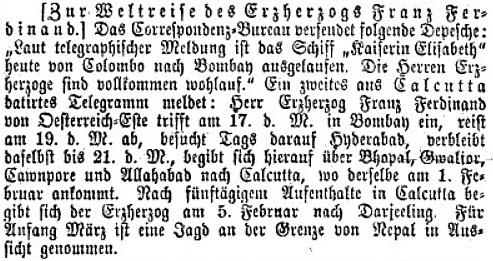
  • ANNO – on 15.01.1893 in Austria’s newspapers. Imperial sightseeing is covered by the Neue Freie Presse: It notes Empress Elisabeth’s visit of villas in Malaga and remarks that the Empress did it all on foot. In Granada, she saw the Alhambra and was especially charmed by the summer palace Generalife. By telegram, the world is informed about Franz Ferdinand’s travel plans in India. He is set to arrive in Bombay on the 17th and depart on the 19th on to his trip across India which will take him to Nepal.
Notice in the Neue Freie Presse 15 January 1893, p.4, about Franz Ferdinand's arrival in Bombay and his itinerary in India to Nepal.

Notice in the Neue Freie Presse 15 January 1893, p.4, about Franz Ferdinand’s arrival in Bombay and his itinerary in India to Nepal.

  • The k.u.k. Hof-Burgtheater is playing Grillparzer’s comedy „Wehe dem, der lügt“, while the k.u.k Hof-Operntheater is offering Richard Wagner’s „Rheingold“.

At Sea to Bombay, 14 January 1893

The fourth hour of the morning meant it was time to hoist the anchor in Colombo and leave this paradise on earth. The days in Ceylon, its majestic tropical world, its hospitality and the pleasures the island offered will live on in our memories.

Not the angel in gleaming armor and a flaming sword who sent Adam out of the paradise but the prosaic figure of the journey timetable made us depart. Thus we left paradise, like our ultimate forebear, in a sad mood. With rather more equipment, however, than him, and also not to plow the acres but to pierce the ocean waves by the sweat of one’s brows. The piercing was truly not easy as in the gulf of Mannar, the sea was moving rather violently. In the afternoon, Cape Comorin became visible which lies southwest oft he so called Adam‘s bridge, a set of sand banks which connect India to Ceylon that constitute the Northern border of the gulf of Mannar, resting on rocky reefs. According to a myth the god Rama should have forced the sea god to create a connection between the island and India in order to recover Sita which had been kidnapped and brought to the island by Ravana. The sea god put stone upon stone until India and Ceylon were connected by a dam over which Rama and his army of humans and monkeys marched.

Towards the evening the wind became somewhat calmer so that we could have a quiet dinner on the afterdeck.

Those whom the god Neptune did not force to pay the maritime tribute were writing in their diaries during the afternoon, the diary had been badly neglected during the last days, or sorted and packed the treasures bought on Ceylon.

Links

  • Location: near Cape Comorin, India
  • ANNO – on 14.01.1893 in Austria’s newspapers. In Paris, the Panama scandal is still raging. Chief topic is the identity of the anonymous owners of some Panama bonds which Ferdinand de Lesseps up to now is not revealing. A group of French senators has met the president to assure him of their commitment to the republic and the public order. Meanwhile, according to a further article in the Neue Freie Presse, the state of the Banque de France is not looking rosy either. The newspaper also includes a report about orphanages in Lower Austria which cared for 20.723 children in 1892. The mortality rate of children under one year was 43%, while the overall mortality rate in the orphanages was 13,9%. More children actually die in the orphanage than leave it annually alive.
  • The k.u.k. Hof-Burgtheater is finally playing Grillparzer’s „Das goldene Vließ“, while the k.u.k Hof-Operntheater is also repeating the combo of „Cavalleria Rusticana“ and „Rouge et Noir“.

Kandy to Colombo, 13 January 1893

At half past 7 o’clock in the morning, the Papal delegate for India, Monsignore Zaleski, who stays most of the year in Kandy, celebrated a mass in the small Catholic church attended by the whole Catholic community consisting mostly of mixed bloods of Europeans and Sinhalese. A large number of mostly dark-colored priests assisted the Montsignore while music and song in a not so harmonic way was contributed by the faithful. After the end of the mass I wanted to meet the delegate but unfortunately did find him there.

We then went on a glorious morning drive on Lawrence Drive, a road that leads along a number of hills with a beautiful view of Kandy, the large pond, the Buddha temple, the whole panorama of the city and the mountain peaks in the distance. Everything was still covered in a blueish morning mist: the city houses at my feet, the Kandy valley and the distant mountain ranges.

After I had browsed through the Reuter dispatches, eager for news about home, I took my leave from Sir Arthur und Lady Havelock in the governor’s pavilion. To remember the hours spent together with this lovely couple with a visible memento, we had a group photograph of us with the couple taken.

The return drive to Colombo was glorious, part of which I did in the locomotive to have an unrestricted view. I couldn’t get enough of the wonderful scenery of the whole journey.

The afternoon in Colombo was dedicated to shopping. We took the dinner, upon the invitation of our consular agent Schnell in his country house located outside the city. Mr and Mrs Schnell, the latter a young and pretty woman dressed in a patriotic black and yellow dress, gave me the honors and after the dinner, enchanted me with a performance of a devil dance which differed markedly from that seen in Kalawewa. It was, I might say, more civilized, less grotesque and notable especially by the dancer’s large wooden grimacing head masks out of which they very skilfully blew and spit fire. Music and song were of the same type as that of the jungle dance performed in Kalawewa. We were sitting under palm trees in a garden kiosk while the dancers moved on the open green.

The devil dance was followed by an act of a conjurer who performed many tricks. The way in which he demonstrated the growth of a mango tree was interesting. The conjurer laid out a cloth on the ground, lifted it after a bit of hocus-pocus and, well, there suddenly was inch-high small green plant. The conjurer repeatedly covered the plant with the cloth and every time he lifted it, the plant had grown. It grew larger and larger and became a rich bush with long beautiful leaves, a growing little tree, a blooming tree and finally there stood a full grown blooming mango tree with ripe fruits in front of us on the green. He also showed his skills as a snake charmer. Out of two baskets, to the sound of a shalm, emerged two cobra snakes. They beamed and displayed their hood with clearly visible marks that looked like glasses and starred and moved hissing towards their master which looked dangerous but was in reality harmless as the teeth of the snakes had been removed. Still, Mrs Schnell uttered a light scream when one of the beasts turned and advanced on the green toward our feet.

This garden party concluded our stay in Ceylon. We took leave of our very obliging hosts and returned hours later on board of SMS Elisabeth.

Links

  • Location: Colombo, Ceylon
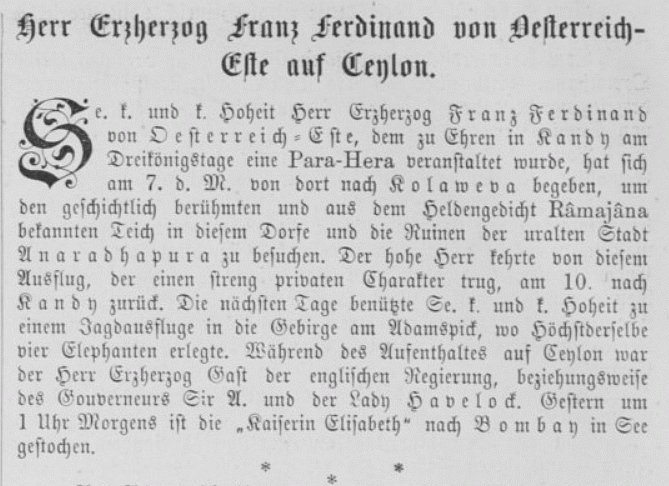
  • ANNO – on 13.01.1893 in Austria’s newspapers. In Paris, the Panama scandal is still raging in the streets, in the newspapers, in parliament as well as in the court room where the third day in court has started. A new 3,5 m long photographic panorama of Vienna’s city center has been completed and will soon be on public display. Out of Calcutta comes a telegram that informs about the planning of a governmental gala dinner for Franz Ferdinand, a reception of the Austro-Hungarian community, museum visits, parades, a native dance performance as well as a sightseeing trip to Darjeeling.
  • The Wiener Salonblatt Nr. 3 of 15 January already includes a notice about Franz Ferdinand’s stay in Ceylon and departure to Bombay.
Notice in the Wiener Salonblatt no. 3 about Franz Ferdinand's stay in Ceylon

Notice on page 8 in the Wiener Salonblatt no. 3 about Franz Ferdinand’s stay in Ceylon

  • The k.u.k. Hof-Burgtheater is playing „Der Bibliothekar“, a comedy by Gustav von Moser while the k.u.k Hof-Operntheater performs Jules Massenet’s Werther.

Kalawewa to Kandy, 12 January 1893

The day of departure from Kalawewa and return to Kandy had arrived. At 6 o’clock in the morning we were in the saddle to return by another road than we had taken to Dambul. My horse was an Australian fox from the governor’s stable. The nag didn’t promise much but proved to formidable during the ride especially displaying admirable stamina.

At the start we moved through familiar territory, then through beautiful jungle, over rocky ridges, past many ponds and marshes, as well as dried out river beds on whose banks large trees offered shade.

At the rest stop of Nalande close to a picturesque small Buddha temple we took a break. Back in the saddle again, Pirie explained we were advancing too slowly and made us trot at a speed worthy even for Russian trotters. If even that wasn’t sufficient, we galloped at a fast hunting speed without attention to the winding road, the numerous stones and roots, across rice fields, through the thickest jungle. A mad ride! Pirie in front on a thick black-brown horse, then I on the stiff, obstructing fox that sped like a dragon.  Kinsky and Clam on two large Australian wagon horses. Wurmbrand on a small polo pony, Prónay again on a 17 hands high wagon nag and at the end a constable black as the night on an old snow-white horse. The animals stood the great heat and the mad jog incredibly well. Soon we had covered 26 km. Dripping with sweat, horse and rider arrived in Dambul where we had to wait for the arrival of the hunters, the baggage and the wagons.

But we enjoyed the break very much! In Dambul, we were greeted with messengers from home, bringer of good news – the first letters and newspapers from Vienna.  Posted on 18 December, the mail had covered the distance from the Imperial city on the Danube to the jungle of Dambul in 25 days.

After a short rest, we continued our journey in wagons but made a stop to visit the large Kawadapella factory owned by a stock company and managed by Englishmen on whose extensive plantations grew tea, coffee and cacao.

Currently, about a fifth of Ceylon’s surface area is used for agricultural crops. These are partly native plants such as cotton, indigo, sugar cane, bamboo, fruits and spices of all sorts, partly foreign plants that owe their cultivation to the colonizing activities of the English. The introduction, adaptation and cultivation of new fertile and profitable trade crops offers one of the main levers of efficient production in all colonial even all agricultural areas.

Just as our Europe, formerly only covered with native plants, now offers a diverse vegetation of many able often foreign elements given a European right of domicile to immigrants often from Asiatic agricultural crops, so too has the economic speculative spirit and agricultural experience introduced new and extremely valuable agricultural crops to Ceylon which now occupy again and again the top ranks of agricultural production of the island.

Under Dutch rule (1656 bis 1802), the tradition of cultivating Ceylon cinnamon (Cinnamomum ceylanicum) has played a key role in the island’s production and among the planter’s care. When coffee became a fashionable drink among civilized nations in the 18th and 19th century, the commercial outlook of the planters switched to the cultivation of coffee which up to the 17th century was only grown in Arabia. Its importance grew so much under English rule that in the middle of this century, the coffee plantations became the foremost source of wealth in Ceylon. This period ended abruptly when leaf spot or coffee pest (Hemileia vastatrix), a fungus, first observed in 1869, hit the planted fields and damaged them so intensively that in the decade between 1878 to 1889, the production volume of the coffee plantation were reduced by four fifth in their area of cultivation, even though in 1891, that area still covers around 27.000 hectares.

The damage caused by the coffee pest made the plantation owners, ably supported by English capitalists, switch to the cultivation of tea from 1873 on. The work necessary in labor and cost for the plantation of tea is larger than those required for coffee both in production and operation, further aggravated by the difference in price of the finished product to the disadvantage of tea. In spite of this, the cultivation of tea is bound to stay in Ceylon, it even surpassed in 1891 with its around 95.000 hectares the area dedicated to coffee.

The leaves of an intensive green color of the low-rise tea plant are collected, laid out to dry on linen cloth covered stellings and are then rolled in a machine and roasted until they have obtained a known darker coloring. The final step of the procedure consists of a machine sorting the leaves in three quality grades according to different criteria. The product then is ready for packaging. The whole process from collection to packaging takes around 48 hours. I have been told that in Kawadapella, 400 kg of tea are produced out of 1600 kg of leaves.

Since the 1860s, cinchona, originally from the Cordilleras of the Andes and out of whose bark is produced quinine, has been cultivated in Ceylon, so that in 1891 around 16.000 hectares have been planted with cinchona trees. An area of 263.000 hectares is used for the cultivation of coconut trees (Cocos nucifera) which provides wood, fiber, nuts and oils. The cultivation of rice takes up more than 267.000 hectares. The famous fruit gardens of Ceylon also cover extensive areas.

After we had sampled the plantation’s delicious tea which I had never tasted before, we took leave. Only 16 km more and we were in Matale. There a telegram reached me from Mr Jevers who had stayed back in Kalawewa that the buffalo I had shot had been found dead about 1000 paces from the place where I had fired.

From Matale, a special train transported us to Kandy.

A real Scottish bagpiper called us to dinner in the pavilion at 8 o’clock. The dinner was attended, besides the governor and his family, by General Massy with his charming daughter who spoke German. After the dinner, the two young ladies, Miss Havelock and Miss Massy, and two young adjutants of the governor, two Scottish highland officers in their sharp dresses, performed gracious Scottish national dances to the sound of the bagpipes.

Links

  • Location: Kandy, Ceylon
  • ANNO – on 12.01.1893 in Austria’s newspapers. While the attention is directed towards Paris but no news has yet reached Vienna about the latest situation, the Neue Freie Presse continues to fill its pages with survey articles, this time about the state of Italy. In the United States it is reported that the Union general Benjamin Butler has died at the age of 75 years. During the American Civil War, Butler was in charge of the occupation of New Orleans and earned the nickname „Beast“ from the local secessionist population. Butler later was a supporter of president U.S. Grant and ran unsuccessfully for president himself.
  • The k.u.k. Hof-Burgtheater is playing Shakespeare’s Richard III while the k.u.k Hof-Operntheater performs Verdi’s The Troubadour, both events are reserved for subscribers.